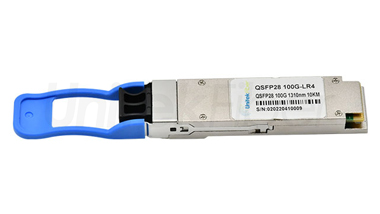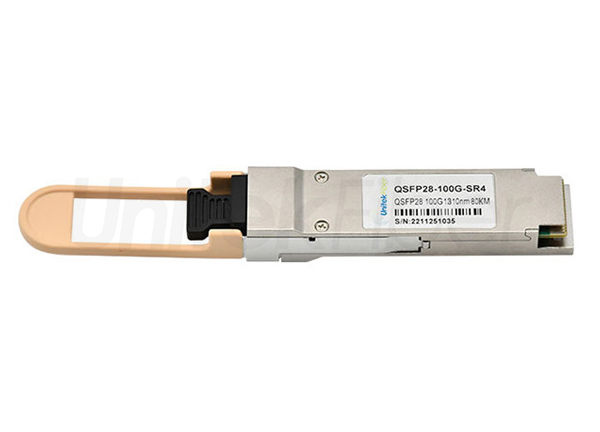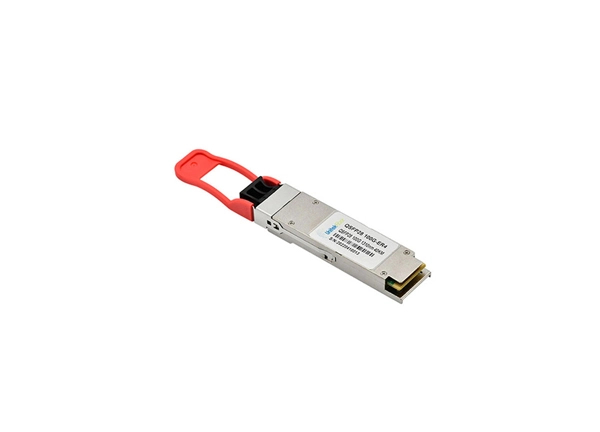

The continuous surge in network traffic is placing increasingly stringent demands on communication bandwidth and data transmission performance. 100G optical transceivers, with their higher speeds and longer transmission distances, are gradually replacing 40G and 10G transceivers, especially in long-distance transmission applications such as metropolitan area networks. Currently, the 100G QSFP28 LR4 fiber optic transceiver has gained a certain market share with its 10KM transmission distance. Is it possible to extend its transmission distance to 40KM while maintaining the current network architecture, thereby ensuring its greater advantage?

Metropolitan area networks (MANs) have a wide range of applications, including data center interconnection, mobile transmission (backbone networks, fronthaul, and backhaul), enterprise networks, and branch networks, all of which require scalable and reliable optical solutions. With the advent of 5G, the increased data rates in the access network of mobile transmission architectures are providing further impetus for the development of metropolitan area networks.
Although the vast majority of current metropolitan area networks (MANs) are based on 10G or 40G, 100G is widely considered the best option to cope with the explosion of metropolitan network traffic, and its scalability meets future bandwidth demands. The figure below shows the market share of different speeds in metropolitan area networks in 2020, indicating that 100G will surpass 40G and 10G in metropolitan network deployments.
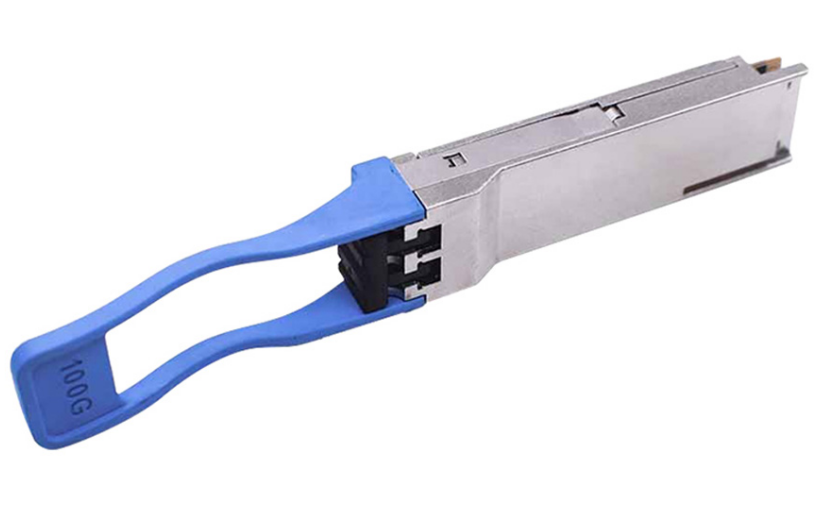
The 100G QSFP28 LR4 optical transceiver works by converting four 25G electrical signals into four LAN WDM optical signals at the transmitting end, which are then multiplexed into a single channel for 100G transmission. At the receiving end, the 100G optical transmission signal is demultiplexed into four LAN WDM optical signals, which are then converted back into four electrical signals for output.
The 100G QSFP28 LR4 transceiver module is typically used with LC single-mode patch cords and has a maximum transmission distance of up to 10 km.
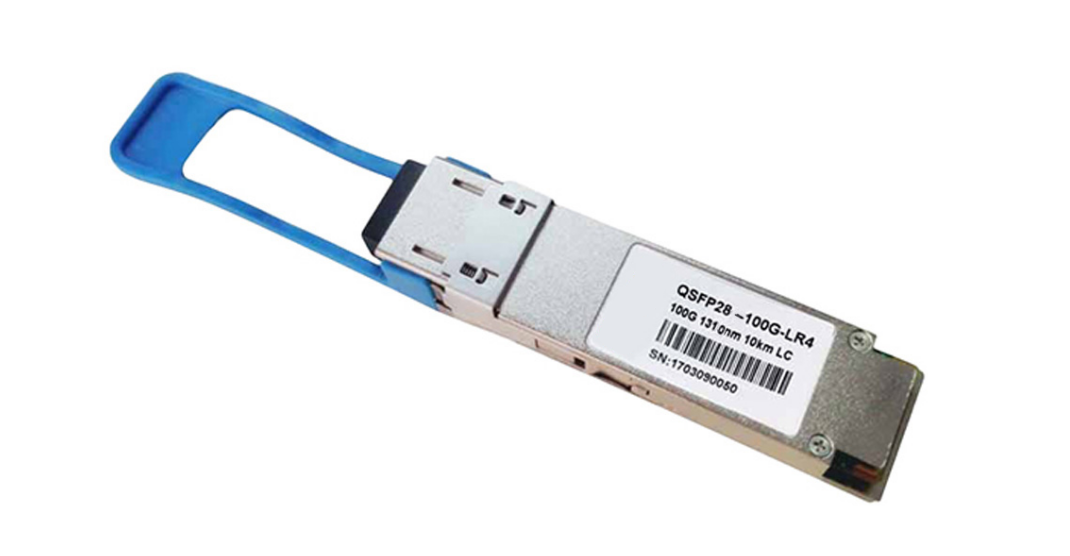
The attenuation of 100G QSFP28 fiber optic transceivers occurs at the 1310nm wavelength, which is typically higher than the 1550nm band. Therefore, signal amplification is a crucial requirement. Ordinary EDFA (Erbium-doped fiber amplifier) optical amplifiers cannot be used because they amplify at 1550nm, blocking the 1310nm signal. SOA (Semiconductor Optical Amplifier) optical amplifiers, however, are specifically designed to enhance signals in optical transmission systems operating at the 1310nm wavelength.
The UnitekFiber SOA optical amplifier is a compact optical amplifier with a simple plug-and-play design, which can be installed in FMT 1U/2U/4U chassis, saving space. By simply adding the SOA optical amplifier, the transmission distance of 100G QSFP28 LR4 fiber optic transceiver can be easily extended to 40KM.
The SOA optical amplifier acts as a pre-amplifier in the link, enhancing the input optical signal and providing an optimal solution for transmitting signals over distances exceeding 10 km with 100G QSFP LR4 fiber transceivers. This solution is implemented within the existing network architecture, minimizing interference to the lines and reducing costs, making it an economical and feasible option. It is also applicable to CFP, CFP2, and CFP4 transceivers.
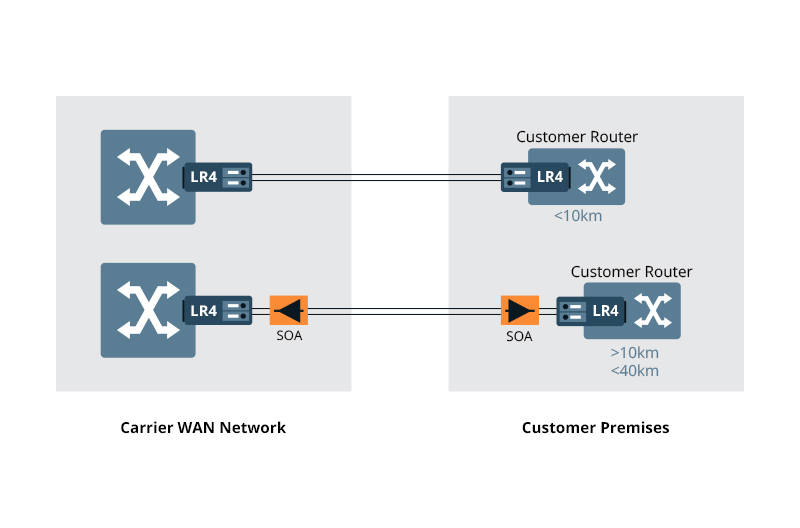
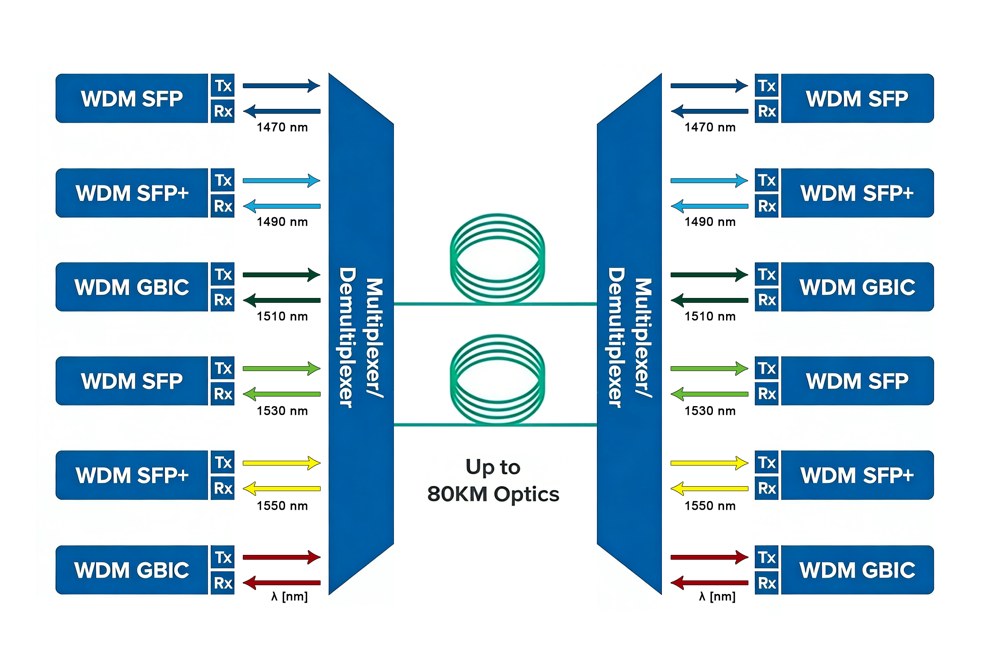
If you have already deployed a 10G DWDM system in your metropolitan area network and need to integrate it with a 100G network, then a solution using SOA optical amplifiers and 100G QSFP28 LR4 optical transceivers can also meet your needs. By using a WDM multiplexer with a dedicated 1310nm port, the LR4 transceiver can be multiplexed with the 10G DWDM system. For example, when deploying a 10G 40-channel DWDM multiplexer with a dedicated 1310nm port, you will simultaneously achieve a network capacity of 10*40G + 100G, totaling 500G. However, in this case, the transmission distance will exceed 10KM but will not reach 40KM due to factors such as multiplexing losses.
Currently, metropolitan area networks and data center networks are transitioning to 100G. The solution combining SOA optical amplifiers with 100G QSFP28 LR4 transceiver modules can economically and efficiently achieve longer transmission distances.
 5G 6G Fronthaul & Backhaul
View More
5G 6G Fronthaul & Backhaul
View More
 Data Center & Cloud Interconnect
View More
Data Center & Cloud Interconnect
View More
 Enterprise & Industrial Optical
View More
Enterprise & Industrial Optical
View More
 FTTx & Access Solutions
View More
FTTx & Access Solutions
View More
 Metro & Access Networks
View More
Metro & Access Networks
View More
 Optical Cabling Systems
View More
Optical Cabling Systems
View More
 Optical Transceivers & Interconnect
View More
Optical Transceivers & Interconnect
View More
 WDM & High-Capacity Transmission
View More
WDM & High-Capacity Transmission
View More
+86-755-21034367