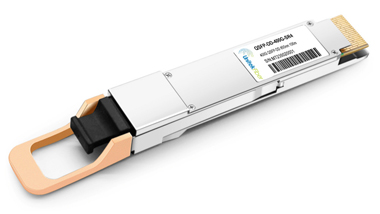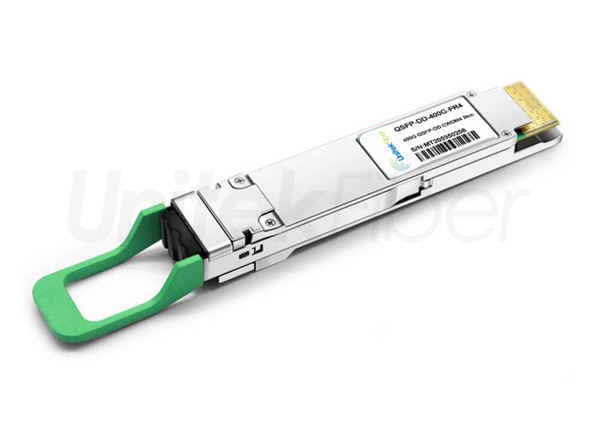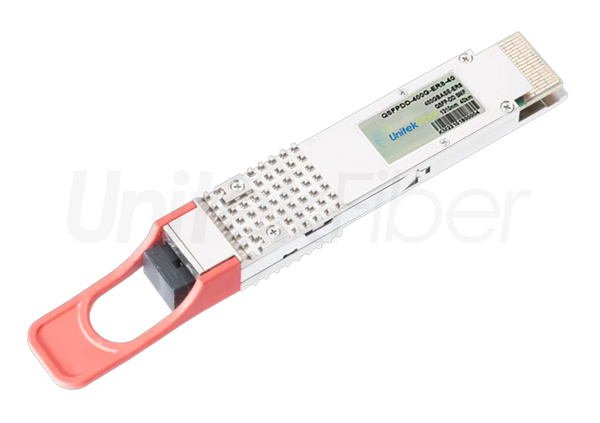

With the explosive growth of applications such as cloud computing, artificial intelligence, 5G, and ultra-high-definition video, the internal traffic of intelligent computing centers is increasing exponentially. Traditional 100G or even 200G interconnect technologies can no longer meet the bandwidth demands of the core aggregation layer and leaf-spine architecture. 400G Ethernet technology has emerged as a core standard for the next generation of intelligent computing center backbone networks. In this technological wave, 400G optical transceivers, as key carriers of physical layer connections, directly determine network efficiency through their performance and reliability. Addressing the short-distance, high-density, and low-power connection requirements within intelligent computing centers, the 400G OSFP SR4 fiber transceiver stands out with its superior design, becoming the preferred solution for high-speed interconnects within 100 meters.
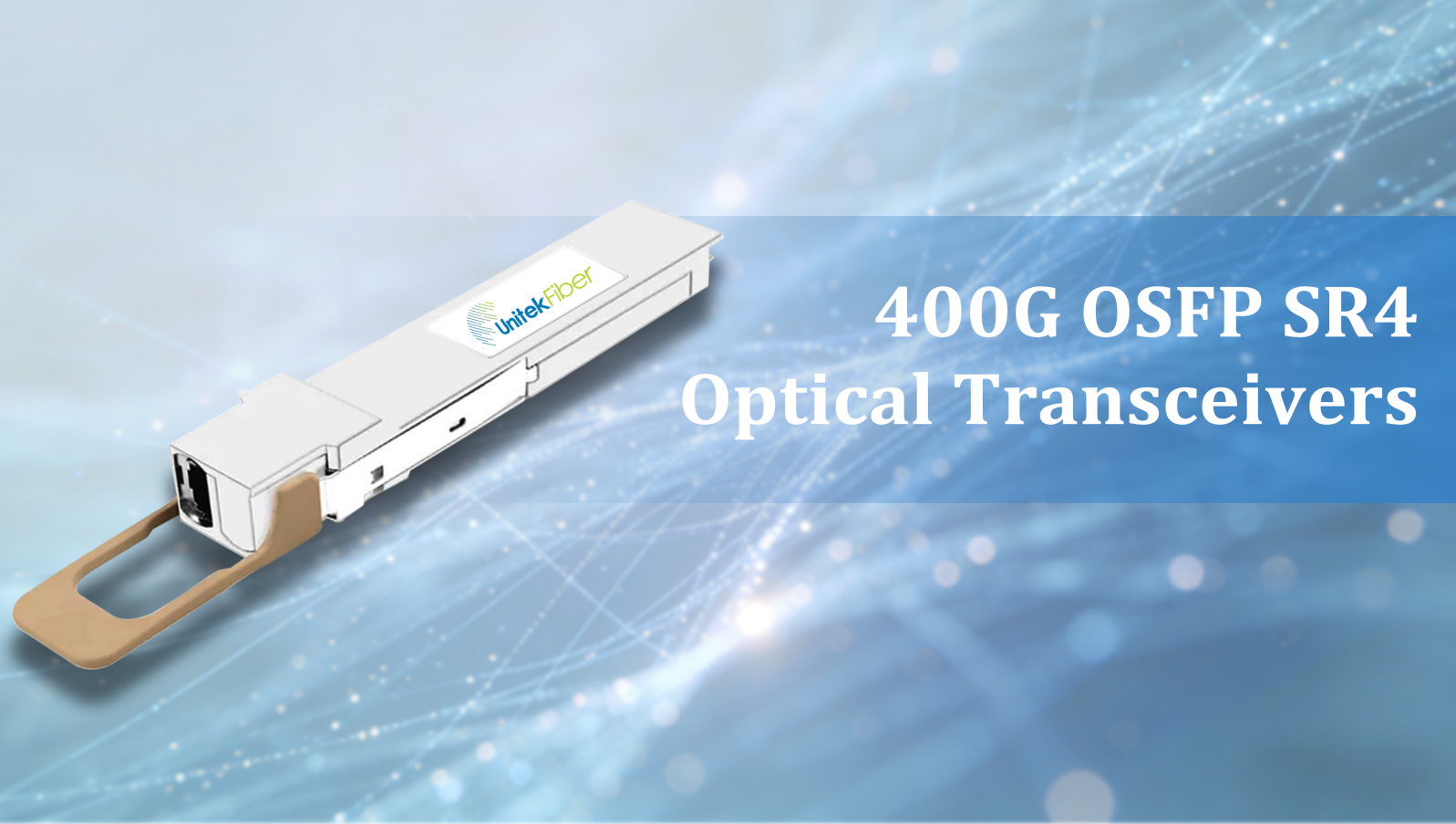
Transmission Rate: 400G OSFP SR4 optical transceiver offers an impressive bidirectional bandwidth of up to 400Gbps (400 Gigabits per second), four times that of the 100G standard, fully meeting the demands of massive data transmission.
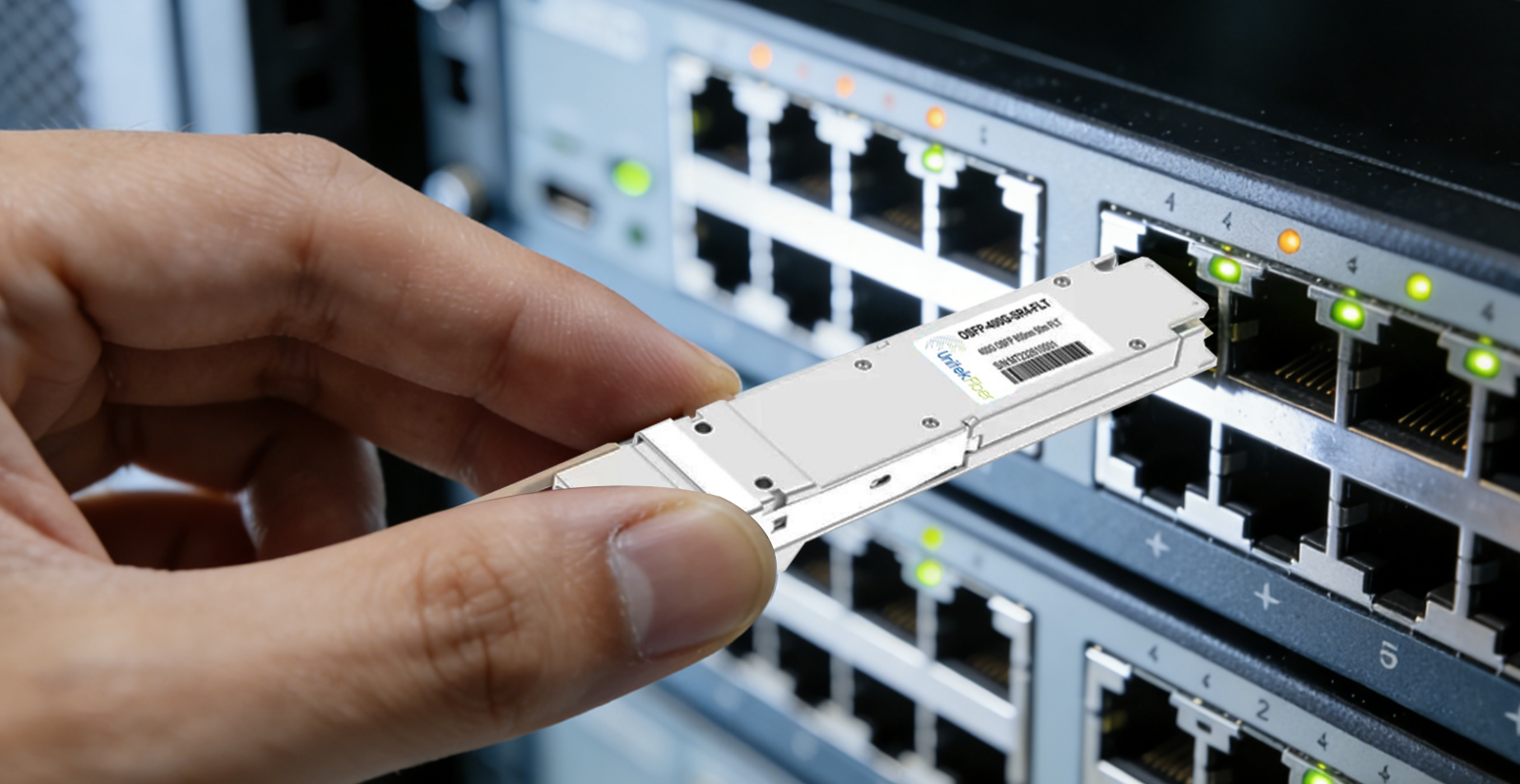
Packaging: 400G OSFP SR4 fiber transceiver utilizes an OSFP (Octal Small Form-factor Pluggable) package. Compared to QSFP-DD, OSFP is slightly larger in physical size (slightly wider and longer), but its design fully considers the requirements of 8 channels and better heat dissipation, making it particularly suitable for modules with slightly higher power consumption (such as the SR4).
Transmission technology: The core of 400G OSFP SR4 transceiver is PAM4 (4-Level Pulse Amplitude Modulation) modulation technology. Compared with traditional NRZ (Non-Return-to-Zero), PAM4 can transmit 2 bits of information (4 level states) within the same symbol period, significantly improving spectral efficiency. This means that at the same baud rate, PAM4 achieves double the transmission rate.
Channel Configuration: 400G OSFP SR4 fiber transceiver employs the SR4 standard. "SR" stands for Short Reach, and "4" indicates the use of four pairs of parallel optical channels (4x100G) for transmission.
Operating Mode: At the transmitting end, the 400G electrical signal is decomposed into four independent 106.25Gbps PAM4 electrical signals. Each signal drives a VCSEL laser, converting it into a 106.25Gbps PAM4 optical signal. These four optical signals are transmitted in parallel through multimode fiber. At the receiving end, four photodetectors convert the optical signals back into electrical signals, which are then reassembled into a 400G electrical signal.
High bandwidth
High bandwidth is one of the core advantages of the 400G OSFP SR4 fiber optic transceiver, providing data transfer rates of up to 400Gbps, far exceeding traditional 100G or 200G fiber transceivers. This means that more data can be transmitted on the same network link, reducing bandwidth bottlenecks, making it particularly suitable for scenarios requiring rapid exchange of large amounts of data, such as data centers and high-performance computing clusters.
High Port Density
Compared to traditional QSFP transceiver modules, 400G OSFP SR4 optical transceiver offers higher port density, allowing more optical modules to be configured in the same device. On the same panel area, OSFP SR4 transceiver modules can support more 400Gbps ports, improving device scalability and flexibility while reducing hardware footprint.
Low Power Consumption
Compared to other high-bandwidth transceivers (such as the 400G DR4), the 400G OSFP SR4 fiber optic transceiver offers significantly lower power consumption. Its optimized power management makes it more suitable for power-sensitive scenarios, especially for the continuous operation requirements of data center equipment. In large-scale deployments, low power consumption can effectively reduce data center operating costs.
Excellent heat dissipation
The 400G OSFP SR4 transceivers’ package provides more physical space and enhanced heat dissipation design, laying a solid foundation for the stable operation of 400G modules, especially in high-density deployment environments.
Data Center Interconnect (DCI)
400G OSFP SR4 optical transceivers are commonly used for high-speed interconnects between switches within data centers. They provide high-bandwidth, low-latency links, supporting rapid data exchange between servers, storage, and switches. In modern data centers, a large amount of East-West traffic needs to be transmitted efficiently within racks and server rooms. 400G OSFP SR4 fiber transceivers meet these needs while supporting high-density fiber optic cabling, improving network throughput and reliability.
High-Performance Computing (HPC)
In high-performance computing environments, the data transfer rate and latency between computing nodes directly impact overall computing efficiency. 400G OSFP SR4 fiber optic transceivers provide high-speed, low-latency links, making them ideal for GPU clusters, CPU node clusters, and distributed computing platforms. Whether for AI training, scientific simulations, or video rendering, they ensure high-speed data flow for massively parallel computing tasks, significantly improving computing performance.
Enterprise Core Network
In an enterprise core network, the uplinks of switches or routers often carry a large amount of aggregated traffic. The 400G OSFP SR4 transceiver module can provide high-speed, stable links for core switches, supporting efficient interconnection between multiple devices. It is particularly suitable for enterprise network environments in finance, healthcare, and scientific research that have strict requirements for bandwidth and low latency, ensuring data transmission stability and network scalability, while also providing support for future network upgrades.
Cloud computing
In cloud computing platforms, the 400G OSFP SR4 optical transceiver is primarily used for high-speed interconnection between servers, storage, and network devices, providing a high-bandwidth, low-latency data transmission channel for virtualization environments, big data analytics, and distributed storage systems. It supports massive concurrent access and large-scale data flow, ensuring the cloud platform maintains high efficiency when handling virtual machine migration, real-time computing, or big data tasks, while providing a reliable hardware foundation for data center capacity expansion and network upgrades.
The 400G OSFP SR4 fiber transceiver is a key cornerstone for intelligent computing centers to enter the 400G era. It cleverly combines the excellent performance of OSFP packaging, the high spectral efficiency of PAM4 modulation, the parallel multimode transmission characteristics of the SR4 standard, and the cost advantages of VCSEL lasers, providing a high-density, low-latency, cost-effective, and flexible deployment solution for high-bandwidth scenarios such as short-distance server access and leaf-spine interconnects. As a leading optical transceivers supplier in the industry, UnitekFiber offers a wide range of premium transceivers such as 10G SFP+, 40G QSFP+, 100G QSFP28, 200G QSFP56, 400 QSFP-DD transceivers and so on. Whether for data centers, enterprise networks, or 5G communication, UnitekFiber provides advanced fiber optic solutions. For more details, please contact us at sales@unitekfiber.com.
 5G 6G Fronthaul & Backhaul
View More
5G 6G Fronthaul & Backhaul
View More
 Data Center & Cloud Interconnect
View More
Data Center & Cloud Interconnect
View More
 Enterprise & Industrial Optical
View More
Enterprise & Industrial Optical
View More
 FTTx & Access Solutions
View More
FTTx & Access Solutions
View More
 Metro & Access Networks
View More
Metro & Access Networks
View More
 Optical Cabling Systems
View More
Optical Cabling Systems
View More
 Optical Transceivers & Interconnect
View More
Optical Transceivers & Interconnect
View More
 WDM & High-Capacity Transmission
View More
WDM & High-Capacity Transmission
View More
+86-755-21034367