
Choosing the right optical transceiver is a mission-critical decision for procurement managers. This decision directly impacts network performance, total cost of ownership (TCO), and long-term scalability. This article breaks down the five critical specifications that every purchasing decision must address, explained in clear, authoritative terms with actionable guidance.
Procurement success hinges on defining exact optical transceiver interface specifications.
Wavelength, reach, and data rate must align with network topology and link budget needs.
Connector type and form factor impact inventory flexibility and cost per port.
Power consumption and temperature tolerance affect operational reliability and TCO.
Vendor ecosystem support and compliance guarantee interoperability across platforms.
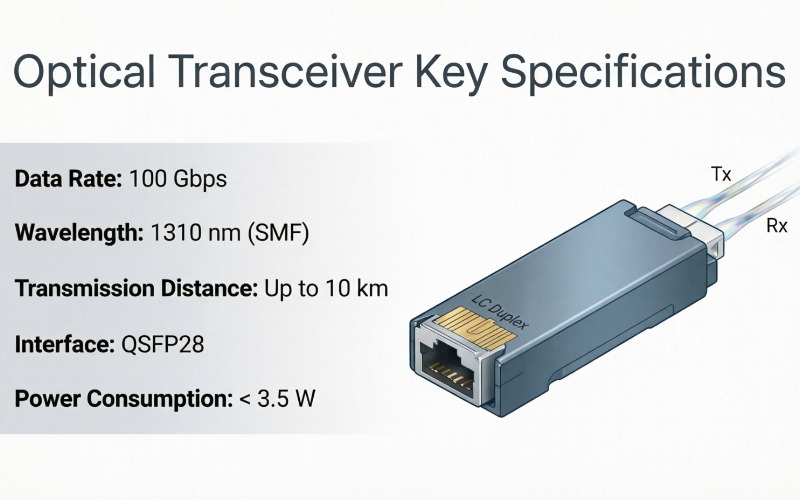
The first specification to define is the required data rate. Optical transceivers are designed to support specific line rates such as 1G, 10G, 25G, 40G, 100G, and beyond. Aligning the transceiver’s data rate to your network’s protocol standards is non‑negotiable for interoperability.
Protocol compatibility refers to standards such as Ethernet (IEEE 802.3), Fibre Channel (e.g., 16GFC, 32GFC), and SONET/SDH. Each protocol has associated requirements for framing and encoding that the optical module must support. Procurement managers must ensure that the chosen transceiver supports the protocol layers deployed within the network.
Actionable criteria: Document the network interface cards (NICs), switches, and routers that will host the transceiver. Confirm their supported protocols and data rates. Mismatches here lead to non‑functional interfaces and costly returns.
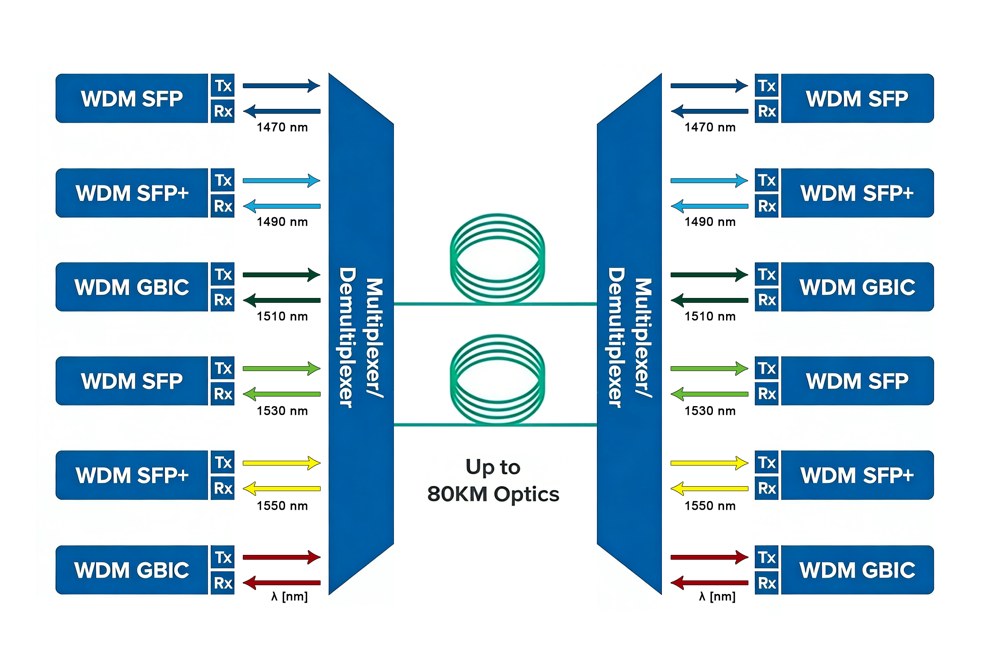
Optical transceivers operate on specific wavelengths (measured in nanometers, nm). Common wavelength windows include 850 nm for short‑reach multimode fiber and 1310/1550 nm for single‑mode long distance. Choosing the appropriate wavelength is essential for achieving your desired reach (the maximum distance the signal can travel without regeneration).
Reach categories include:
SR (Short Reach): typically up to 100 meters over multimode fiber.
LR (Long Reach): up to 10 km over single‑mode fiber.
ZR (Extended Reach): distances beyond 40 km, often requiring dispersion‑optimized modules.
Link budget refers to the total allowable optical power loss between transmitter and receiver. It is calculated by subtracting the receiver sensitivity from the transmitter output power and factoring in fiber attenuation and connector/splice losses.
Procurement tip: Always specify the maximum reach and verify it against real‑world attenuation figures of your fiber plant. In long haul or metropolitan networks, inadequate link budget planning results in degraded performance or link failures.
Form factor determines the module’s physical size and connector interface. Common form factors include SFP (Small Form Factor Pluggable), SFP+, QSFP28 (Quad Small Form Factor Pluggable 28), and CFP/CFP2 (C Form Factor Pluggable). These influence not only space utilization on edge cards but also power consumption.
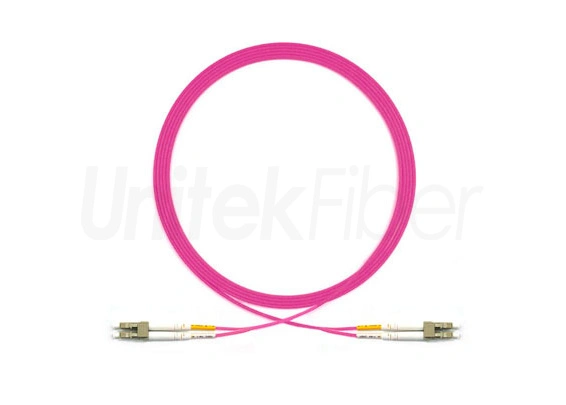
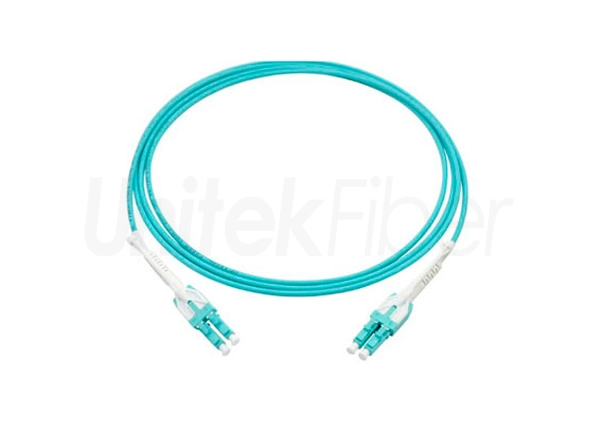
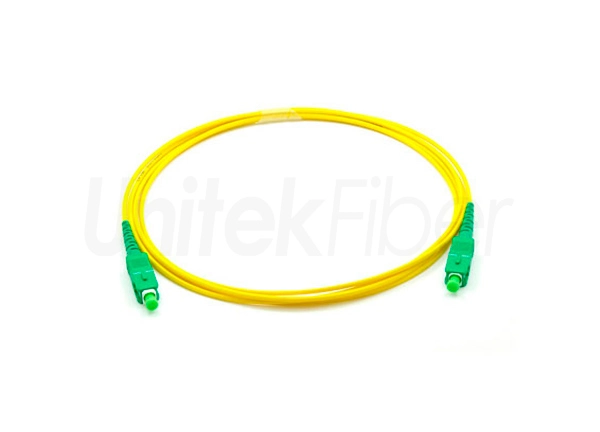
Connector type (e.g., LC, SC) determines how the transceiver interfaces with fiber cabling. LC connectors are widely used in high‑density applications due to their small footprint, while SC connectors may appear in legacy infrastructure.
These specifications have a downstream impact on inventory management. Standardizing form factors and connectors across your estate simplifies logistics and reduces procurement overhead. Additionally, mismatches can lead to unnecessary adapter costs or patch panel redesigns.
Power consumption, measured in watts, is a critical spec for optical transceivers, particularly in high‑density environments such as data centers. Lower power transceivers reduce thermal stress on host equipment and cut operational costs.
Each transceiver’s operating temperature range defines how it performs in specific environmental conditions. For example, industrial‑grade modules support extended temperature ranges (e.g., –40°C to +85°C) compared to commercial modules (0°C to +70°C). Selecting the correct thermal profile ensures reliability, particularly in outdoor enclosures or non‑climate‑controlled spaces.
Checklist: Align power and thermal requirements with equipment specifications. Higher power consumption can lead to increased cooling costs and potential hot spots in densely packed chassis.
Procurement should never compromise on industry compliance and standards support. Ensure modules are compliant with IEEE, ITU, and MSA (Multi‑Source Agreement) specifications. Vendor support, including warranty terms and cross‑platform compatibility, must be factored in.
Vendor ecosystem support is essential for troubleshooting and lifecycle management. Some vendors lock modules to specific hardware platforms, requiring vendor‑branded optics. Others support third‑party optics, which can significantly reduce cost per port but may affect support entitlements.
Interoperability testing ensures that transceivers from one vendor function seamlessly with hardware from another. Lack of proper testing can lead to link flaps, reduced performance, or complete failure to establish connections.
When building a specification sheet for an optical transceiver purchase, use the following ordered checklist:
Data rate and protocol compatibility with existing infrastructure.
Wavelength and reach that match your fiber type and link distances.
Form factor and connector types that fit existing patching and hardware.
Power consumption and thermal profiles suitable for deployment conditions.
Verified compliance, vendor ecosystem support, and interoperability certification.
A common mistake is prioritizing cost over specification alignment. Low‑cost optics that don’t meet network requirements lead to higher operational expenses and degrade network performance.
An optical transceiver is a module that both transmits and receives optical signals across fiber. It converts electrical signals to optical and back, enabling high‑speed communication between endpoints.
Mixing optics can work if they are standards compliant and interoperable. However, vendor‑locked platforms may require branded optics for full support and warranty coverage.
Wavelength determines propagation characteristics. Short‑reach transceivers use wavelengths optimized for multimode fiber, while long‑reach links use wavelengths suited to single‑mode fiber to minimize attenuation and dispersion.
Yes. Modules operate within defined temperature ranges. Deploying outside those limits can lead to failure or degraded performance, especially in outdoor or industrial environments.
 5G 6G Fronthaul & Backhaul
View More
5G 6G Fronthaul & Backhaul
View More
 Data Center & Cloud Interconnect
View More
Data Center & Cloud Interconnect
View More
 Enterprise & Industrial Optical
View More
Enterprise & Industrial Optical
View More
 FTTx & Access Solutions
View More
FTTx & Access Solutions
View More
 Metro & Access Networks
View More
Metro & Access Networks
View More
 Optical Cabling Systems
View More
Optical Cabling Systems
View More
 Optical Transceivers & Interconnect
View More
Optical Transceivers & Interconnect
View More
 WDM & High-Capacity Transmission
View More
WDM & High-Capacity Transmission
View More
+86-755-21034367