
Use a fiber optic cleaning pen or lint-free wipes with isopropyl alcohol. Clean the connector end face gently, avoid touching it with your fingers, and inspect it if possible before reconnecting. Proper cleaning reduces insertion loss and helps prevent intermittent optical link problems.
Yes. Most optical SFP modules are designed to accept fiber optic patch cables directly, typically through LC duplex connectors. Before connecting the fiber, insert the SFP module into the switch or router, remove the dust caps, and ensure the fiber type (single-mode or multimode) matches the SFP specifications.
Check speed, fiber type, wavelength, connector type, transmission distance, and vendor compatibility. For example, a 10GBASE-LR SFP+ requires single-mode OS2 fiber, while a 10GBASE-SR module requires multimode OM3/OM4 fiber. The network device must also support the module’s speed and form factor.
Yes. Most modern SFP, SFP+, and SFP28 modules are hot-swappable, meaning they can be inserted or removed while the switch or router remains powered on. However, always follow the equipment manufacturer’s guidelines and avoid touching the optical interfaces during installation.
A link light that stays off is usually caused by reversed TX/RX polarity, a dirty connector, wrong fiber type, unsupported SFP module, or a damaged cable. Start by cleaning the connectors, verifying polarity, and checking that both devices support the same speed and optical standard.
If TX is connected to TX and RX to RX, the optical link will not come up. Ethernet fiber connections require crossed polarity: TX on one device must connect to RX on the other. Swapping the two fiber connectors usually resolves the problem immediately.
Generally no. Single-mode and multimode components are designed for different core sizes and optical characteristics. Mixing single-mode fiber with a multimode SFP, or vice versa, can cause excessive loss, unstable links, or complete connection failure. Always match the fiber type to the SFP module.
Transmission distance depends on the module type. Typical examples include 1000BASE-SX: up to 550 m, 1000BASE-LX: up to 10 km, 10GBASE-SR: up to 300–400 m, and 10GBASE-LR: up to 10 km. Long-reach ER/ZR modules can transmit 40–80 km or more on single-mode fiber.
No. Most optical SFP modules use LC duplex connectors, but not all. Some BiDi SFPs use a single LC connector, while copper SFPs use RJ45 ports. Higher-density modules such as QSFP often use MPO/MTP connectors.
 5G 6G Fronthaul & Backhaul
View More
5G 6G Fronthaul & Backhaul
View More
 Data Center & Cloud Interconnect
View More
Data Center & Cloud Interconnect
View More
 Enterprise & Industrial Optical
View More
Enterprise & Industrial Optical
View More
 FTTx & Access Solutions
View More
FTTx & Access Solutions
View More
 Metro & Access Networks
View More
Metro & Access Networks
View More
 Optical Cabling Systems
View More
Optical Cabling Systems
View More
 Optical Transceivers & Interconnect
View More
Optical Transceivers & Interconnect
View More
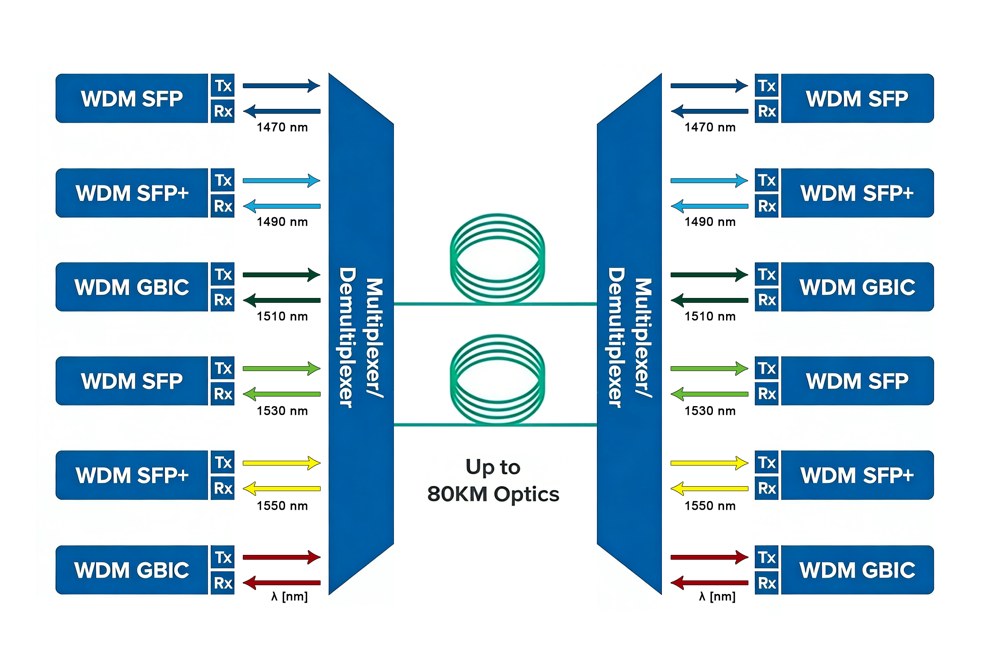 WDM & High-Capacity Transmission
View More
WDM & High-Capacity Transmission
View More
+86-755-21034367