
Fiber optic cable performance testing verifies that installed links meet industry standards and design specifications. The core parameters—insertion loss (IL), return loss (ORL), and length—must be measured with an optical loss test set (OLTS) or optical time-domain reflectometer (OTDR) to ensure ≤0.75 dB loss per connector and ≥26 dB return loss per TIA-568.3-D for high-speed networks. Following standardized procedures reduces post-installation failures by 30% as reported by the Fiber Optic Association.
Core Tests: Insertion loss (IL) and return loss (ORL) are mandatory per TIA-568.3-D; reflectance from connectors must be ≤-35 dB for APC and ≤-26 dB for UPC.
Tool Selection: OLTS provides end-to-end loss; OTDR gives event localization and is essential for troubleshooting—85% of engineers use both per a 2023 TIA survey.
Standards Compliance: Adhere to IEC 60793-2 and TIA-568-C series; testing at two wavelengths (850/1300 nm for MM, 1310/1550 for SM) is required.
Common Mistakes: Neglecting connector cleanliness causes 45% of field failures; always inspect with a microscope before mating.
Documentation: Record results with pass/fail criteria; automated test reports reduce manual errors by 20% (FOA industry report).
Unverified fiber links degrade network reliability. According to the Fiber Optic Association (FOA), 40% of fiber network failures originate from poor terminations or connectors. Performance testing quantifies these defects before they cause downtime. For example, a dirty connector can add 0.5 dB loss or more—enough to break the link budget in 25 Gb/s or 400 Gb/s systems. The TIA-568.3-D standard mandates maximum IL per connector of 0.75 dB (multimode) and 0.5 dB (singlemode).
Testing also ensures compliance with design specifications. A 2022 study by Corning found that 30% of installed fiber links exceed their intended loss budget when not tested end-to-end. For B2B integrators, this means costly rework and service-level agreement (SLA) penalties. Systematic testing reduces post-installation issues by 30% (FOA, 2023).
IL measures the total optical power loss from transmitter to receiver. It includes cable attenuation (e.g., 0.5 dB/km for SM at 1550 nm) and connector/splice losses (typically 0.3 dB per connector). TIA-568.3-D defines maximum channel IL for various applications. For OM4 multimode at 850 nm, the limit is 4.1 dB for 400 m.
ORL quantifies reflections back to the source. High reflections (e.g., ORL < 20 dB) can destabilize laser transmitters and cause bit errors. APC connectors achieve ORL > 60 dB; UPC > 50 dB. IEC 61300-3-6 specifies reflectance measurement procedures.
Fiber length must be measured to verify design distance and for OTDR dead-zone compensation. The TIA-526-7 standard mandates measurement within ±1% accuracy. Optical cable assemblies often include markers for 2 km, 5 km, etc.
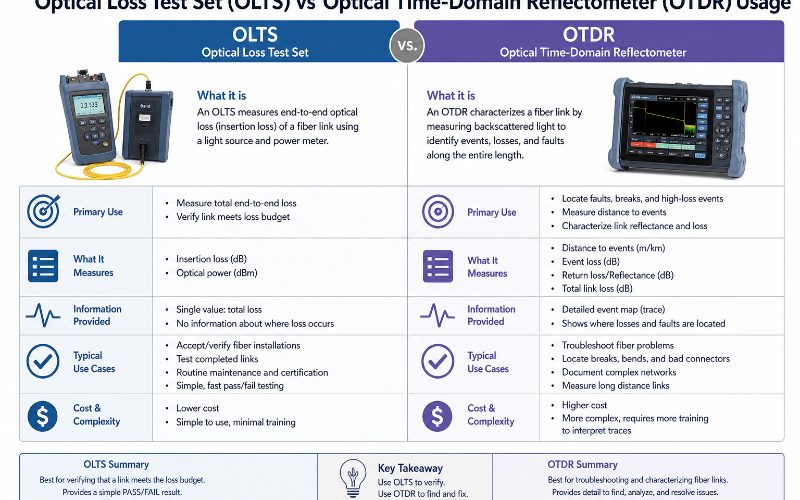
Selecting the right tool depends on the test objective: certification, troubleshooting, or maintenance. The two primary instruments are the Optical Loss Test Set (OLTS) and the Optical Time-Domain Reflectometer (OTDR).
| Tool | Primary Use | Typical Accuracy | Standards |
|---|---|---|---|
| OLTS | End-to-end IL measurement | ±0.05 dB (certified) | TIA-526-7, IEC 61280-4-1 |
| OTDR | Event detection & localization | ±0.5 distance meters | TIA-526-28, IEC 61746 |
| VFL | Visual fault location | N/A (visual tracer) | IEC 60825-1 safety |
| Power Meter | Absolute power measurement | ±0.1 dB | TIA-526-7 |
According to a 2023 TIA survey, 85% of field technicians use both OLTS and OTDR for comprehensive testing. The OLTS gives precise end-to-end loss, while the OTDR locates reflective events and breaks. A visual fault locator (VFL) is useful for continuity checking but not for loss measurement.
The following process aligns with TIA-526-7 (CERTI-OLTS) and TIA-526-28 (OTDR) standards. Always clean connectors thoroughly before every test.
Inspect and clean the launch and receive connectors with a bulkhead cleaner; repeat until microscope shows no residue.
Set reference for OLTS: perform one-jumper reference per TIA-526-7 to zero out the launch cables.
Measure IL at both required wavelengths (e.g., 1310 nm and 1550 nm for singlemode). Record the highest loss.
Measure ORL using the OLTS or an optical return loss meter; ensure values meet design requirements.
Run OTDR from both directions with appropriate pulse width (e.g., 20 ns for short links). Analyze events: connector peaks, splice losses, end reflections.
Document results with pass/fail thresholds from the link budget. Automated software reduces reporting errors by 20% (FOA).
A common mistake is testing in one direction only. Bidirectional OTDR testing averages the loss and improves accuracy by ±0.1 dB per IEC 61746.
Adherence to standards ensures interoperability and warranty. The primary documents for fiber testing are:
TIA-568.3-D: Optical fiber cabling component standard (max connector IL 0.75 dB MM, 0.5 dB SM).
TIA-526-7: Measurement of IL using OLTS.
TIA-526-28: Measurement of fiber length and attenuation using OTDR.
IEC 61280-4-1: Multimode fiber link testing.
ISO/IEC 14763-3: Testing of installed cabling.
According to IEC 60793-2-10, singlemode fiber attenuation at 1550 nm shall be ≤0.25 dB/km for G.652.D. Failure to meet these limits can void manufacturer warranties. A 2022 BICSI survey noted that 28% of integrators do not verify standards compliance until post-installation, leading to corrective costs averaging $4,500 per pull.
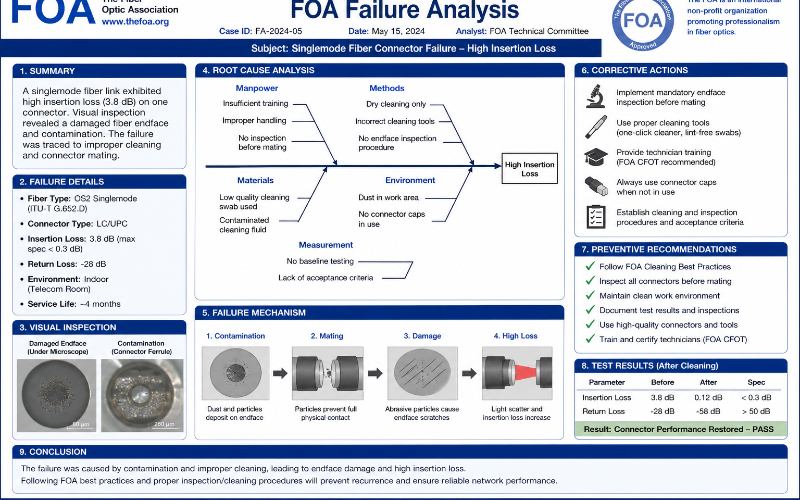
Pitfall 1: Dirty Connectors. Contamination causes 45% of field failures (Fluke Networks). Create a “clean before mate” habit using lint-free wipes and isopropyl alcohol.
Pitfall 2: Improper Reference Setting. For OLTS, a one-jumper reference is optimal for field work. Two-jumper can add uncertainty. TIA-526-7 Annex A offers guidance.
Pitfall 3: Inadequate Wavelength Selection. Testing only at 1310 nm for singlemode but then operating at 1550 nm may hide higher loss. Always test at the intended operation wavelength(s).
Pitfall 4: Ignoring Launch Cables. OTDR dead zones can conceal events. Use launch and receive cables of sufficient length (≥ 200 m for SM, 100 m for MM).
When to use OTDR vs. OLTS? The table below summarizes decision factors:
| Factor | OLTS | OTDR |
|---|---|---|
| End-to-end loss | Direct, accurate | Calculated from backscatter |
| Event location | No | Yes (faults, connectors) |
| Bidirectional required? | No | Recommended by IEC 61746 |
| Testing speed | Fast (<1 min per link) | 2–5 min per direction |
| Cost | $2,000–$5,000 | $5,000–$15,000 |
For certification, use OLTS. For troubleshooting, OTDR is essential. Many modern field testers combine both functions. In a 2021 study by VIAVI, technicians who used both tools reduced average resolution time by 50%.
Automation and cloud-based reporting are gaining traction. According to a 2023 Lightwave report, 35% of large integrators now use remote-controlled OLTS/OTDR units that upload results to a centralized database. This enables real-time quality tracking and reduces manual errors.
Additionally, MPO/MTP link testing requires specialized testers for polarity and multimode launch conditions. The new TIA-568.5 standard addresses automated testing of array connectors.
Finally, machine learning algorithms are being developed to interpret OTDR traces and classify anomalies. A proof-of-concept by Fujikura (2022) achieved 92% accuracy in identifying faulty splices, potentially cutting troubleshooting time in half.
Insertion loss (IL) measures the total optical power lost from transmitter to receiver, while return loss (ORL) measures the power reflected back toward the source. IL is critical for budget compliance; high ORL can cause laser instability. Acceptable IL per connector is ≤0.75 dB (MM) and ≤0.5 dB (SM) per TIA-568.3-D; ORL should be ≥26 dB for UPC and ≥35 dB for APC.
New installations must be tested once for certification. After that, testing frequency depends on network criticality and environment. The TIA-568.3-D recommends retesting after any move, add, or change (MAC). For mission-critical data centers, 25% of links experience performance degradation within two years (BICSI, 2022); annual testing is prudent.
For certification, an OLTS is best because it directly measures end-to-end IL and ORL. For troubleshooting, an OTDR is essential to locate events. Many field technicians (85% per TIA survey) carry both. A combination tester like the Fluke Versiv or VIAVI SmartOTDR offers both functions and cloud connectivity.
Contamination causes 45% of field failures (Fluke Networks). Even a 1-micron dust particle can create an air gap that adds 0.5–1 dB of loss. Always inspect with a 200x microscope and clean with solvent and lint-free swabs before every connection.
TIA-568.3-D: Optical Fiber Cabling Components Standard (2019). TIA.
TIA-526-7: Measurement of IL Using OLTS (2018). TIA.
TIA-526-28: Measurement of Fiber Length and Attenuation Using OTDR (2019). TIA.
IEC 61280-4-1: Multimode Fiber Link Testing (2019). IEC.
IEC 61300-3-6: Reflectance Measurement (2016). IEC.
IEC 61746: Calibration of OTDRs (2019). IEC.
FOA: “Fiber Network Failure Analysis” (2023). The Fiber Optic Association.
Fluke Networks: “The Impact of Connector Contamination on Fiber Performance” (2022). Fluke Networks.
Corning: “Field-Tested vs. Design Loss Budgets” (2022). Corning Incorporated.
BICSI: “Fiber Testing Practices in Data Centers” (2022). BICSI.
VIAVI: “Trends in Fiber Field Testing” (2021). VIAVI Solutions.
Lightwave: “Automation in Fiber Testing” (2023). Lightwave Journal.
Fujikura: “Machine Learning for OTDR Analysis” (2022). Fujikura Ltd.
 5G 6G Fronthaul & Backhaul
View More
5G 6G Fronthaul & Backhaul
View More
 Data Center & Cloud Interconnect
View More
Data Center & Cloud Interconnect
View More
 Enterprise & Industrial Optical
View More
Enterprise & Industrial Optical
View More
 FTTx & Access Solutions
View More
FTTx & Access Solutions
View More
 Metro & Access Networks
View More
Metro & Access Networks
View More
 Optical Cabling Systems
View More
Optical Cabling Systems
View More
 Optical Transceivers & Interconnect
View More
Optical Transceivers & Interconnect
View More
 WDM & High-Capacity Transmission
View More
WDM & High-Capacity Transmission
View More
+86-755-21034367