
ttenuation is lower at 1550nm primarily because Rayleigh scattering is inversely proportional to the fourth power of the wavelength ($\lambda^{-4}$). Since 1550nm is a longer wavelength than 1310nm, it experiences far fewer collisions with the microscopic imperfections inside the silica glass core, resulting in a cleaner, lower-loss transmission path.
FTTH networks typically utilize both wavelengths for different functions within a PON (Passive Optical Network) structure. Standard GPON uses 1310nm for upstream traffic (from user to central office) to leverage low-cost transmitters at the home, and 1490nm/1550nm for downstream traffic and overlay cable TV (CATV) signals over long distribution distances.
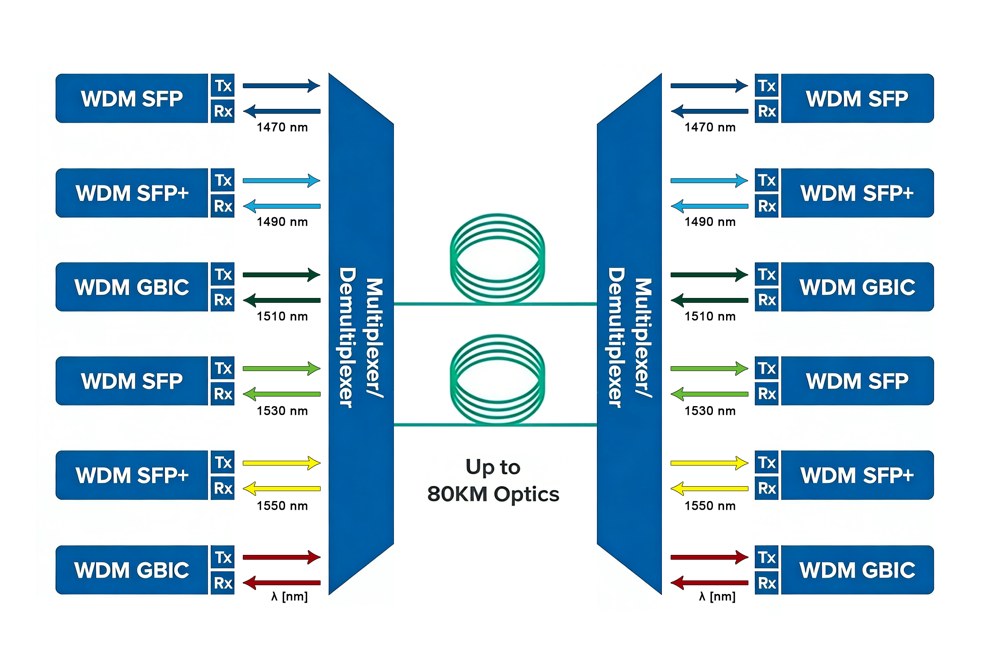
Yes, you can transmit both 1310nm and 1550nm wavelengths through the same physical fiber core simultaneously. This is achieved using Wavelength Division Multiplexing (WDM) technology. Filters at each end separate the wavelengths, allowing bidirectional or multi-channel data throughput over a single fiber string without interference.
Bending affects the 1550nm wavelength much more severely than the 1310nm wavelength. Because 1550nm light travels with a weaker confinement inside the core, tight macro-bends or micro-bends cause the light waves to exceed the critical angle of total internal reflection, leading to massive localized optical power drops.
 5G 6G Fronthaul & Backhaul
View More
5G 6G Fronthaul & Backhaul
View More
 Data Center & Cloud Interconnect
View More
Data Center & Cloud Interconnect
View More
 Enterprise & Industrial Optical
View More
Enterprise & Industrial Optical
View More
 FTTx & Access Solutions
View More
FTTx & Access Solutions
View More
 Metro & Access Networks
View More
Metro & Access Networks
View More
 Optical Cabling Systems
View More
Optical Cabling Systems
View More
 Optical Transceivers & Interconnect
View More
Optical Transceivers & Interconnect
View More
 WDM & High-Capacity Transmission
View More
WDM & High-Capacity Transmission
View More
+86-755-21034367