
Is fiber optic cable loss better at 1310nm or 1550nm? > Yes, fiber optic cable loss is significantly better at the 1550nm wavelength. In standard single-mode fiber (SMF/OS2), the typical attenuation rate at 1550nm is 0.20 dB/km, whereas it is 0.35 dB/km at 1310nm. This means 1550nm inherits a much lower optical power loss, making it the premier choice for long-haul transmission and WDM systems. However, 1310nm features near-zero chromatic dispersion, making it highly cost-effective and optimal for short-to-medium distance networks (under 10km).
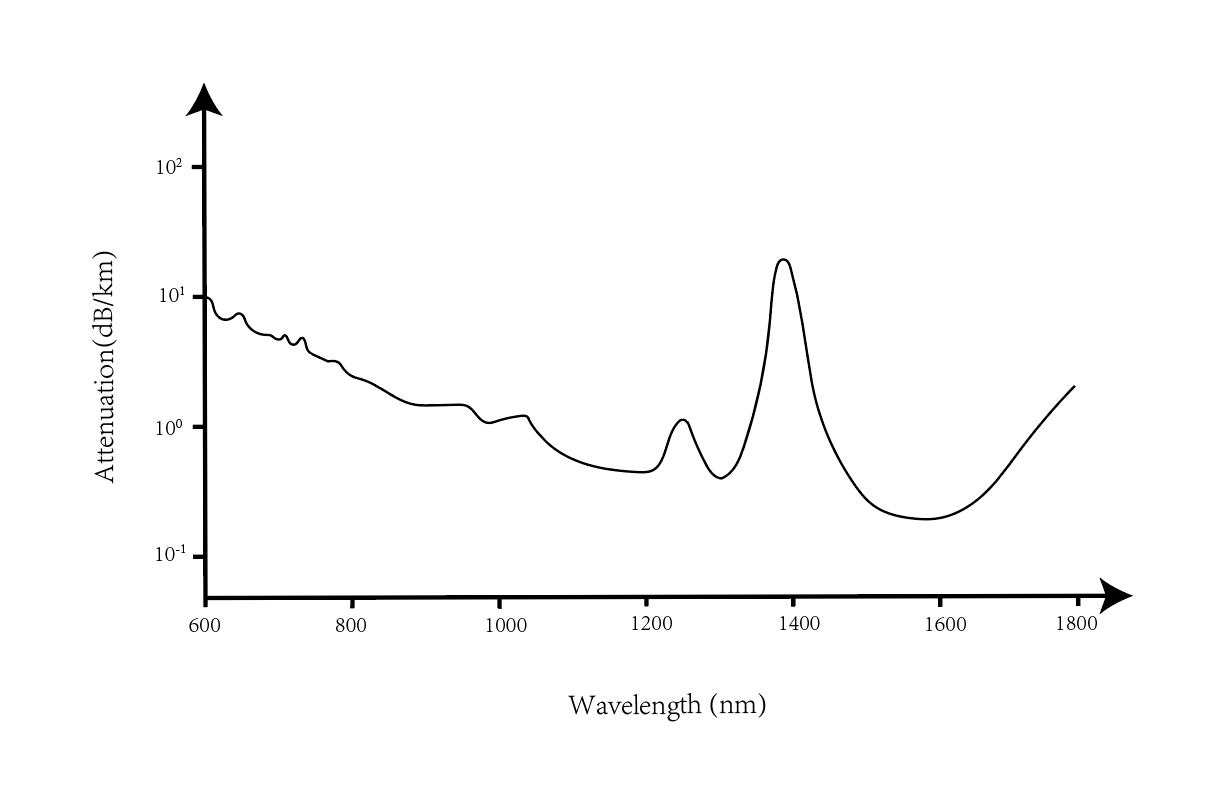
In optical fiber communication, light travels through the silica glass core as an electromagnetic wave. The performance of this transmission is fundamentally governed by two metrics: Wavelength (measured in nanometers, nm) and Optical Loss/Attenuation (measured in decibels per kilometer, dB/km).
Learn about the difference between single mode and multimode fiber optic cables
As light propagates through a fiber optic cable, its signal strength decreases. This reduction in power is called attenuation. It is caused by three primary physical phenomena:
Rayleigh Scattering: Microscopic variations in the density of the glass silica structure that scatter light in all directions. Rayleigh scattering decreases drastically as the wavelength increases.
Infrared Absorption: The molecular structure of pure silica glass absorbs light energy at higher infrared regions (typically starting to spike past 1600nm).
Hydroxyl (OH-) Ion Absorption: Residual water vapor trapped in the glass causes high loss peaks, historically known as the "water peak" around 1383nm.
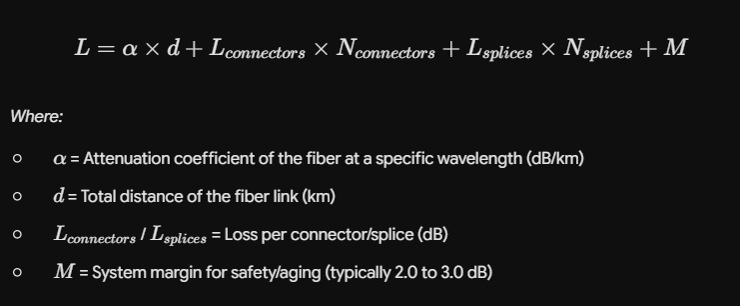
To calculate the total link loss (L)of a fiber optic deployment, engineers at Unitekfiber utilize the following standard optical budget formula:
The attenuation or loss of light in a fiber optic cable varies depending on the wavelength, the type of fiber, and other factors. In general, the attenuation of light in an optical fiber is lower at the longer wavelength of 1550nm than at 1310nm.
This is because optical fibers have a lower absorption coefficient at 1550nm, which means that less light is absorbed by the fiber compared to 1310nm. The lower attenuation at 1550nm allows for longer transmission distances and higher bandwidth capacity in fiber optic communication systems.
Single-mode fibers are designed to operate within specific "low-loss windows" where the combination of scattering and absorption is at its lowest. The 1310nm wavelength sits in the second transmission window, where chromatic dispersion drops to near zero. The 1550nm wavelength resides in the third transmission window (C-band), representing the absolute lowest attenuation point for silica glass before infrared absorption takes over.
To help network engineers and purchasing managers make data-driven decisions, we have structured the empirical data and mechanical properties of G.652.D OS2 single-mode fiber under these two wavelengths:
| Performance Metric | 1310nm Wavelength | 1550nm Wavelength | Technical Impact on Network Design |
| Typical Attenuation Rate | 0.35 dB/km | 0.20 dB/km | 1550nm yields 43% lower loss per km than 1310nm. |
| Maximum Attenuation (Standard) | 0.40 dB/km | 0.30 dB/km | Strict worst-case threshold for link budget formulas. |
| Chromatic Dispersion | ≈0 ps/nm.km | ≈18 ps/nm.km | 1310nm requires no dispersion compensation up to 10km. |
| Bending Sensitivity | Lower | Higher | 1550nm is more prone to macro-bending and leakage. |
| Max Transmission Distance | ≈10 km - 40km | Up to 100 km+ (Without Reg.) | 1550nm is vital for unrepeatered ultra-long hauls. |
| Optical Transceiver Cost | Lower (FP/DFB lasers) | Higher (EML lasers / cooled) | 1310nm optics drastically cut short-range CAPEX. |
| EDFA Amplification Support | No | Yes | 1550nm allows active optical amplification. |
Selecting between 1310nm and 1550nm is not simply about picking the lowest loss; it requires a balanced evaluation of distance, bandwidth, optics cost, and structural design.
The 1310nm wavelength remains the dominant standard for localized networks, enterprise backbones, and standard FTTx access lines.
Short-to-Medium Distance (≤10km): Within campus networks, data center interconnects (DCIs), and metropolitan local loops, the cumulative loss difference between 1310nm and 1550nm is negligible.
Budget-Constrained Projects: 1310nm optical modules (such as 10G SFP+ LR or 100G QSFP28 LR4) utilize simpler, uncooled laser components. This lowers the electronic component hardware cost by 30% to 50% compared to 1550nm equivalents.
Dispersion-Limited Systems: Since 1310nm features near-zero chromatic dispersion in standard G.652 fibers, the digital pulse does not smear or deform over moderate distances, eliminating the need for expensive dispersion compensation modules (DCM).
The 1550nm window is indispensable for high-capacity, long-distance infrastructure.
Long-Haul & Telecommunication Backbones: When spans exceed 20km or 40km, saving 0.15 dB per kilometer is monumental. It allows signals to travel over 80km without requiring expensive active inline regeneration stations.
Wavelength Division Multiplexing (WDM / DWDM): The 1550nm band (C-band and L-band) features a wide flat spectrum that allows multiplexing dozens of high-speed data channels into a single fiber core.
Amplified Systems: 1550nm is perfectly aligned with the gain spectrum of Erbium-Doped Fiber Amplifiers (EDFAs). This allows optical signals to be amplified directly in the light domain without converting them back to electricity, supporting trans-oceanic and cross-country links.
For longer distances, it is generally advantageous to use higher wavelengths such as 1550nm for transmission, as the lower attenuation allows for signals to travel over greater distances. This is why 1550nm is commonly used in long-haul applications, where distances can span thousands of kilometers.
Additionally, optical amplifiers such as erbium-doped fiber amplifiers (EDFAs) are available for use in 1550nm wavelengths, which can boost the optical fiber signal without converting it to an electrical signal. This further enhances the advantages of using 1550nm wavelengths over 1310nm.
It's important to consider all these factors when designing a fiber optic system by fiber optic supplier for long distance transmission to ensure optimal performance and reliability.
As field application engineers at Unitekfiber Solution, we frequently consult with contractors facing unexpected signal drops during deployment. Here are two critical installation pain points you must manage:
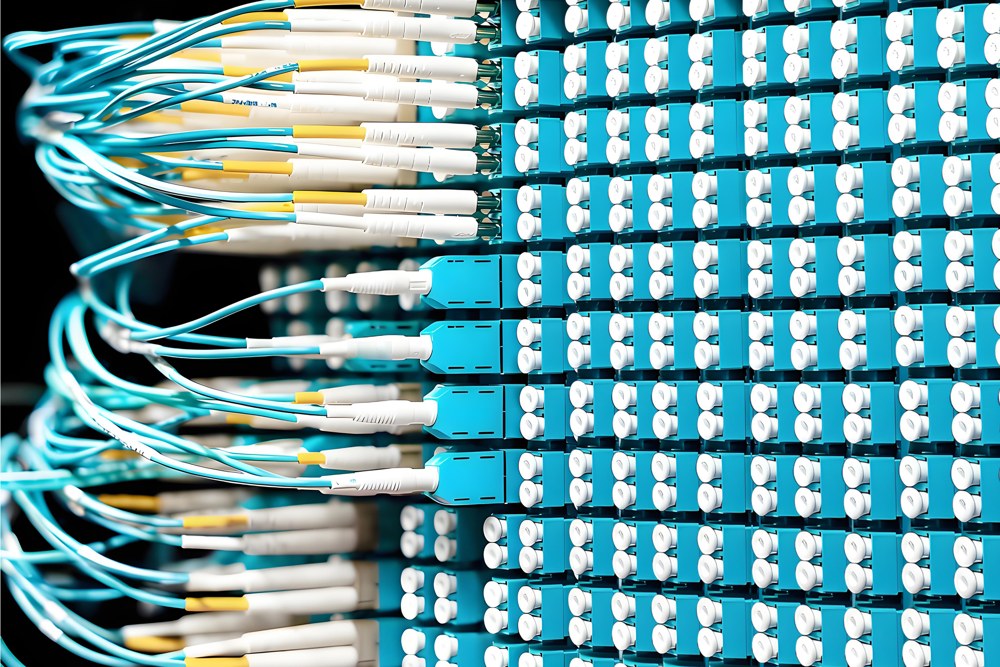
A common issue during high-density fiber patching inside ODFs (Optical Distribution Frames) or Patch Panels is sudden link failure at 1550nm while 1310nm remains functional.
The Reason: Light at 1550nm has a larger Mode Field Diameter (MFD) than at 1310nm. This means the optical energy is less tightly bound to the physical core. When a fiber optic patch cord is bent past its minimum bend radius, the 1550nm light leaks out into the cladding much faster.
Our Solution: For tight spaces, routing trays, and drop cables, Unitekfiber recommends specifying bend-insensitive single-mode fiber conforming to the ITU-T G.657.A2 standard instead of standard G.652.D.
Never sign off on an installation after testing at only one wavelength. Fiber link commissioning requires an OTDR (Optical Time Domain Reflectometer) check at both 1310nm and 1550nm. If the loss at 1550nm is significantly worse than 1310nm at a specific point, you have identified a macro-bend or a pinched cable. If the loss is high at 1310nm but normal at 1550nm, it usually points to a bad fusion splice or a contaminated connector.
To verify the attenuation criteria, geometric specs, and fiber optic cabling properties discussed in this article, please refer to the official international documentation below:
ttenuation is lower at 1550nm primarily because Rayleigh scattering is inversely proportional to the fourth power of the wavelength ($\lambda^{-4}$). Since 1550nm is a longer wavelength than 1310nm, it experiences far fewer collisions with the microscopic imperfections inside the silica glass core, resulting in a cleaner, lower-loss transmission path.
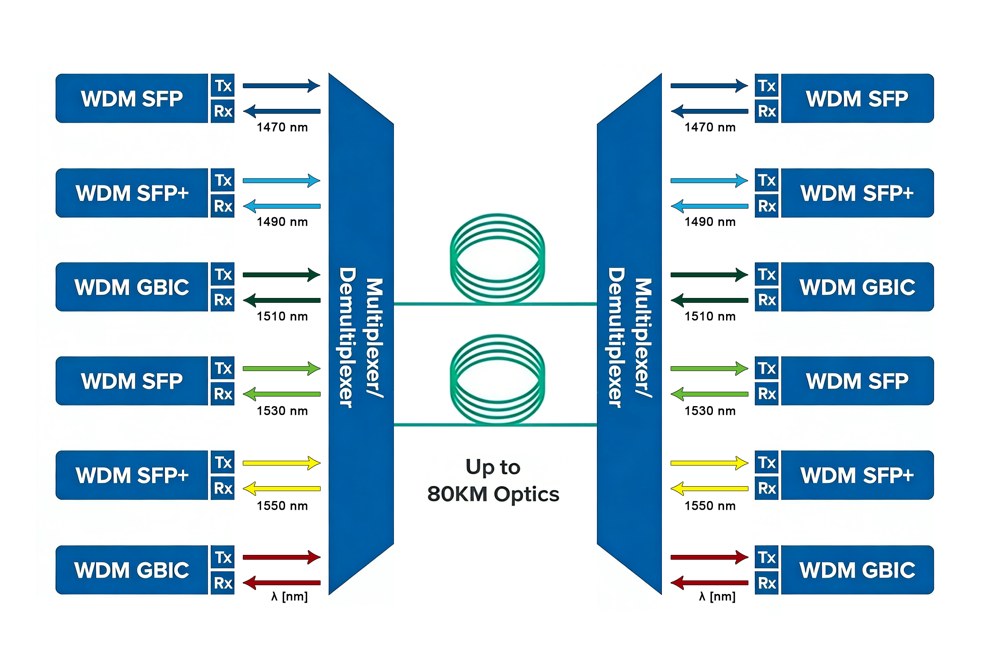
Yes, you can transmit both 1310nm and 1550nm wavelengths through the same physical fiber core simultaneously. This is achieved using Wavelength Division Multiplexing (WDM) technology. Filters at each end separate the wavelengths, allowing bidirectional or multi-channel data throughput over a single fiber string without interference.
Bending affects the 1550nm wavelength much more severely than the 1310nm wavelength. Because 1550nm light travels with a weaker confinement inside the core, tight macro-bends or micro-bends cause the light waves to exceed the critical angle of total internal reflection, leading to massive localized optical power drops.
 5G 6G Fronthaul & Backhaul
View More
5G 6G Fronthaul & Backhaul
View More
 Data Center & Cloud Interconnect
View More
Data Center & Cloud Interconnect
View More
 Enterprise & Industrial Optical
View More
Enterprise & Industrial Optical
View More
 FTTx & Access Solutions
View More
FTTx & Access Solutions
View More
 Metro & Access Networks
View More
Metro & Access Networks
View More
 Optical Cabling Systems
View More
Optical Cabling Systems
View More
 Optical Transceivers & Interconnect
View More
Optical Transceivers & Interconnect
View More
 WDM & High-Capacity Transmission
View More
WDM & High-Capacity Transmission
View More
+86-755-21034367