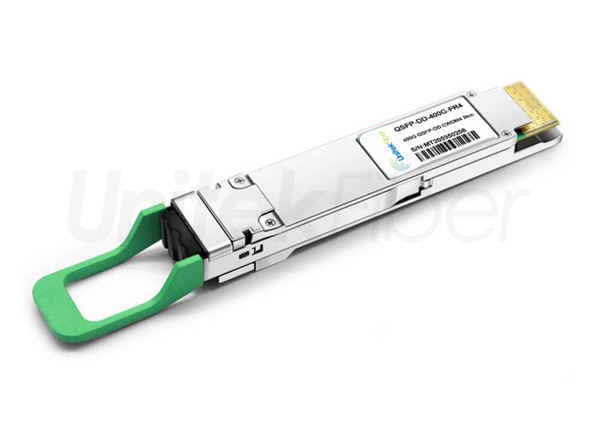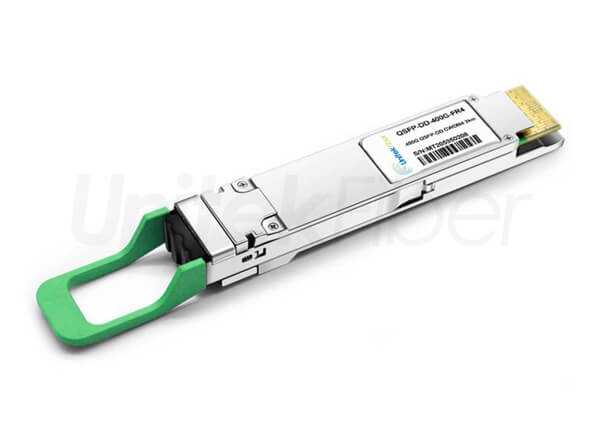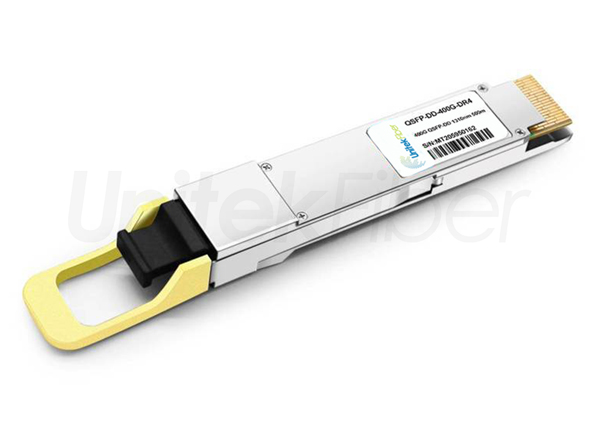

With the continuous growth of the optical communication market, QSFP-DD optical transceiver have become the most in-demand product in the 400G market. Both the 400G QSFP-DD FR4 transceiver and 400G QSFP-DD FR8 transceiver are solutions for wavelength-division multiplexing (WDM) medium-distance transmission (2km). What are the differences between them? How should they be selected and applied?
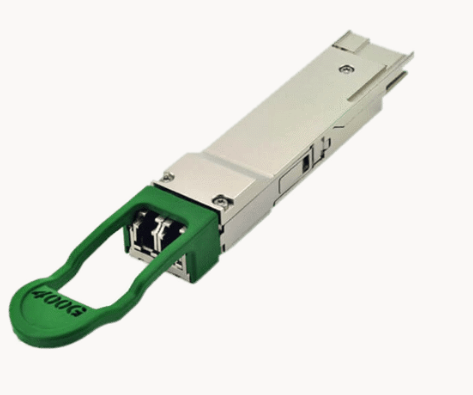
The 400G QSFP-DD FR4 fiber optic transceiver is a hot-pluggable 400Gbps optical transceiver with a QSFP-DD form factor, supporting single-mode fiber links up to 2km via a duplex LC connector. It integrates four independent channels at CWDM4 center wavelengths of 1271/1291/1311/1331nm, with each channel operating at up to 100Gbps, compliant with the 100G single-wavelength MSA specification.
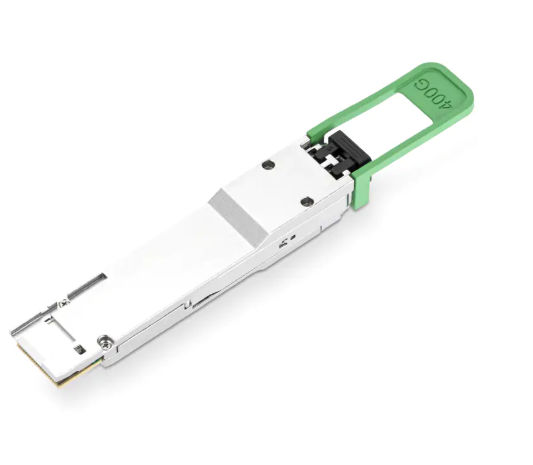
Both the 400G QSFP-DD FR8 and 400G QSFP-DD FR4 transceiver modules utilize 50G PAM4 modulation technology. They employ eight channels for data transmission, with each channel capable of a transmission rate of up to 53.125Gbps, resulting in a total transmission rate of 400Gbps. Unlike the 400G QSFP-DD SR8 transceiver module, which is only suitable for short-distance transmission, the 400G QSFP-DD FR8 fiber optic transceiver can be used for medium-distance transmission, with a maximum transmission distance of 2km.
On the electrical interface side, the 400G QSFP-DD FR4 fiber transceiver and 400G QSFP-DD FR8 transceivers are the same, both using 8-channel 53Gbps PAM4 modulation. However, on the optical interface side, the 400G QSFP-DD FR4 optical transceiver multiplexes two different electrical signals into one optical signal through its built-in chip, so its optical interface to electrical interface transmission rate ratio is 2:1, while the 400G QSFP-DD FR8 fiber transceiver transmits electrical and optical signals normally (the rate ratio of the optical interface to the electrical interface is 1:1). Therefore, there are differences in the optical interface modulation technology of the 400G QSFP-DD FR4 fiber optic transceiver and 400G QSFP-DD FR8 optical transceivers, which use 4-channel 106Gbps PAM4 and 8-channel 53Gbps PAM4 modulation, respectively.
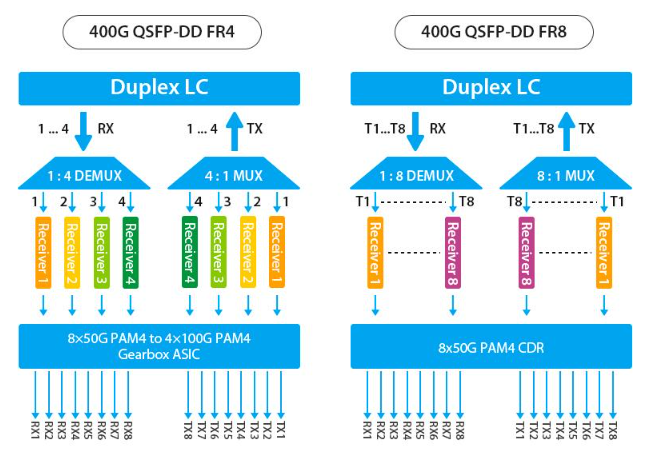
The baud rates of the 400G QSFP-DD FR4 fiber optic transceiver and 400G QSFP-DD FR8 fiber transceivers are 53.125 GBd and 26.5625 GBd, respectively. The maximum pulse interval (MPI) cost and chromatic dispersion (CD) cost of PAM4 gradually increase with the baud rate. Excessively high costs will make it difficult to maintain long-term reliable and stable operation, requiring more powerful forward error correction (FEC). However, the communication margin will not differ because both optical modules use KP4 FEC. Under the same KP4 FEC usage, the channel margin of the 400G QSFP-DD FR4 transceiver module exceeds 80%, while the channel margin of the 400G QSFP-DD FR8 transceiver module exceeds 90%, making the latter more reliable than the former.
The 400G QSFP-DD FR8 transceiver module improves the link budget. However, due to the use of more lasers, the total laser cost is higher, and the more complex optical packaging leads to lower yield and higher production costs. In contrast, the 400G QSFP-DD FR4 transceiver has lower power consumption and simpler thermal management capabilities.
The Difference in Latency Performance Between 400G QSFP-DD FR4 And 400G QSFP-DD FR8 Transceivers
Due to the use of an 8:4 gearbox, the 400G QSFP-DD FR4 optical transceiver exhibits poor latency performance, approximately 102ns; whereas the 400G QSFP-DD FR8 transceiver has a latency of only about 84ns. Therefore, the 400G QSFP-DD FR8 transceiver module offers better latency performance and is more suitable for scenarios requiring high-performance computing.
The 400G QSFP-DD FR4 and 400G QSFP-DD FR8 transceivers are suitable for various high-speed network transmission environments. However, in terms of power consumption and cost, the 400G QSFP-DD FR4 optical transceiver is more suitable for commercial data centers, while the 400G QSFP-DD FR8 fiber optic transceiver is more suitable for high-performance computing.
 5G 6G Fronthaul & Backhaul
View More
5G 6G Fronthaul & Backhaul
View More
 Data Center & Cloud Interconnect
View More
Data Center & Cloud Interconnect
View More
 Enterprise & Industrial Optical
View More
Enterprise & Industrial Optical
View More
 FTTx & Access Solutions
View More
FTTx & Access Solutions
View More
 Metro & Access Networks
View More
Metro & Access Networks
View More
 Optical Cabling Systems
View More
Optical Cabling Systems
View More
 Optical Transceivers & Interconnect
View More
Optical Transceivers & Interconnect
View More
 WDM & High-Capacity Transmission
View More
WDM & High-Capacity Transmission
View More
+86-755-21034367