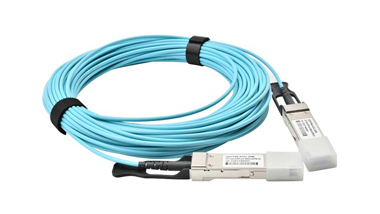

In data centers, enterprise networks, and high-performance computing environments, efficient and reliable interconnect solutions are crucial for achieving high-speed communication within and between racks. With the maturation of 400G technology, 400G direct attach cables suitable for short-distance interconnects have achieved large-scale commercial deployment, with 400G DAC (Direct Attach Cable) and 400G AOC (Active Optical Cable) becoming the mainstream choices.
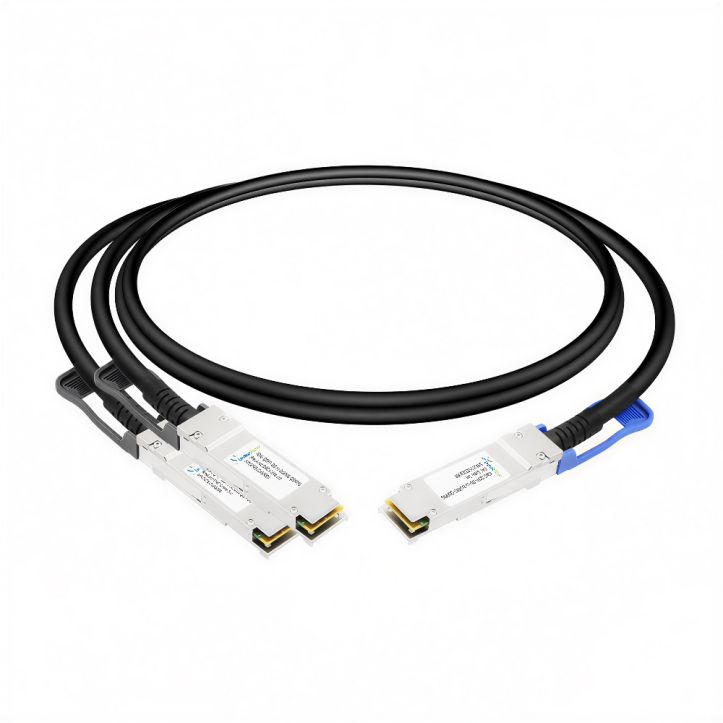
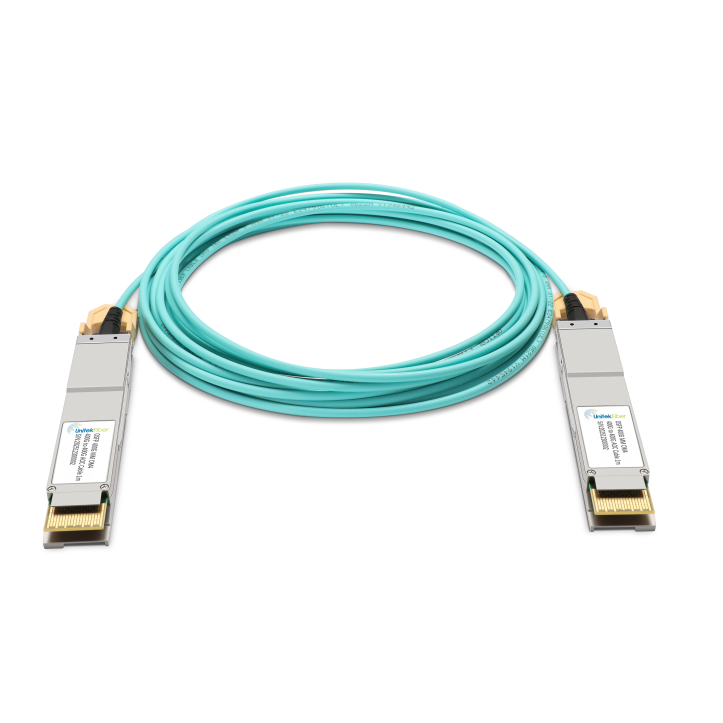
Currently, 400G DAC cable and AOC cable products on the market primarily utilize QSFP-DD and OSFP packaging formats, both based on PAM4 (four-level pulse amplitude modulation) electrical signal modulation technology, achieving a single-channel rate of 50Gbps and an overall 400G transmission. In addition to direct-connect cables, there are also branched configurations, such as one end with a single 400G interface and the other end with multiple lower-speed interfaces (e.g., 4×100G or 8×50G), maintaining a total bandwidth of 400G to enable flexible topology adaptation.
Discover more about AOC Vs DAC Cable.
Regarding transmission distance and medium, 400G direct attach cable uses copper cables for transmission, with a maximum distance generally not exceeding 3 meters; 400G aoc active optical cable uses fiber optic cables, reaching up to 70 meters with OM3 multimode fiber and even supporting 100 meters with OM4, making it suitable for a wider range of data center or cross-rack scenarios. In terms of physical characteristics, the fiber optic material makes AOC cables approximately half the size and one-quarter the weight of DAC cables, making them easier to route and manage. They also have a superior minimum bending radius, making them suitable for high-density deployment environments. In terms of anti-interference performance, AOC (Active Optical Cable) uses optical fiber as the transmission medium, possessing inherent electrical isolation characteristics and being immune to electromagnetic and lightning interference; DAC (Direct Attach Cable), which transmits electrical signals, requires shielding design in complex electromagnetic environments. What’ more, In terms of price, for the same packaging and performance level, AOC cable generally costs more than DAC cable . If the actual transmission distance is within 3 meters, DAC cable is the more cost-effective option.
Explore more about 400G DAC Cables and 400G AOC Cables
For detialed information about DAC cable: The Ultimate Guide to Direct Attach Copper (DAC) Cables
Currently, the market offers a wide variety of 400G direct attach cable types, covering various branch configurations; however, some types of 400G AOC active optical cables (such as QSFP-DD to 4×100G branch AOC Cables) have not yet been widely adopted. Users need to consider factors such as actual transmission distance, cabling environment, interference immunity requirements, and budget when making their selection.
PAM4 modulation technology is at the heart of 400G high-speed cables. Its baud rate utilization is twice that of traditional NRZ, significantly increasing bandwidth without requiring additional optical fibers. However, PAM4 is more sensitive to noise, so a DSP (digital signal processor) chip is typically introduced to perform functions such as clock recovery, equalization, noise suppression, and nonlinear compensation, ensuring signal integrity during high-speed, long-distance transmission.
Future Development And Scenarios with Higher Demands
Both DAC cable and AOC cable are cost-effective solutions for interconnecting equipment within the same rack or between adjacent racks. When the transmission distance exceeds 100 meters, 400G optical modules (such as QSFP-DD/OSFP) and multi-fiber patch cords (such as MTP/MPO-16) are required for connection. Currently, 400G optical modules have entered the mass commercialization stage, providing more comprehensive solutions for data center backbone interconnection and metropolitan area networks.
400G interconnect technologies, including DAC cable and AOC cable solutions, have become vital components in meeting the growing bandwidth demands of modern data centers, enterprise networks, and high-performance computing environments. While both technologies offer distinct advantages depending on factors such as transmission distance, environmental considerations, and cost constraints, their continued development, driven by advancements in PAM4 modulation and DSP technologies, promises to further enhance network performance and flexibility. As data traffic continues to surge and new use cases emerge, the evolution of 400G connectivity, with a combination of direct attach cable , aoc active optical cable will play a pivotal role in enabling the next generation of high-speed, reliable, and scalable networking infrastructure.
 5G 6G Fronthaul & Backhaul
View More
5G 6G Fronthaul & Backhaul
View More
 Data Center & Cloud Interconnect
View More
Data Center & Cloud Interconnect
View More
 Enterprise & Industrial Optical
View More
Enterprise & Industrial Optical
View More
 FTTx & Access Solutions
View More
FTTx & Access Solutions
View More
 Metro & Access Networks
View More
Metro & Access Networks
View More
 Optical Cabling Systems
View More
Optical Cabling Systems
View More
 Optical Transceivers & Interconnect
View More
Optical Transceivers & Interconnect
View More
 WDM & High-Capacity Transmission
View More
WDM & High-Capacity Transmission
View More
+86-755-21034367