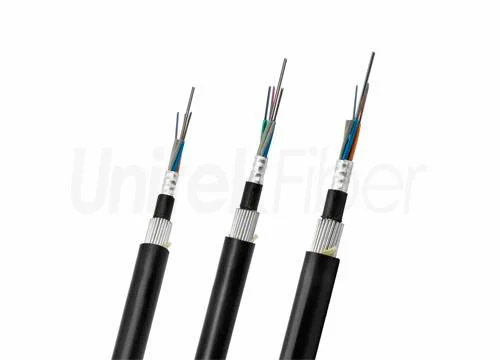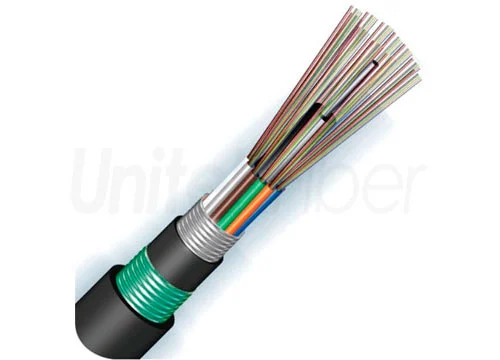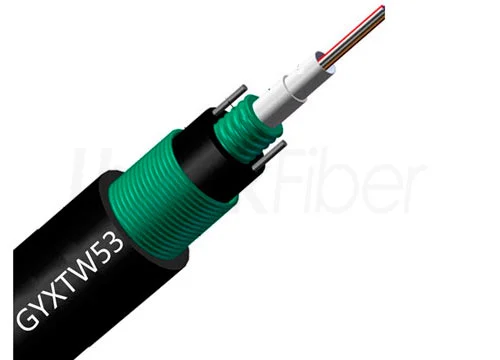

The proper burying of fiber optic cables requires meeting various requirements, including burial depth, trench preparation, cable laying, protective measures, labeling, and construction standards. The following are a detailed explanation:
General Burial Depth: The burial depth of underground fiber optic cables varies depending on geographical conditions, road surface type, traffic volume, and other factors. Generally, the burial depth in ordinary soil (hard soil) should be no less than 1.2 meters, in semi-rocky (gravelly soil, weathered stone) areas no less than 1.0 meter, and in fully rocky areas no less than 0.8 meters (calculated after adding a layer of fine soil or sand to the bottom of the trench). In quicksand areas, suburbs, and villages, the burial depth should be no less than 1.2 meters; on urban sidewalks, no less than 1.0 meter; when crossing railways or highways, the distance from the bottom of the ballast or the road surface should be no less than 1.2 meters; in ditches, canals, and ponds, no less than 1.2 meters; and in farmland drainage ditches, no less than 0.8 meters.
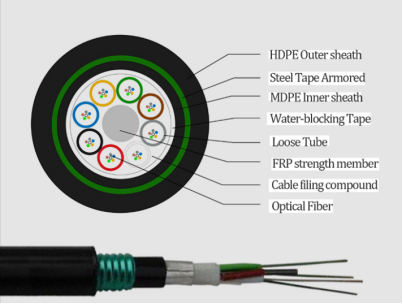
Special areas: In special areas, such as those with loose soil, susceptible to erosion by water currents, or with complex geological conditions, the burial depth may need to be appropriately increased, even up to around 1.5 meters, to ensure the safety of the fiber optic cable.
General area: The bottom of the trench should be flat, without debris such as gravel and hard soil clumps that could hinder the laying of the optic cable. In general areas, the bottom of the trench can be filled with fine soil or sand and then compacted. After compaction, its thickness will be approximately 250px (about 10 centimeters).
Weathered rock and gravel sections: In areas with weathered rock and gravel, a layer of mortar approximately 125 mm (about 5 cm) thick should be laid first, followed by fine gravel or sand, to ensure that the fiber optic cable is not damaged by the sharp edges of the gravel.
In areas with loose soil: In areas where the soil is loose and prone to collapse, temporary retaining walls made of wooden stakes and blocks can be used to protect against trench wall collapse and damage to the fiber optic cables.
Rocky and semi-rocky areas: In rocky and semi-rocky areas, a 100mm thick layer of fine soil or sand should be laid at the bottom of the trench and above the optic cable to protect the cable from direct pressure from rocks.
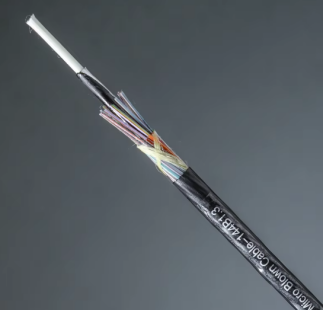
Installation Method of Fiber optic cable laying: Optical cables can be installed using mechanical pulling or manual lifting. Mechanical pulling is suitable for flat areas such as along roads, while manual lifting is suitable for areas with complex terrain or requiring precise handling. Regardless of the method used, dragging the optical cable is strictly prohibited to avoid damaging the outer protective layer of the cable.
Radius of curvature: During installation, the radius of curvature of the fiber cable should be strictly controlled to ensure it is no less than 15 times the outer diameter of the cable (static bending) or 20 times the outer diameter (dynamic bending), to prevent damage to the optic cable due to excessive bending.
Parallel trench laying: When multiple optical cables or electrical cables need to be laid in the same trench, ensure that they do not cross or overlap, and the parallel clearance between cables should not be less than 10 cm. Furthermore, electrical cables should be laid first, followed by fiber optic cables, and both should be arranged in parallel at the bottom of the trench.
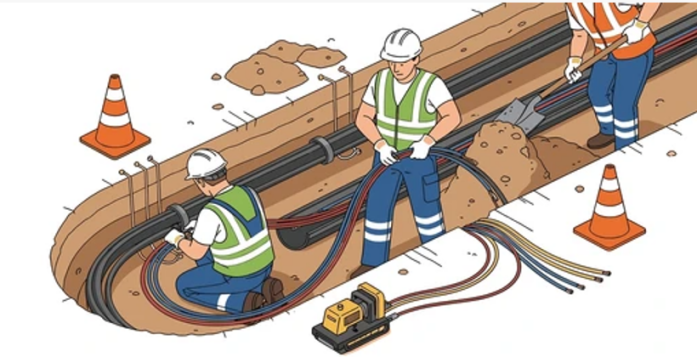
Crossing obstacles: When fiber optic cables need to cross obstacles such as railways, roads, or rivers, protective measures such as steel pipes, rigid plastic pipes, or reinforced concrete slabs should be used to prevent mechanical damage to the cables. The inner diameter of the steel pipe should be no less than 80mm, and 2 to 4 polyethylene plastic sub-pipes should be inserted inside to enhance protection.

Special terrain handling: When laying optical cables on slopes with a gradient greater than 20 degrees and a length greater than 330 meters, an "S" shaped laying method or other measures as required by the design should be adopted to reduce the tension on the fiber optic cable. In areas susceptible to water erosion, protective measures such as spillways and retaining walls should be installed.
Lightning protection measures: In areas prone to lightning strikes, lightning protection measures should be implemented, such as installing lightning rods and grounding wires, to protect the fiber optic cables from lightning damage.
Marker stone setting: Markers stones should be placed at cable joints, turning points, reserved cable lengths, or intersections with other pipelines to facilitate future maintenance and repair. Markers stones can be made of sturdy stone or reinforced concrete. In general areas, standard markers (1000 × 140 × 140 mm) are used, while longer markers stones(1500 × 140 × 140 mm) are used in areas with loose soil or on slopes.
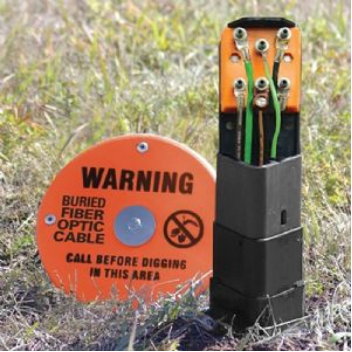
Documentation and record-keeping: In addition to setting up marker posts, permanent structures near the fiber optic cable can also be used as markers. Measure the distance between a specific point on the structure and the fiber optic cable and record this information for future reference.
Pre-construction training: Before laying the fiber optic cables, the construction personnel and other relevant staff should receive appropriate training on important aspects of the construction process, such as cable laying techniques and safety procedures. It is also essential to ensure that all construction personnel follow instructions.
Construction Drawing Verification: Verify whether the specific routing, laying method, environmental conditions, and splice locations of the fiber cable conform to the construction drawing design. Also verify the ground distance and repeater section length, as well as the specific locations and protective measures required for sections where the fiber optic cable crosses obstacles.
Safe Construction Practices: During the construction process, safety regulations must be strictly followed to ensure the safety of personnel and equipment. For example, before excavating cable trenches, a chalk line should be laid along the route to mark the excavation location; the pulling speed and tension should be controlled during mechanical pulling; and after the optical cables are laid, the trenches should be backfilled and compacted promptly.
The burying of fiber optic cables requires meeting various requirements. If you have any questions or need assistance, please feel much free to contact us at Email sales@unitekfiber.com
 5G 6G Fronthaul & Backhaul
View More
5G 6G Fronthaul & Backhaul
View More
 Data Center & Cloud Interconnect
View More
Data Center & Cloud Interconnect
View More
 Enterprise & Industrial Optical
View More
Enterprise & Industrial Optical
View More
 FTTx & Access Solutions
View More
FTTx & Access Solutions
View More
 Metro & Access Networks
View More
Metro & Access Networks
View More
 Optical Cabling Systems
View More
Optical Cabling Systems
View More
 Optical Transceivers & Interconnect
View More
Optical Transceivers & Interconnect
View More
 WDM & High-Capacity Transmission
View More
WDM & High-Capacity Transmission
View More
+86-755-21034367