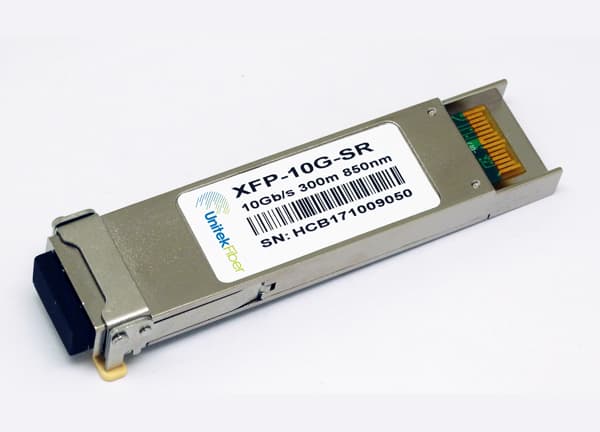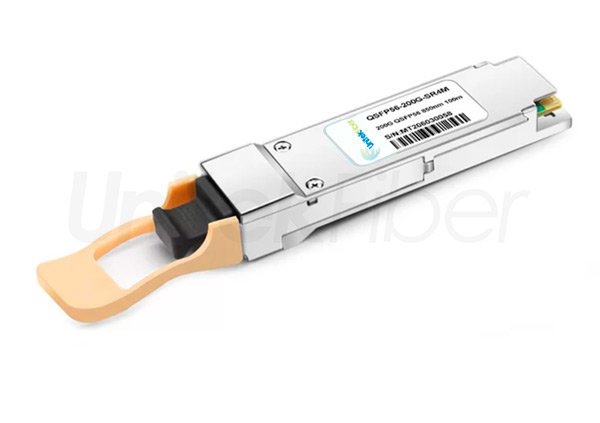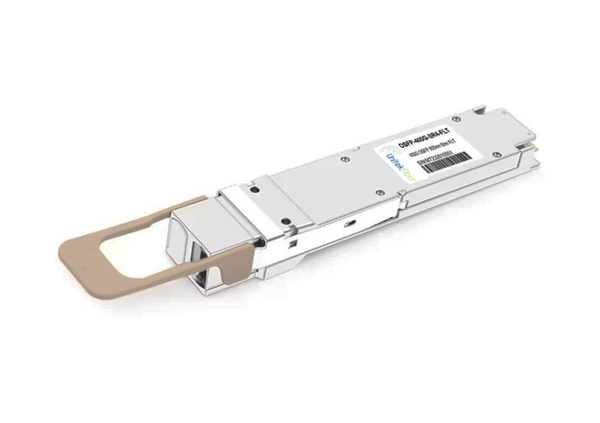

Transceiver modules are available in various types, differentiated by their key performance characteristics as well as their specific intended use cases. Common characteristics used to classify fiber optic transceivers include: fiber mode, transmission rate, transmission distance, wavelength, and connector type. These categories will be discussed in more detail below.
Fiber optic transceiver modules with similar characteristics are further grouped and classified into different package types, also known as form factors. Currently, there are eight commonly used fiber transceiver form factors: 1.25G SFP, 10G SFP+, 25G SFP28, 40G QSFP+, 100G QSFP28, 200G QSFP56, 400G OSFP, 800G OSFP etc. The QSFP 40G to QSFP-DD 400G transceiver are becoming increasingly popular.
The most basic classification of fiber optic transceivers is perhaps based on the "mode type" of the optical fiber they use. Fiber optic mode types are mainly divided into two categories: multimode fiber and single-mode fiber. Multimode fiber typically has a core diameter between 50 and 62.5 micrometers, which is much larger than that of single-mode fiber, whose core diameter is approximately 8 to 9 micrometers.
Due to its larger core diameter, multimode fiber allows multiple modes of light to be coupled into the fiber. These different light modes travel at slightly different speeds within the fiber. The result is pulse "spreading", which is known as modal dispersion. This dispersion, unique to multimode fiber, severely limits the transmission distance of multimode fiber, a limitation not present in single-mode fiber. Because multimode applications are typically for short-distance transmission, multimode transceivers usually use very inexpensive transmitters and receivers. Therefore, although the price of multimode fiber itself does not differ significantly from that of single-mode fiber, the price of multimode transceivers is typically only a fraction of the price of single-mode transceivers.
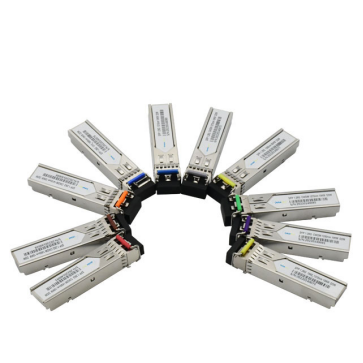
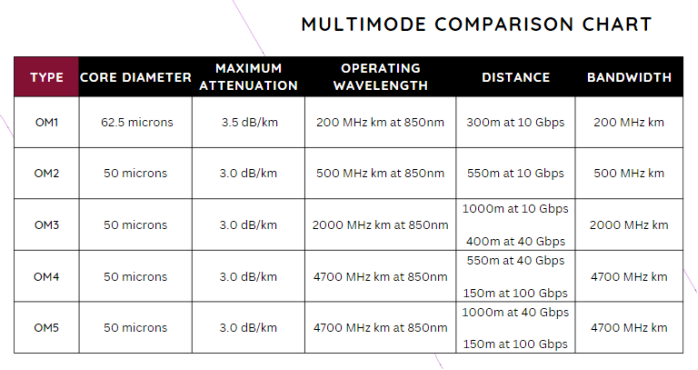
As shown in the table below, there are several commonly used types of multimode fiber. OM1 and OM2 fibers are suitable for low-speed transmission, such as 100 Mbps to 1 Gbps, and typically use LED transmitters. OM3 and OM4 are referred to as laser-optimized multimode fibers because they use lasers as the light source at speeds of 10 Gbps and higher.
As the name suggests, single-mode fiber allows only one light mode to be coupled into the fiber core. This completely eliminates modal dispersion problems. Single-mode fiber transmission is limited by several other forms of dispersion, particularly chromatic dispersion and polarization mode dispersion. However, these dispersion effects are "much weaker," allowing single-mode fiber to support transmission distances several orders of magnitude longer than multimode fiber.
The most common type of single-mode fiber is designated "OS1" by the ITU, and is also known as "standard single-mode fiber." While other types of single-mode fiber exist (such as dispersion-shifted fiber and non-zero dispersion-shifted fiber), most optical transceivers are specified for use with OS1 fiber.
Finally, it's important to note that multimode transceivers are almost impossible to use successfully with single-mode fiber, even for short distances. Single-mode light sources can work over short distances on multimode fiber, but they are more expensive, making their use in these applications impractical.
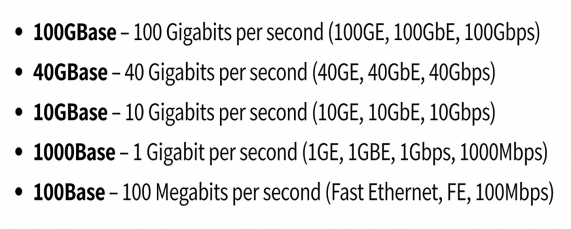
Fiber optic transceiver modules are typically classified according to their data transmission rate. There are five common rate categories used in fiber optic transceiver classification: 100GBase, 40GBase, 10GBase, 1000Base, and 100Base. These rates refer to the speed at which the fiber transceiver transmits data over Ethernet.
There are other transmission rate levels associated with specific market segments. Common rates for Fibre Channel (historically used for high-speed supercomputer interconnects and Storage Area Networks (SANs)) include: 1Gbps, 2Gbps, 4Gbps, 8Gbps, and 16Gbps. Telecommunications networks have used SONET/SDH multiplexing hierarchies for many years, with optical transmission rates including: 155Mbps, 622Mbps, 2.488Gbps, 9.953Gbps, and 39.813Gbps.
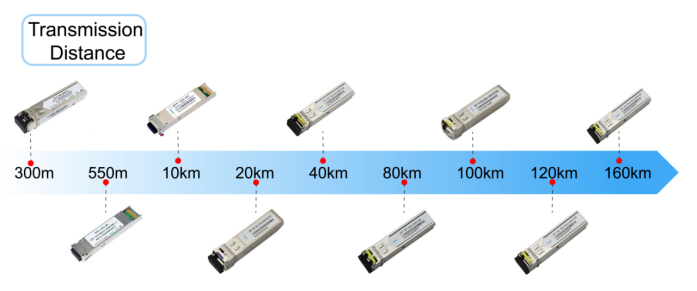
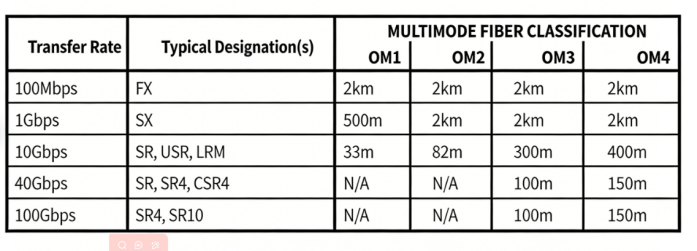
Not every fiber optic transceiver module supports the same data transmission distance. As we pointed out previously, the core distinction comes down to multimode versus singlemode variants. For multimode deployments, the transfer distance is impacted by two key factors: transmission speed and the exact fiber type used. On the singlemode side, however, transmission speed is the overriding factor that dictates the maximum reach.
Multimode applications are typically categorized as "short-range," usually using the "SR" naming convention (earlier 100Mbps applications used "FX," and 1Gbps transceivers typically use "SX"). Some multimode transceivers on the market are advertised as "long-range multimode" or "LRM," offering slightly longer transmission distances than SR devices, but product specifications vary considerably between different vendors, and they still fall under the category of short-range modules. The table below shows typical transmission distances at common data rates on the four most common types of multimode fiber. The table also provides common (but not exhaustive) identifiers used to describe (and sometimes name) these devices.
Single-mode applications on OS1 grade fiber optic cables can cover longer distances. The table below shows the typical transmission distances supported at commonly used transmission rates.
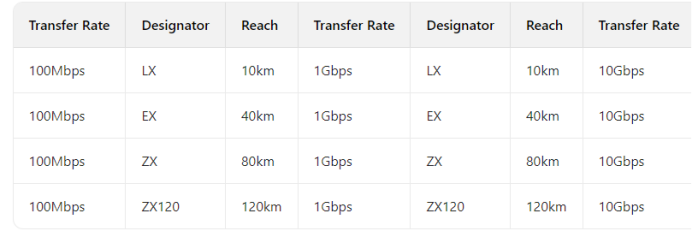
Remark: Transmission distances of several thousand kilometers can be achieved using devices such as optical amplifiers and dispersion compensators. The engineering design of such links is highly specialized and beyond the scope of this article.
Fiber optic networks use infrared light to transmit data. Wavelength is the distance between adjacent peaks in a light wave. Fiber optic transceiver modules typically transmit data at one of three main wavelengths: 850nm, 1310nm, or 1550nm.
These three wavelengths are so commonly used for two reasons: 1) Fiber optic attenuation is much lower at these wavelengths; and 2) The National Institute of Standards and Technology (NIST) provides metrological calibration for fiber optic testing at these wavelengths.
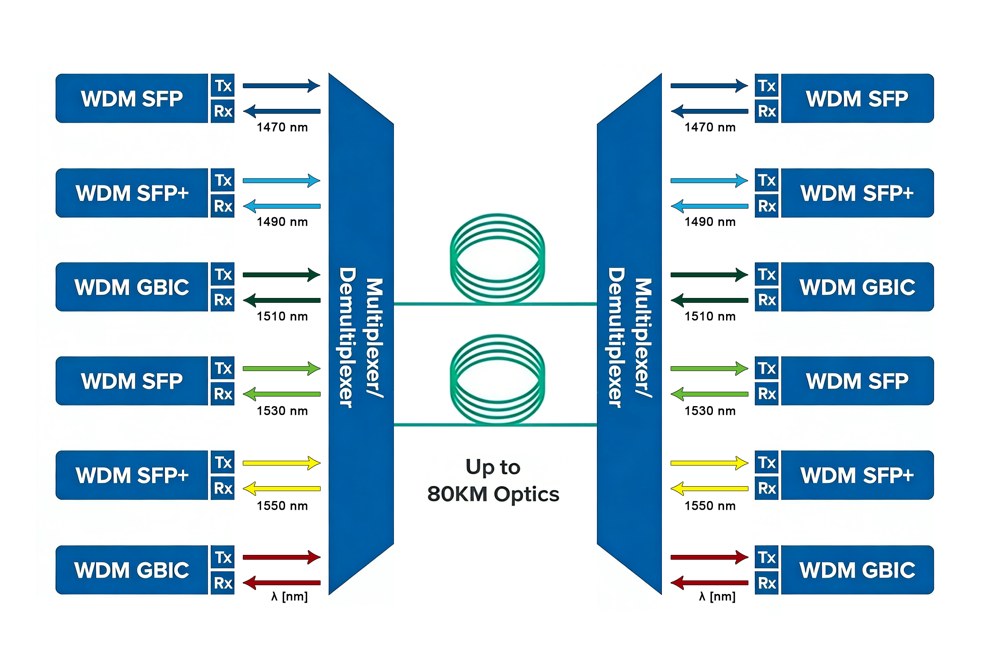
Multimode fiber is designed for 850nm and 1300nm wavelengths, while single-mode fiber is optimized for 1310nm and 1550nm wavelengths. In the single-mode domain, using precisely manufactured transmitters, finer wavelength division can be achieved within the 1310nm and 1550nm "windows." The two most common and standardized schemes are CWDM (Coarse Wavelength Division Multiplexing) and DWDM (Dense Wavelength Division Multiplexing).
CWDM has a wavelength spacing of 20nm and can be used in the 1310nm window, but is more commonly used in the 1550nm window, as shown in the table below.
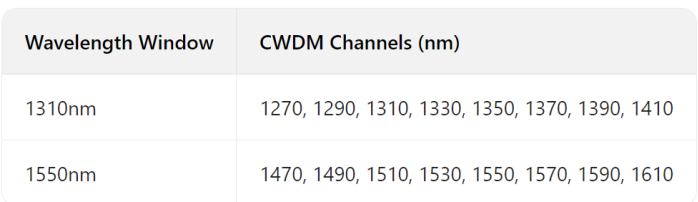
As the name suggests, DWDM schemes have much denser wavelength spacing than CWDM schemes. The spacing of DWDM channels is typically described using the frequency of light (rather than wavelength in nm). The most common standard channel spacings for DWDM are 25GHz, 50GHz, and 100GHz, with 100GHz being the most widely used. These channels are allocated within the frequency range of 190.1 THz to 197.2 THz, or expressed in wavelengths, ranging from 1577.03 nm to 1520.25 nm.
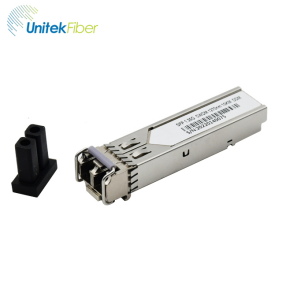
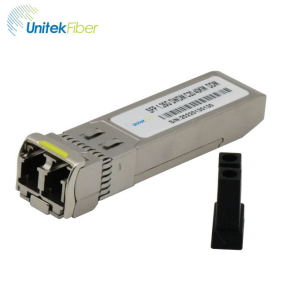
In CWDM and DWDM systems, each optical transceiver transmits at its specific wavelength and connects to a wavelength division multiplexing device. These devices combine/separate multiple wavelengths (or colors) of optical signals onto a single fiber or fiber pair. CWDM systems are popular due to their cost-effectiveness, even for relatively short transmission distances, especially when the number of fibers is limited and adding more fibers is expensive. DWDM systems are widely used in long-distance transmission systems that require multiple amplification and dispersion compensation. Erbium-doped fiber amplifiers (EDFAs) and dispersion compensators can operate on all DWDM channels simultaneously, without the need to demultiplex and fully regenerate each channel approximately every 80 kilometers.
Fiber optic connectors are used to connect and align optical transceivers, allowing optical signals to be transmitted through the fiber core. Optical transceiver modules can be classified according to their connector type. Currently, there are four main types of fiber optic connectors used with optical transceivers: SC, LC, MPO, and ST.
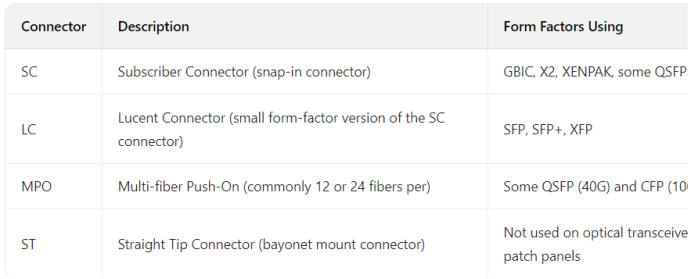
Most optical transceivers adopt duplex connectors, with one port assigned to signal transmission and the other to reception. Bi-Directional (BiDi) optical transceivers, by comparison, are deployed in matched pairs, with each unit transmitting on a unique wavelength (such as 1310nm and 1490nm). A built-in 2-channel wavelength division multiplexer is included in every BiDi transceiver to enable the separation and combination of these dual wavelengths.
For the new QSFP and CFP modules that use MPO connectors, there is only one connector, but as shown in the table above, each connector may contain 12 or 24 fibers, with each fiber connected to an independent transmitter/receiver inside the optical transceiver.
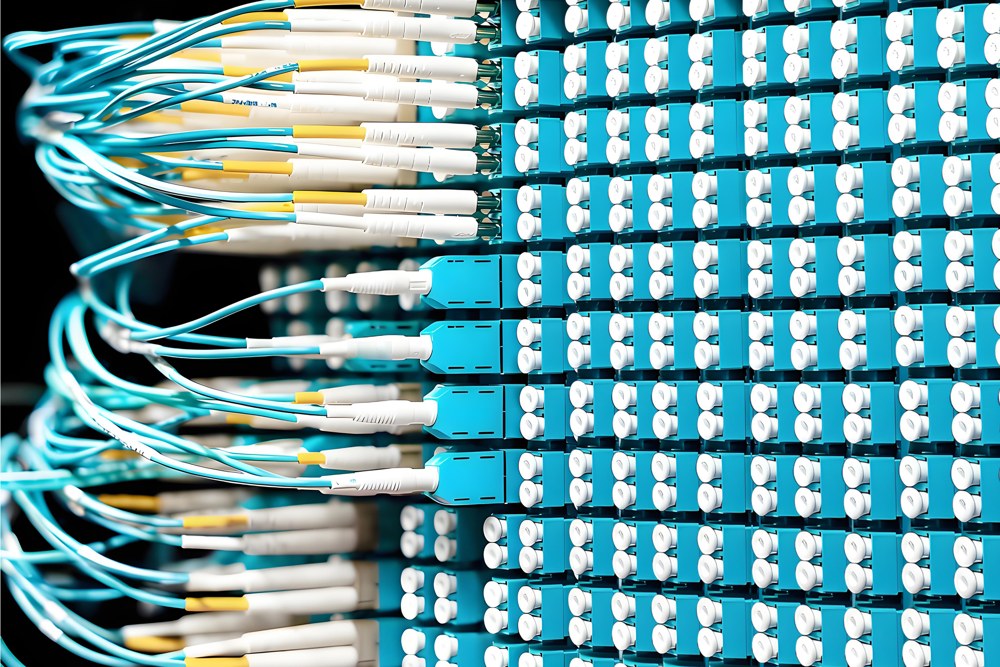
Connector types typically follow a color coding system. Yellow indicates compatibility with single-mode fiber. Connector types compatible with multi-mode fiber are orange, black, or gray. If a protective boot is used on the connector, a blue boot indicates compatibility with single-mode fiber, and a beige boot indicates compatibility with multi-mode fiber.
Fiber optic transceivers are classified by fiber mode, data rate, transmission distance, wavelength, and connector type, with various common form factors. Understanding these categories helps select the right transceiver for specific requirements. As a leading for fiber optic solutions, Unitekfiber offers a full range of optical transceivers, such as 1.25G SFP, 10G SFP+, 25G SFP28, 40G QSFP+, 100G QSFP28, 200G QSFP56, 400G OSFP, 800G OSFP etc, Shop with us for your fiber optic business requires. Please contact us at Email sales@unitekfiber.com, if you have any inquiry or need any need.
 5G 6G Fronthaul & Backhaul
View More
5G 6G Fronthaul & Backhaul
View More
 Data Center & Cloud Interconnect
View More
Data Center & Cloud Interconnect
View More
 Enterprise & Industrial Optical
View More
Enterprise & Industrial Optical
View More
 FTTx & Access Solutions
View More
FTTx & Access Solutions
View More
 Metro & Access Networks
View More
Metro & Access Networks
View More
 Optical Cabling Systems
View More
Optical Cabling Systems
View More
 Optical Transceivers & Interconnect
View More
Optical Transceivers & Interconnect
View More
 WDM & High-Capacity Transmission
View More
WDM & High-Capacity Transmission
View More
+86-755-21034367