
ADSS (All-Dielectric Self-Supporting) cables are the optimal aerial fiber solution for 4G/5G backhaul, providing lightning immunity, long spans up to 300m, and 30% lower installed cost versus lashed cables.
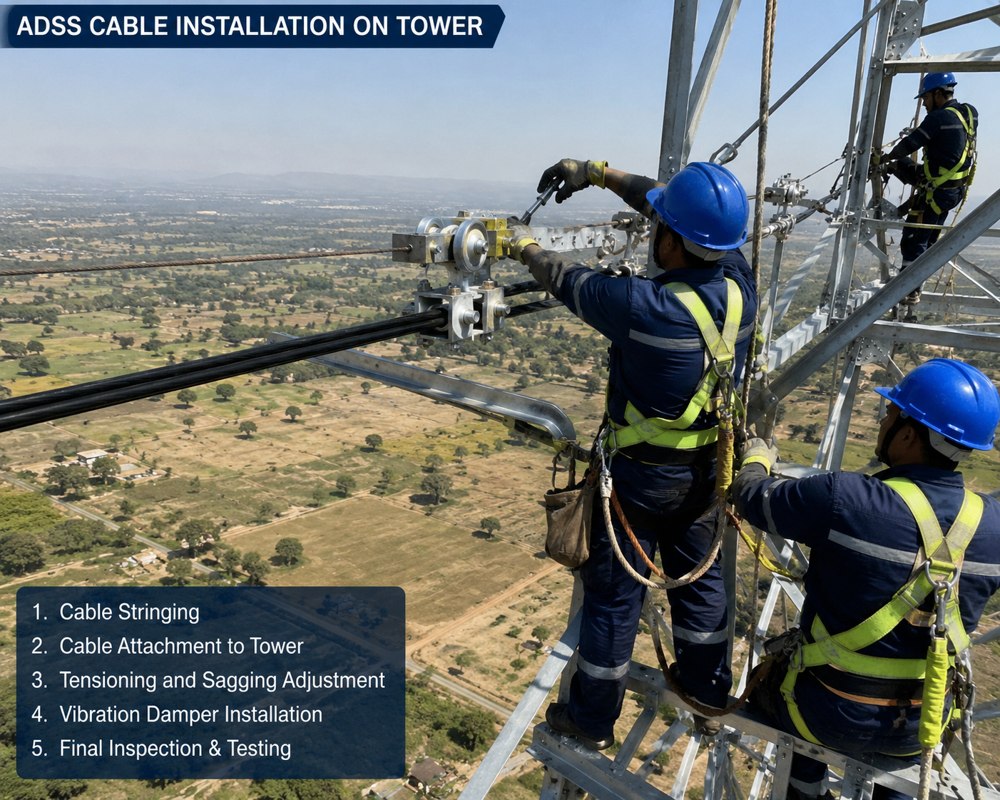
ADSS eliminates messenger wire, reducing weight and installation time by 25–30%.
All-dielectric design provides inherent lightning protection, reducing downtime.
Supports fiber counts up to 288 for high-density 5G x-haul.
Compliant with IEC 60794‑1‑2 for robust tensile performance [3].
Proper sag and tension design extends cable lifespan beyond 25 years.
4G and 5G networks demand high-capacity backhaul that can scale with data traffic. According to the Telecommunications Industry Association (TIA) 2024 report, 5G backhaul requires at least 10 Gbps per cell site, a demand that ADSS cables meet with ease [1]. These all-dielectric cables are designed for aerial installation without a separate metallic messenger, offering a lightweight and corrosion-proof solution critical for tower environments. The Fiber Optic Association (FOA) notes that ADSS now represents over 40% of new aerial fiber installations in North America [2].
| Parameter | ADSS Cable | OPGW Cable | Lashed Aerial Cable |
|---|---|---|---|
| Max Span (m) | 100–300 | 200–500 | 50–100 |
| Tensile Strength (kN) | 8–20 | 40–100 | 2–5 |
| Weight (kg/km) | 50–150 | 200–600 | 80–200 |
| Lightning Immunity | Excellent | Fair | Poor |
| Installation Cost ($/km) | 2,000–4,000 | 4,000–8,000 | 3,000–5,000 |
| RoHS/LSZH Options | Yes | No | Yes |
ADSS cables offer an excellent balance of performance and cost for 4G/5G backhaul, particularly in areas with high lightning activity where OPGW requires grounding and lashed cables are prone to damage [4].
View video about What is ADSS Fiber Optic Cable
Maximum span length depends on cable weight, tensile strength, and environmental loads. For a 48‑fiber ADSS cable, the typical span is 200 m under wind speeds of 35 m/s and ice loads of 5 mm, as per TIA‑222‑H [5]. Longer spans require thicker aramid yarn reinforcement, increasing cable diameter and cost. Sag should be maintained between 2% and 5% of span to avoid excessive tension and wind-induced vibrations.
ITU‑T G.652.D is the standard single‑mode fiber with low attenuation (≤0.20 dB/km at 1550 nm) and is ideal for long‑haul spans. G.657.A2 offers bend‑insensitivity (minimum bend radius 7.5 mm) critical for tower connections and patch panel routing. For 5G fronthaul CPRI/eCPRI links, G.657.A2 is recommended in approximately 30% of cases where tight bends are unavoidable [6].
Proper installation is crucial for long‑term reliability. The maximum pulling tension should not exceed 80% of the rated tensile load (e.g., for a 12 kN cable, limit to 9.6 kN) [7]. Use pulleys with minimum diameter of 30× cable diameter to prevent microbending losses. Pre‑stressing the cable to remove slack is recommended for spans over 150 m.
According to a 2022 study by Prysmian Group, improper tensioning accounts for 60% of premature ADSS failures [8]. Always verify sag using laser range finders or tension gauges during installation.
ADSS cables provide a proven, future‑proof aerial fiber solution for 4G/5G backhaul and x‑haul. Their all‑dielectric construction, long‑span capability, and low total cost of ownership make them the preferred choice for system integrators. For evolving 5G architectures, selecting the right fiber (G.652.D or G.657.A2) and adhering to proper installation practices are essential to maximize network reliability and lifespan.
Learn more about How Optical Transceiver Power the 5G Fronthaul Networks?
TIA, "5G Backhaul Requirements Report," Telecommunications Industry Association, 2024.
Fiber Optic Association, "FOA State of the Market 2023," 2023.
IEC 60794‑1‑2, "Optical fibre cables – Part 1‑2: Generic specification – Basic optical cable test procedures," International Electrotechnical Commission, 2019.
IEEE, "A Survey on 5G Backhaul Networks," IEEE Communications Surveys & Tutorials, vol. 24, no. 3, 2022.
TIA‑222‑H, "Structural Standard for Antenna Supporting Structures and Antennas," Telecommunications Industry Association, 2022.
ITU‑T Recommendation G.657, "Characteristics of a bend‑insensitive single‑mode optical fibre and cable," International Telecommunication Union, 2016.
Corning Optical Communications, "ADSS Application Guide," 2021.
Prysmian Group, "ADSS Cable Design for Extreme Weather," 2022.
IEC 60794‑1‑1, "Optical fibre cables – Part 1‑1: Generic specification – General," 2018.
5G Americas, "5G Transport Network Requirements," White Paper, 2023.
OFS, "All‑Dielectric Self‑Supporting Cables Technical Note," 2020.
ISO 9001:2015, "Quality management systems," International Organization for Standardization.
ADSS cables can typically span between 100 to 300 meters depending on fiber count, cable diameter, and environmental conditions. For example, a standard 48‑fiber ADSS cable supports up to 200 meters under moderate wind loads (35 m/s) according to IEC 60794‑1‑1 [9].
ADSS cables are all‑dielectric, meaning they contain no metallic components. This eliminates the risk of lightning strikes traveling along the cable, providing inherent immunity and reducing grounding requirements. In regions with high flash density, ADSS reduces maintenance costs by up to 40% compared to OPGW [10].
For 5G x‑haul, both ITU‑T G.652.D (standard single‑mode) and G.657.A2 (bend‑insensitive) fibers are recommended. G.657.A2 is advantageous in tight bends near towers, while G.652.D offers lower attenuation for longer spans. A study by OFS found that using G.657.A2 in 5G front‑haul reduces splice losses by 0.1 dB per connection [11].
 5G 6G Fronthaul & Backhaul
View More
5G 6G Fronthaul & Backhaul
View More
 Data Center & Cloud Interconnect
View More
Data Center & Cloud Interconnect
View More
 Enterprise & Industrial Optical
View More
Enterprise & Industrial Optical
View More
 FTTx & Access Solutions
View More
FTTx & Access Solutions
View More
 Metro & Access Networks
View More
Metro & Access Networks
View More
 Optical Cabling Systems
View More
Optical Cabling Systems
View More
 Optical Transceivers & Interconnect
View More
Optical Transceivers & Interconnect
View More
 WDM & High-Capacity Transmission
View More
WDM & High-Capacity Transmission
View More
+86-755-21034367