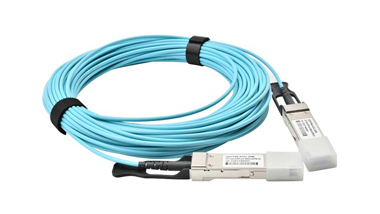

Nowadays, high-performance and cost-effective solutions are the preferred choice for user network deployments. For short-distance 40G network deployments, QSFP+ direct attach cables and QSFP+ AOC active optical cables offer low cost and high efficiency, and are widely used in enterprise networks and data centers, for example, in connections between switches and servers. So how much do you know about these two types of cables? What are the differences between QSFP+ DAC cables and AOC active optical cables? How do these two types of cables differ from the QSFP+ optical modules that connect optical fibers? Read this article to find the answers.
The 40G QSFP+ DAC cable is a high-speed biaxial cable with QSFP+ connectors at both ends. This cable primarily uses silver-plated conductors, physically foamed polyolefin insulated core wires, and pair shielding or overall shielding. Typically, the wire gauge (copper cable diameter) of shielded cables is between 24 and 30 AWG. Since a higher wire gauge number indicates a higher grade of bore and a smaller wire diameter, longer DAC cables generally have smaller wire gauges. This effectively reduces signal transmission loss; in other words, a smaller wire gauge number allows for a longer transmission distance.
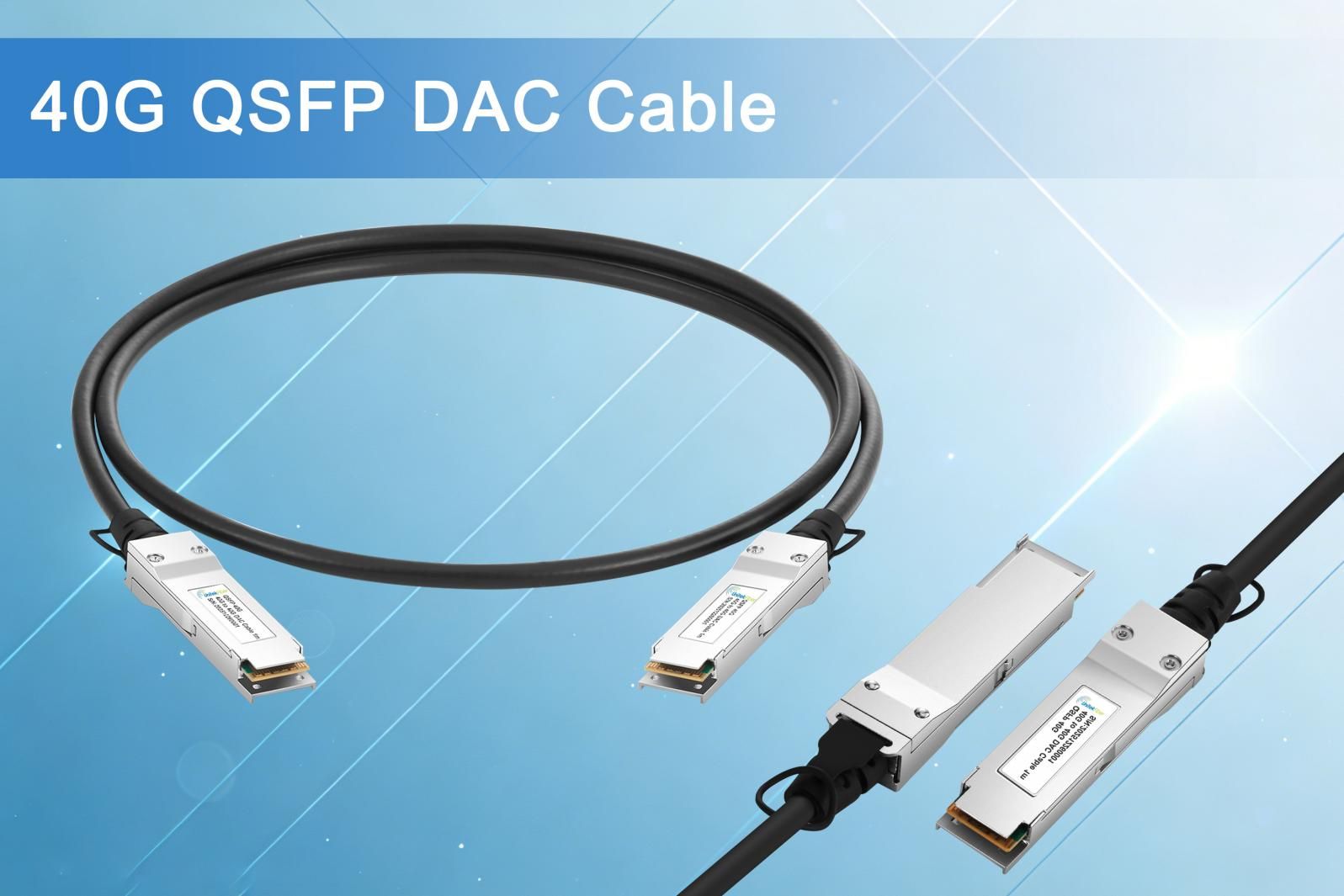
QSFP+ direct attach cables come in two types: active and passive. Passive QSFP+ DAC cables do not have a driver chip, so they can transmit signals without electrical power, and they do not amplify or equalize the signal during transmission. Typically, the maximum transmission distance of passive QSFP+ DAC cables is 7 meters, while active QSFP+ DAC cables have a driver chip that can perform signal conditioning, so their transmission distance is slightly longer, approximately 10 meters or even longer. Currently, QSFP+ DAC cables on the market include two types: 40G QSFP+ to QSFP+ DAC cables and 40G QSFP+ to 4*SFP+ branch cables. These two types of QSFP+ DAC direct attach cables have different application scenarios. The QSFP+ to QSFP+ DAC direct attach cable is mainly used for short-distance 40G link direct connections, such as direct connections between a 40G switch and a 40G network card; while the QSFP+ to 4*SFP+ branch DAC cable can split a 40G signal into four 10G signals, therefore it is mainly used for 10G to 40G network upgrades.
QSFP+ AOC active optical cables consist of optical fibers and two QSFP+ connectors (one at each end). The optical fibers in QSFP+ active optical cables are multimode fibers, and the QSFP+ connections on the cables are actually QSFP+ optical modules. Therefore, the structure and price of QSFP+ AOC cables are more complex and expensive than QSFP+ DAC cables. QSFP+ AOC active optical cables require an external power supply to achieve the conversion between electrical and optical signals, and the maximum transmission distance is up to 100 meters.
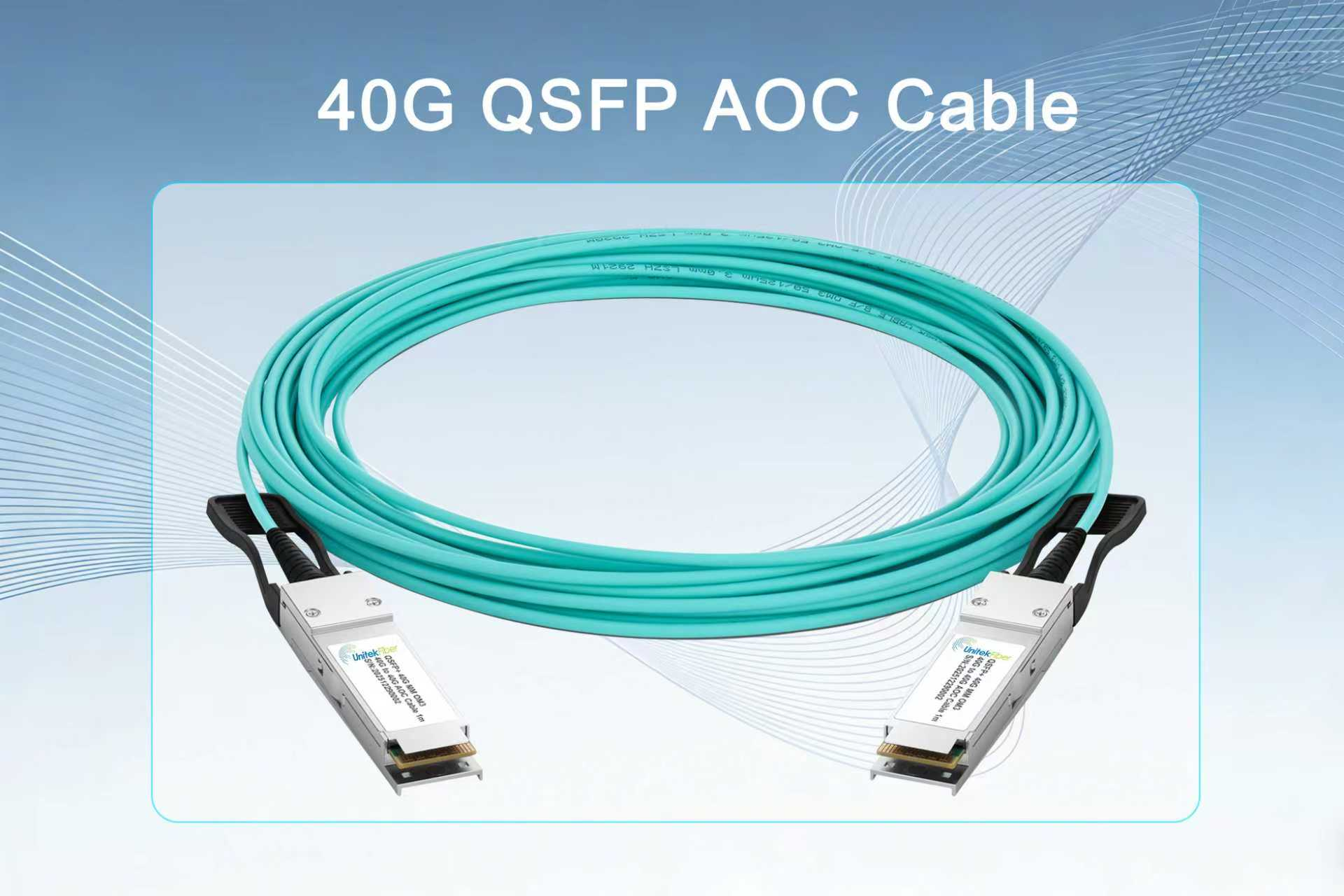
Currently, the industry has launched various QSFP+ active optical cables for different 40G transmission application scenarios, including three main types: 40G QSFP+ AOC active optical cables, 40G QSFP+ to 4*SFP+ active branch optical cables, and 40G QSFP+ to 8*LC active branch optical cables (i.e., 40G QSFP+ to 4*duplex LC active branch optical cables). QSFP+ AOC cable is a cost-effective solution for interconnecting two 40G switches; 40G QSFP+ active branch optical cable is suitable for 10G-40G network upgrades. Note that a 40G QSFP+ to 8*LC active branch optical cable requires four 10G SFP+ optical modules connected to an LC duplex connector, as shown in the diagram below:
QSFP+ DAC cables and QSFP+ AOC cables differ in design and structure, and also in the following aspects.
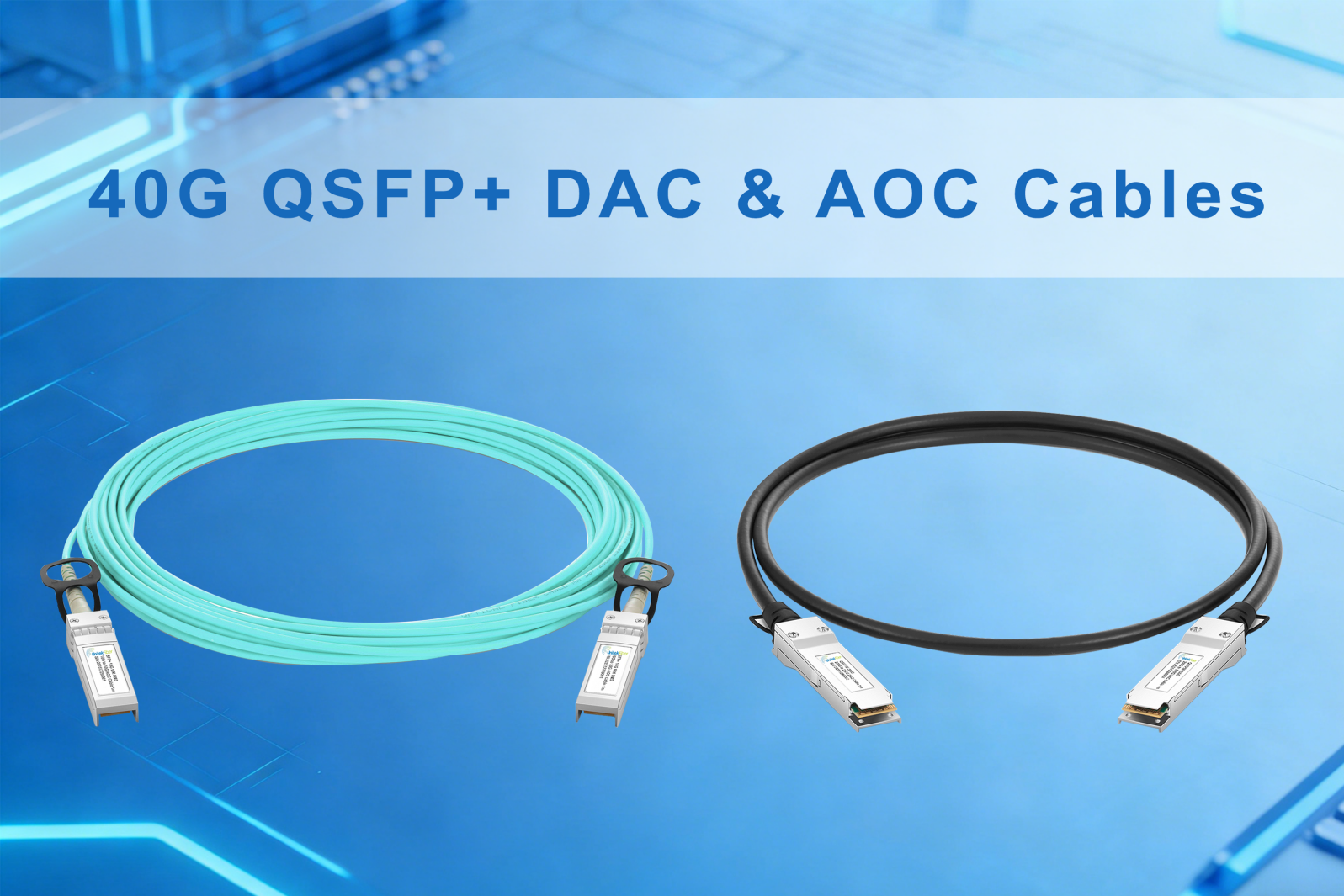
Due to the different structures of QSFP+ DAC cables and QSFP+ AOC cables, their working principles differ. Both passive and active QSFP+ DAC direct attach cables can use copper cables for signal transmission. Passive QSFP+ direct attach cables can transmit directly without signal conditioning, while active QSFP+ DAC cables have an internal driver chip that amplifies the signal before transmission. QSFP+ active optical cables, on the other hand, use optical fiber for signal transmission, and they require an external power supply to convert the electrical signal to an optical signal and then back to an electrical signal.
As shown above, QSFP+ AOC active optical cable transmits signals via optical fiber, while QSFP+ DAC direct attach cables transmits signals via copper cable. Therefore, QSFP+ AOC cable has a stronger transmission capacity than QSFP+ DAC cable, with a maximum transmission distance of approximately 100 meters. At the same time, QSFP+ AOC has a smaller bending radius, making cabling more flexible.
If you want to get more ingormation about the difference between AOC cable and DAC cable, go to AOC Vs DAC Cable.
Both QSFP+ DAC cables and QSFP+ AOC active optical cables provide efficient solutions for short-distance 40G network interconnections, but they are designed for different deployment needs. QSFP+ DAC cables are ideal for very short distances due to their lower cost, simple structure, and low power consumption, making them widely used for connections within racks or between nearby devices. In contrast, QSFP+ AOC cables support longer transmission distances and offer greater flexibility in cabling, making them suitable for connections across racks or within larger data center environments. You can choose the most suitable option based on distance requirements, cost considerations, and deployment scenarios. UnitekFiber is a professional supplier of AOC (Active Optical Cable) and DAC (Direct Attach Cable) high-speed cables, specializing in data center and high-speed interconnect solutions. Our company primarily offers high-speed interconnect products such as 10G/25G/40G/100G/200G/400G, widely used in data centers, cloud computing, servers, storage, and network equipment interconnection scenarios.
Explore more about 400G DAC Cables and 400G AOC Cables, Applications of AOC Cables and DAC Cables in Data Centers.
 5G 6G Fronthaul & Backhaul
View More
5G 6G Fronthaul & Backhaul
View More
 Data Center & Cloud Interconnect
View More
Data Center & Cloud Interconnect
View More
 Enterprise & Industrial Optical
View More
Enterprise & Industrial Optical
View More
 FTTx & Access Solutions
View More
FTTx & Access Solutions
View More
 Metro & Access Networks
View More
Metro & Access Networks
View More
 Optical Cabling Systems
View More
Optical Cabling Systems
View More
 Optical Transceivers & Interconnect
View More
Optical Transceivers & Interconnect
View More
 WDM & High-Capacity Transmission
View More
WDM & High-Capacity Transmission
View More
+86-755-21034367