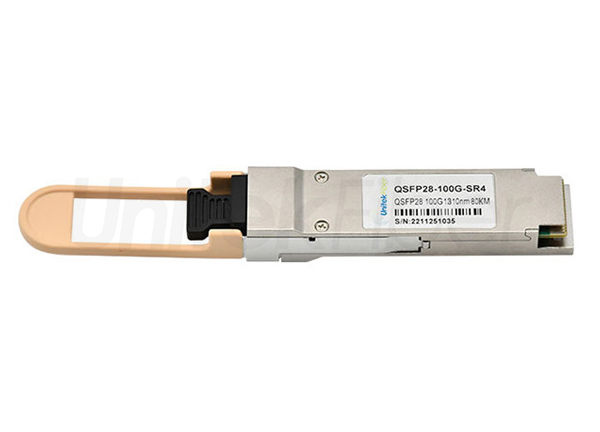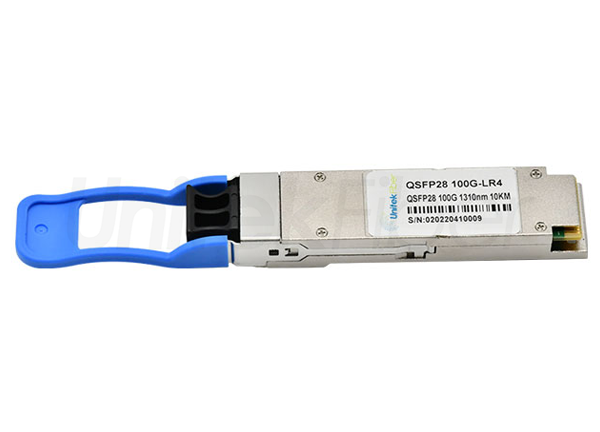

In 2025, amidst the booming development of AI computing power and cloud computing, high-speed data center interconnects are facing new challenges and opportunities.
With the rapid development of AI training, cloud computing, and networks, the global volume of data is growing exponentially, and the demand for high-speed data transmission in data centers is becoming increasingly urgent. Against this backdrop, 400G optical transceiver modules have become mainstream in the market, and among them, the 400G QSFP112 FR4 optical transceiver, with its high performance, low power consumption, and strong compatibility, is emerging as a key product for next-generation optical interconnects.
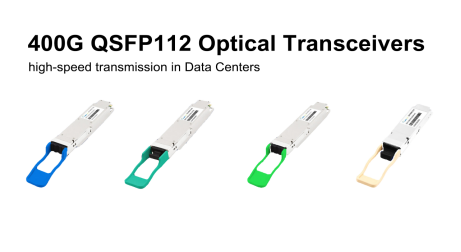
The 400G QSFP112 FR4 is a high-speed fiber optic transceiver module based on the QSFP112 form factor, supporting a transmission rate of 400Gbps (400 gigabits per second) and utilizing the FR4 (Four Wavelengths over 2km) transmission standard.
It is primarily intended for high-speed optical links in data center backbone networks and between switches and routers.
Compared to traditional 400G QSFP-DD fiber transceivers, the QSFP112 offers higher signal rate capabilities, reaching 112Gbps PAM4 per channel, with a more compact interface and better compatibility, making it an ideal solution for high-density server racks.
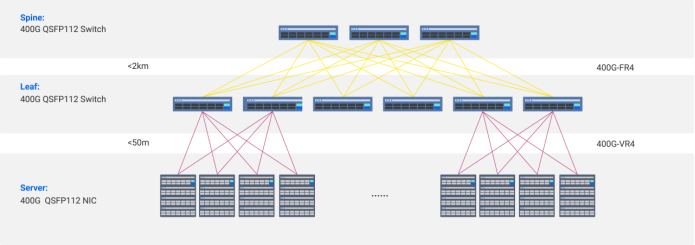
This module uses PAM4 (4-level pulse amplitude modulation) and employs four channels, each at 100G, with a maximum transmission distance of up to 2 kilometers (single-mode fiber). It features a typical power consumption of less than 10W, achieving energy efficiency.
Although both the 400G QSFP112 FR4 and QSFP-DD FR4 belong to the 400G series of fiber optic transceivers, both operate at a speed of 400Gbps and at a wavelength of 1310nm, achieving a maximum transmission distance of 2 kilometers via duplex LC single-mode fiber, they differ fundamentally in their modulation methods.
The 400G QSFP112 FR4 uses 4×100G PAM4 modulation on both the electrical and optical interfaces; while the 400G QSFP-DD FR4 uses 8×50G PAM4 on the electrical interface and 4×100G PAM4 on the optical interface.
Because the QSFP-DD has a lower electrical interface speed, it requires less demanding chip and PCB design, resulting in a generally lower overall cost compared to the QSFP112 FR4.
However, the QSFP112 offers higher signal rate capabilities and better compatibility, allowing for backward compatibility with QSFP56 and QSFP28 ecosystems, enabling smooth upgrades with existing network equipment.
In the field of AI training and inference clusters, as the parameters of artificial intelligence models continue to grow, high-speed interconnection between GPU servers has become a bottleneck.

The 400G QSFP112 FR4 effectively reduces latency and improves cluster communication efficiency, providing solid support for AI computing power.
Cloud computing and edge computing centers are also important application scenarios, suitable for data exchange nodes in hyperscale cloud platforms such as Alibaba Cloud, Tencent Cloud, and AWS, enabling high-bandwidth, low-latency optical interconnection.
In high-performance computing (HPC) networks, this module can be used for HPC data exchange, supporting high-throughput transmission of large-scale parallel computing tasks.
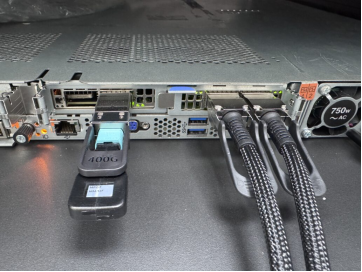
At the same time, it also serves as a data center backbone link, acting as the main optical link module between core switching equipment, meeting short-distance interconnection needs within 2 kilometers.
In 2025, the adoption of 400G optical transceiver modules in hyperscale data centers is accelerating, leading to significant market changes: prices have fallen to multi-year lows.
Unlike previous adoption cycles that primarily focused on cost savings, current adoption emphasizes power efficiency, thermal management, and long-term operational sustainability.
AI workloads and high-performance cloud services demand high throughput while minimizing power consumption per bit, making 400G transceivers a strategic choice.
Modern 400G transceivers utilize advanced modulation techniques (such as PAM4) and silicon photonics technology to reduce power consumption per gigabit.
For operators targeting AI and cloud workloads, focusing on energy efficiency can significantly reduce operating costs.
In terms of specific performance metrics, typical power consumption for 400G QSFP-DD/OSFP optical transceivers is 14W, with a power consumption of 35mW/Gbps, a significant improvement compared to 200G and 100G modules.
With 800G and 1.6T fiber optic transceivers gradually entering the market, the 400G QSFP112 FR4 still maintains a solid application base.
It not only serves as a transitional product supporting current AI training networks but will also play a crucial role in multi-mode interconnect architectures.
In the future, fiber transceiver manufacturers will further optimize chip-level integration and silicon photonics technology to achieve lower power consumption and higher bandwidth density, laying the technical foundation for 1.6T and even 3.2T interconnects.
Co-packaged optics (CPO) technology is expected to be more widely adopted in 2026, further reducing the power consumption of 800G/1.6T modules by 50%.
Driven by the explosive demand for AI computing power and the "Eastern Data, Western Computing" policy, the 400G QSFP112 FR4 technology not only reduces enterprises' TCO (Total Cost of Ownership) but also injects a strong impetus into the continuous innovation of the optical communication industry chain.
Looking ahead, 800G and 1.6T fiber optic transceivers have already emerged. However, the 400G QSFP112 FR4 will not quickly fade from the historical stage; it will continue to play a key role in AI training networks and multi-mode interconnect architectures.
As industry experts have pointed out, the future development of fiber transceivers will focus on optimizing chip-level integration and silicon photonics technology, aiming to achieve lower power consumption and higher bandwidth density, laying a solid foundation for the upcoming era of higher-speed interconnects.Please contact us at Email sales@unitekfiber.com,if you have any inquiry or need any need.
 5G 6G Fronthaul & Backhaul
View More
5G 6G Fronthaul & Backhaul
View More
 Data Center & Cloud Interconnect
View More
Data Center & Cloud Interconnect
View More
 Enterprise & Industrial Optical
View More
Enterprise & Industrial Optical
View More
 FTTx & Access Solutions
View More
FTTx & Access Solutions
View More
 Metro & Access Networks
View More
Metro & Access Networks
View More
 Optical Cabling Systems
View More
Optical Cabling Systems
View More
 Optical Transceivers & Interconnect
View More
Optical Transceivers & Interconnect
View More
 WDM & High-Capacity Transmission
View More
WDM & High-Capacity Transmission
View More
+86-755-21034367