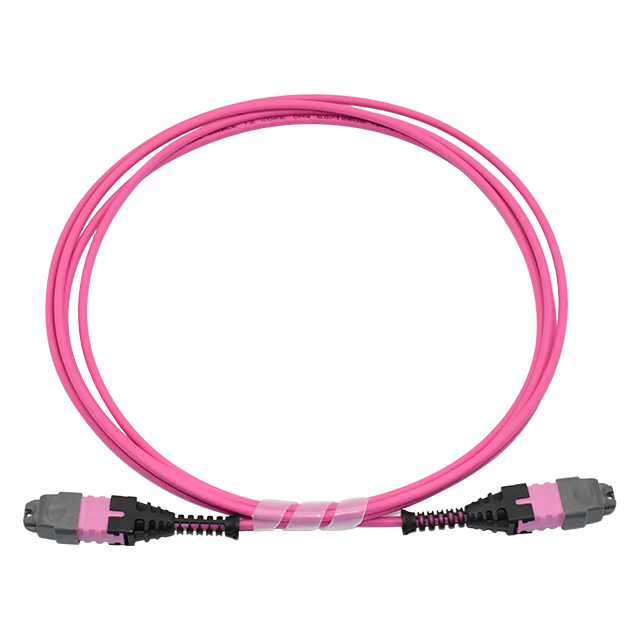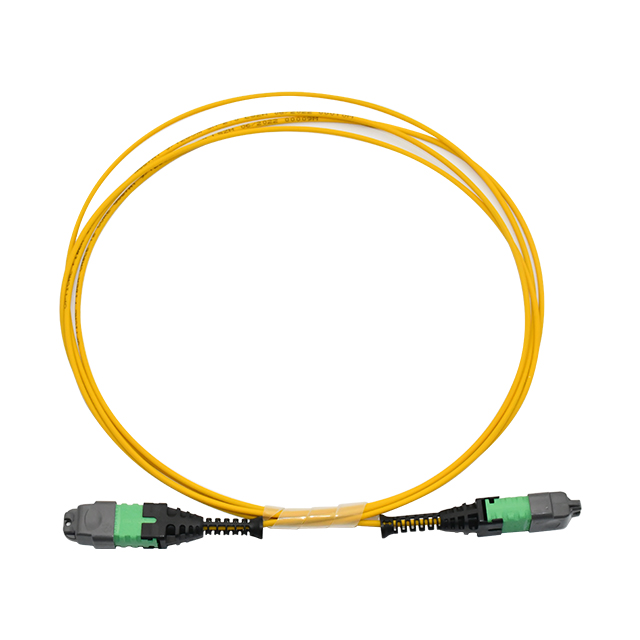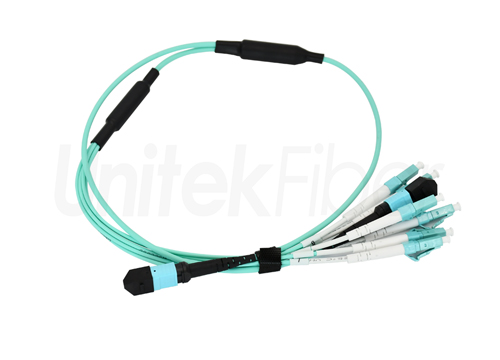

With the rapid development of smart cities in recent years, the era of the Internet of Things is dawning. More reliable and convenient fiber optic networks are providing strong impetus for applications in industries such as the Internet of Things, 5G, and data centers. To meet high-speed transmission requirements, MPO fiber optic patchcords are widely used in high-density cabling for fiber optic networks.
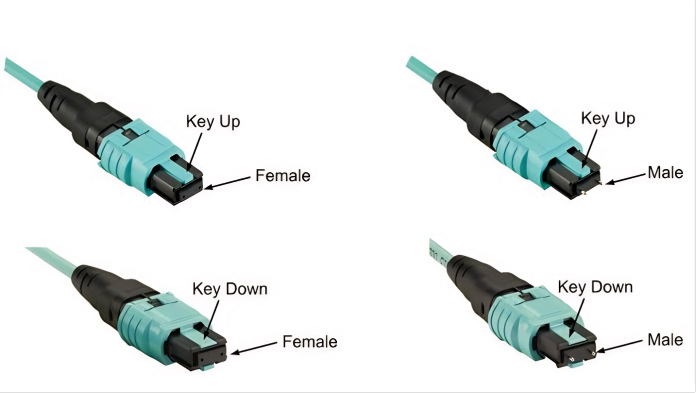
MPO, full name Multi-fiber Push ON, is used as a patch cord for connecting equipment to fiber optic cabling links. An MPO fiber optic patchcord consists of an MPO connector and a fiber optic cable. The MPO connector is a high-density multi-fiber connector that uses precision molded pins for mechanical mating. Depending on the bandwidth and wavelength, the compatible fiber types are typically OM3, OM4, and OM5. According to IEC standards, MPO connectors are defined as a type of connector for transmission speeds of 40G and 100G.
Currently, MPO fiber optic patchcords have three main application areas: high-density applications in data centers, dense fiber optic connections, and optical transceiver applications such as splitters. MPO fiber optic patchcords can be used to simplify fiber optic cabling in various scenarios, including LAN cabling between different buildings within an enterprise, interconnecting optical links in active optical equipment, and cabling in communication base stations. They can also save significant connection time in internal signal connections within various commercial data centers and in cabling systems in densely populated buildings.
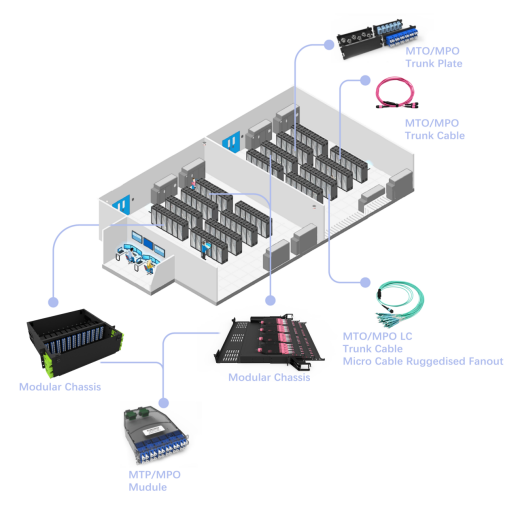
Taking typical data center applications as an example, the ever-increasing bandwidth demands and massive data transmission volumes mean that traditional coaxial interconnect cables face limitations in terms of weight, EMI, EMC, wiring density, and transmission distance. Parallel optical fiber connections have become an alternative to coaxial cables.
In data center optical modules, MPO fiber patchcords can serve as a modular connection system, allowing multi-core MPO multimode fiber patch cords to connect racks and cabinets. Short-distance direct connections typically use 8-core MPO patch cords for duplex fiber interconnection, while long-distance transmission by multimode fiber can reach up to 70 to 100 meters.
Currently, the most commonly used MPO connectors are the 12-core and 24-core types. Their circular, small-diameter design significantly reduces the bending radius of the trunk fiber optic cable, minimizing fiber connection failures and reducing the space required for cabling.
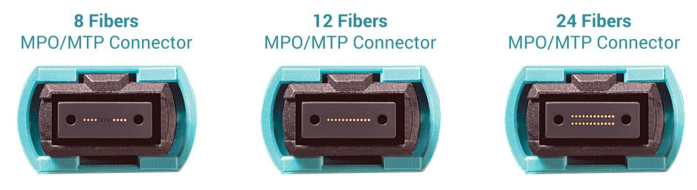
Compared to other connectors, MPO connectors have a clear advantage in terms of compactness, specifically their small size and high density. MPO connectors designed with a large number of fiber cores can accommodate significantly more fibers than SC connectors within the same size constraints.
Any MPO jumper can be seamlessly upgraded from 40G to 100G and 100G and 200G network transmission, and supports the latency standards for 100G transmission. 40G MPO fiber patch cords typically use 8-core multimode fiber, while 100G MPO fiber optic patchcords generally use 12-core fiber.
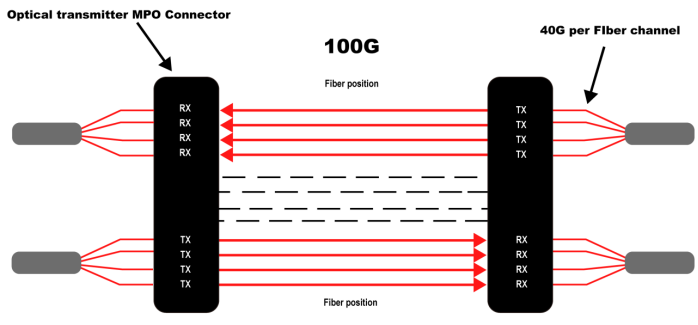
At the same time, the precise MT guide pins and guide holes of the MPO connector effectively ensure the accuracy of fiber alignment. Its insertion loss and reflection performance are significantly superior to other similar fiber optic connectors.
In the context of the current explosion of information traffic driven by the Internet of Things, the accelerated construction of global super data centers, powered by technologies such as cloud computing and big data, is driving transmission speeds towards 400G and even higher bandwidths. Since its inception, MPO technology has continuously upgraded and iterated to meet these evolving demands. Currently, MPO connectors are developing towards higher capacity, lower insertion loss, higher density, and more convenient usability.
Under the new process, MPO connectors can now be used in harsh environments such as high humidity, extreme heat, and extreme cold. Current MPO connectors are suitable not only for fiber-to-fiber connections but also for all applications related to the electronics industry. Whether it's duplex 8-core or 16-core fiber optic transmission, or parallel fiber optic transmission, MPO connectors have a wide range of applications.
The development of high-speed, high-quality electrical signal transmission technology is driving the growth of the optical communication market. With the rapid increase in transmission demands for communication equipment, MPO connectors continue to break through limitations in high transmission rates, demonstrating significant potential for further development, Please contact us at Email sales@unitekfiber.com, if you have any inquiry or need any need.
 5G 6G Fronthaul & Backhaul
View More
5G 6G Fronthaul & Backhaul
View More
 Data Center & Cloud Interconnect
View More
Data Center & Cloud Interconnect
View More
 Enterprise & Industrial Optical
View More
Enterprise & Industrial Optical
View More
 FTTx & Access Solutions
View More
FTTx & Access Solutions
View More
 Metro & Access Networks
View More
Metro & Access Networks
View More
 Optical Cabling Systems
View More
Optical Cabling Systems
View More
 Optical Transceivers & Interconnect
View More
Optical Transceivers & Interconnect
View More
 WDM & High-Capacity Transmission
View More
WDM & High-Capacity Transmission
View More
+86-755-21034367