
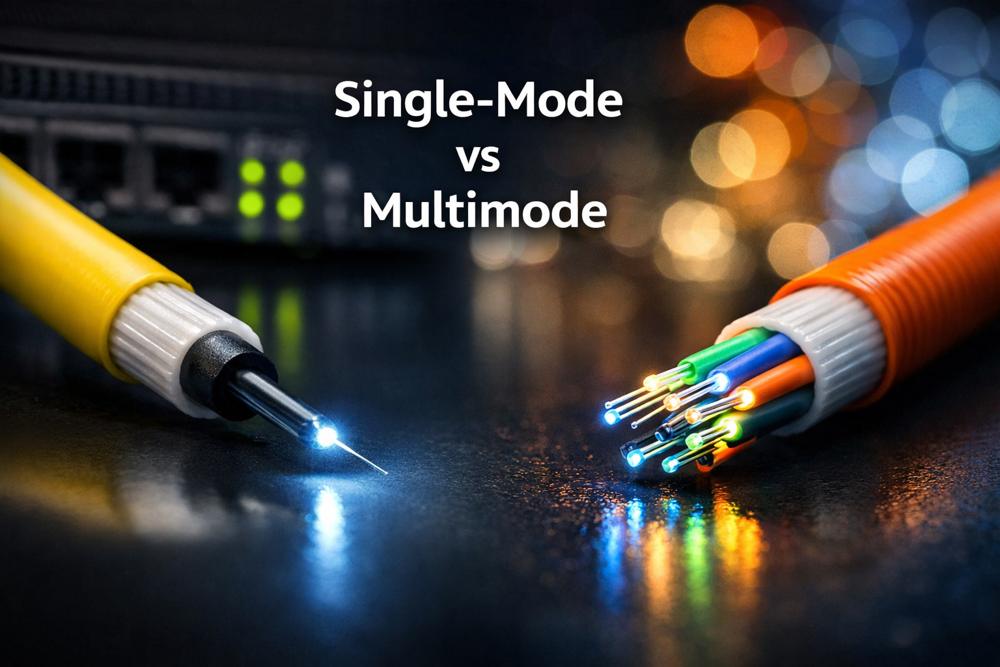
The fundamental difference between Single Mode (SMF) and Multimode (MMF) fiber is the core size and how light travels through it. Single Mode has a small 9µm core for long-distance (up to 100km) high-speed data. Multimode has a larger 50µm core optimized for short-reach (up to 400m) high-bandwidth applications in data centers using cost-effective VCSEL transceivers.
To build a resilient network, you must first understand the physics of the medium. In my 20 years at Unitekfiber Solution, I’ve seen that the "cheapest" cable often leads to the most expensive re-works because the fundamental mode of propagation was misunderstood.
Single Mode fiber features a narrow core (8.3 to 10 um) that allows only one mode of light to propagate. This eliminates Modal Dispersion, which is the primary factor that limits distance in optical communications. It is the gold standard for carrier-grade telecommunications and long-haul backbones.
Multimode fiber has a significantly larger core (50 um or 62.5 um). This allows multiple "modes" or paths of light to travel simultaneously. While this increases the Numerical Aperture (NA) and makes it easier to couple light from inexpensive sources, it leads to Differential Mode Delay (DMD), which limits the effective distance of the signal.
When we consult for Tier-1 data centers, we use a structured fact-base to determine the cabling ROI. Below is the 2026 performance benchmark used by Unitekfiber engineers.
| Technical Parameter | Single Mode (OS2) | Multimode (OM4) | Multimode (OM5) |
| Core Diameter | 9 um | 50 um | 50 um |
| Light Source | Laser (DFB/FP) | VCSEL (850nm) | VCSEL (WBMMF) |
| Max 10G Distance | 40km - 80km | 400m | 400m |
| Max 100G Distance | 10km (LR4) | 100m (SR4) | 150m (SWDM4) |
| Attenuation (850nm) | N/A | 2.5dB/km | 2.3dB/km |
| Attenuation (1310nm) | 0.35dB/km | N/A | N/A |
| Typical Connector Color | Blue (UPC) / Green (APC) | Erika Violet | Lime Green |
Not all Multimode fiber is created equal. The evolution from OM3 to OM5 was driven by the need for higher "Effective Modal Bandwidth" (EMB).
OM3: Optimized for 10G and 40G. It supports 10G up to 300 meters.
OM4: The modern standard for data centers. It increases 10G reach to 400m and is the baseline for 100G-SR4 (up to 100m).
OM5 (Wideband MMF): Designed for SWDM (Shortwave Wavelength Division Multiplexing). It can carry four wavelengths on a single fiber, effectively quadrupling the capacity of a single pair.
Why work with Unitekfiber? Our OM4 and OM5 patch cords are manufactured with Bend-Insensitive Fiber (BIF) as a standard, reducing loss caused by tight cable management in high-density racks.
The "better" choice depends entirely on your reach and budget architecture.
Campus Backbones: Connecting buildings that are more than 500 meters apart.
Future-Proofing: OS2 has virtually "infinite" bandwidth capacity. You can upgrade from 10G to 800G just by changing the transceivers.
Carrier/ISP Networks: Any outdoor deployment involving ADSS or FTTH Drop cables.
Data Center Interconnects (DCI): Short runs between switches and servers (Top-of-Rack).
Budget Constraints on Hardware: While the MMF cable is slightly more expensive per meter, the Multimode transceivers (SFPs) are 60%-80% cheaper than Single Mode optics.
Ease of Maintenance: The larger core makes it more resilient to slight misalignments in the field.
In my two decades of field engineering, I have found that most "faulty cables" are actually "faulty installations."
Problem 1: Contamination. A 1-micron dust particle on an MPO connector can block 24 fibers.
Solution: Always use the "Inspect, Clean, Inspect" protocol with a digital fiber microscope.
Problem 2: Excessive Bend Radius. Bending a standard fiber too sharply causes light to leak out of the core (Macrobending).
Solution: Use Unitekfiber’s G.657.A2 bend-insensitive single mode fiber for tight enclosures.
Problem 3: Polarity Mismatches. In MTP/MPO systems, getting "Type A" instead of "Type B" will result in zero link light.
Solution: Clearly label your trunks and utilize our custom polarity mapping service before ordering.
When evaluating a supplier like Unitekfiber Solution versus a generic marketplace, look for these "Atomic Facts":
Jacket Rating: Ensure it is LSZH (Low Smoke Zero Halogen) for European safety or OFNP (Plenum) for US air-handling spaces.
End-Face Geometry: Ask for interferometer test reports. The apex offset should be <50 um to ensure long-term reliability.
Brand of Glass: We use high-purity silica (Corning or equivalent) to ensure the 1310nm/1550nm attenuation is stable over a 25-year lifespan.
If you are designing a new 400G or 800G network in 2026, the trend is shifting toward Base-8 Single Mode architecture.
While Multimode served us well for the 10G/40G era, the power consumption and cost of Single Mode silicon photonics have dropped so significantly that Single Mode is now viable for links as short as 100 meters.
My Professional Advice: For any new build, install a "Hybrid" backbone: 70% Single Mode for future-proofing and 30% OM4 for legacy short-reach connections.
Choosing between Single Mode and Multimode is a high-stakes decision for your infrastructure's 10-year lifespan. At Unitekfiber Solution, we don't just sell cables; we provide certified engineering peace of mind.
+86-755-21034367