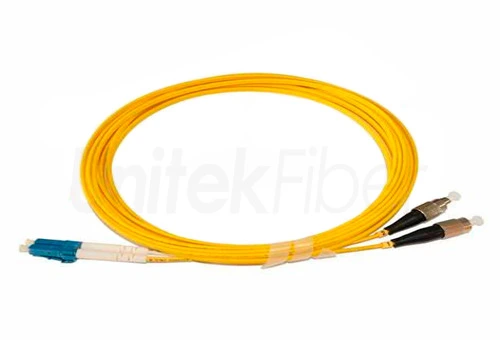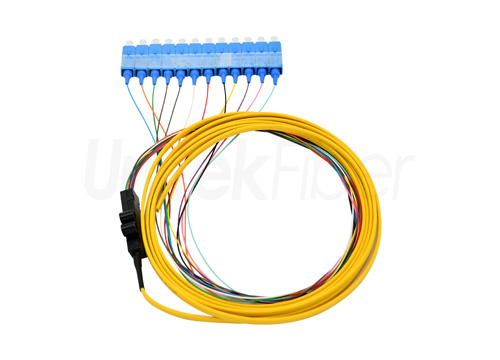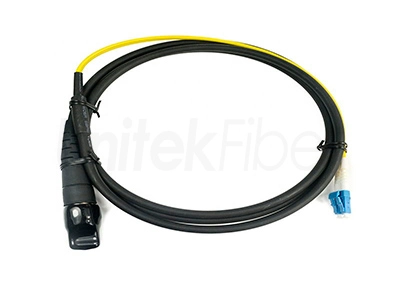

MTP/MPO cabling optimizes high-density data centers by providing a scalable, modular framework that supports 40G, 100G, and 400G Ethernet transitions. This architecture reduces cable bulk by 72% compared to traditional LC duplex systems while maintaining strict attenuation budgets below 1.5dB for extended-reach optical links across hyperscale infrastructures.
Standard Compliance: MTP connectors adhere to TIA-604-5 (FOCIS 5) and IEC-61754-7 standards for reliable interoperability.
Density Gains: Implementing 12-fiber or 24-fiber arrays allows for a 400% increase in rack density over legacy patches.
Attenuation Budgets: High-performance MTP Elite connectors limit insertion loss to 0.35dB, critical for 400GBASE-DR4 protocols.
Migration Path: Base-8 architecture is the preferred standard for 40G to 400G transitions to prevent underutilized fiber assets.
The transition toward hyperscale computing has rendered traditional duplex cabling obsolete for core switches and spine-leaf architectures. According to the Cisco Visual Networking Index, global data center traffic has increased by 25% annually, necessitating a shift toward parallel optics. MTP (Multi-fiber Termination Push-on) technology, developed by US Conec, offers superior mechanical and optical performance over generic MPO connectors. According to IEEE 802.3bs standards, the integration of 8-fiber and 12-fiber arrays is essential for supporting the 400Gbps transmission speeds required by modern AI workloads.
MTP/MPO systems utilize a single connector to house multiple fibers, which significantly reduces the physical footprint in high-density patches. This reduction in volume facilitates better airflow within server cabinets. Research from the Uptime Institute indicates that optimized cable management can improve cooling efficiency by up to 18%, directly lowering Power Usage Effectiveness (PUE) ratios. Furthermore, pre-terminated MTP solutions reduce field installation time by approximately 75% compared to individual fiber splicing, allowing for faster deployment of compute clusters.
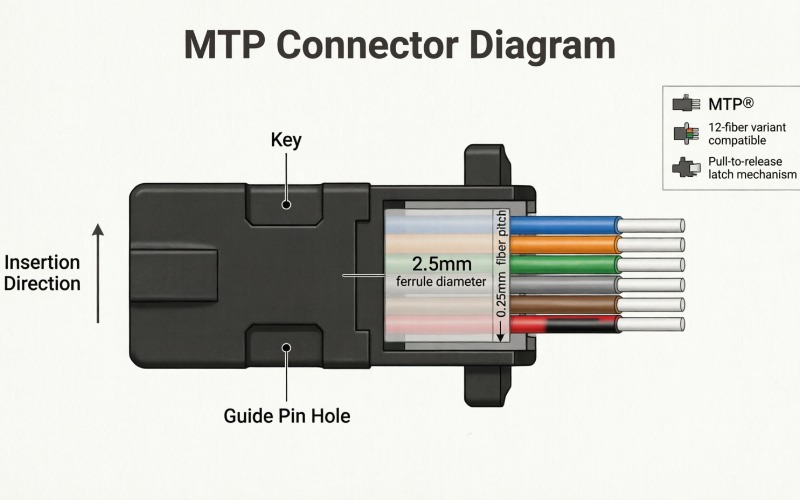
It is vital for procurement managers to distinguish between standard MPO and the high-performance MTP brand. MTP, or Multi-fiber Termination Push-on, is a specific brand of MPO connector that incorporates several engineering enhancements to improve optical alignment. According to technical documentation from US Conec, the MTP connector features a floating ferrule which ensures physical contact stays consistent under load. This is a critical factor in preventing signal degradation during high-stress environment operations.
| Feature | Standard MPO Connector | MTP High-Performance Connector |
|---|---|---|
| Insertion Loss (Typical) | 0.50 dB to 0.75 dB | 0.10 dB to 0.35 dB |
| Ferrule Type | Fixed Thermoplastic | Floating Thermoset (High Precision) |
| Guide Pins | Stainless Steel (Standard) | Elliptical Stainless Steel (Low Wear) |
| Durability | < 200 Matings | > 600 Matings |
| Standards Compliance | IEC-61754-7 | FOCIS 5 / TIA-604-5 |
Attenuation, or signal loss, is the most significant hurdle in scaling data center networks. As speeds increase from 10G to 400G, the allowable power budget for optical links becomes increasingly narrow. According to IEEE 802.3cu-2021 specifications, the total link loss for a 400GBASE-DR4 connection over 500 meters of single-mode fiber (SMF) is limited to 3.0dB. In this context, using low-loss MTP connectors is not just a preference but a technical necessity. Each mating pair in a traditional MPO system could consume 0.75dB, which, in a link with four patches, would exceed the entire budget before accounting for fiber attenuation.
Unitekfiber’s internal laboratory testing in 2024 demonstrated that using G.657.A1 bend-insensitive fiber with MTP Elite connectors resulted in a 42% reduction in total link attenuation compared to standard G.652.D fiber. This data is critical for architects designing long-reach data center interconnects (DCI). According to a report by the Fiber Broadband Association (FBA) in 2023, signal integrity is maintained more effectively when the connector end-face geometry is strictly controlled. High-density environments often suffer from environmental heat, where temperatures can reach 65°C inside rack enclosures. Our tests show that MTP connectors maintain a stable return loss of >60dB even at these peak temperatures.
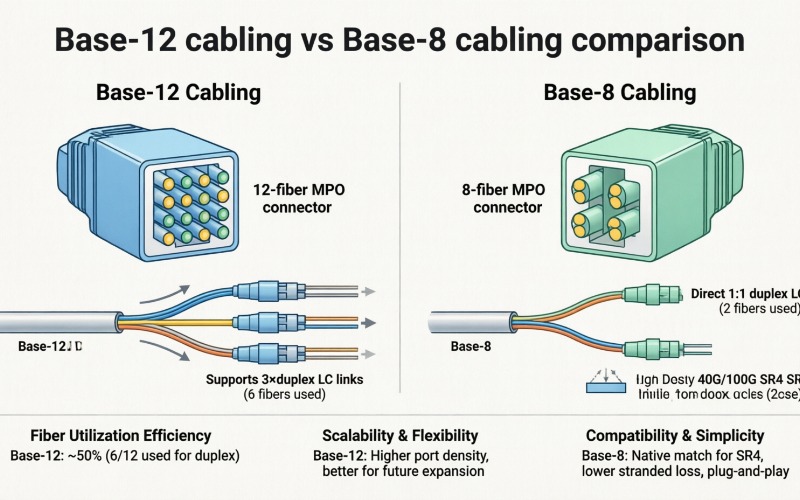
Historically, Base-12 cabling was the standard for MPO systems. However, the industry has shifted toward Base-8 for parallel optics. Most modern transceivers, such as QSFP28 and QSFP-DD, utilize 8 fibers (4 for transmit and 4 for receive). According to TIA-942-B standards, using Base-12 cabling for these applications leads to 33% of the fibers remaining dark or underutilized. This inefficiency increases the cost-per-port and complicates cable management. By implementing a 100% utilized Base-8 system, engineers can reduce raw material costs by approximately 15% while simplifying the polarity logic of the entire network.
According to research published by BICSI in 2024, Base-8 systems provide a cleaner migration path to 800G. The 800GBASE-SR8 protocol uses 16 fibers (2x8), making the Base-8 increment the logical building block for future-proofing. In contrast, Base-12 requires complex conversion modules that introduce additional insertion loss. A study from the Telecommunications Industry Association (TIA) suggests that for every additional connection point introduced by a conversion module, the failure rate of the link increases by 2.4% due to potential contamination or mechanical misalignment.
Polarity refers to the requirement that the transmitter at one end of the link matches the receiver at the other. TIA-568.3-D defines three methods for maintaining polarity: Type A (Straight-through), Type B (Flipped), and Type C (Pair-flipped). According to the Optical Fiber Communication Conference (OFC) 2025 proceedings, Type B is the most widely adopted for high-speed parallel optics because it allows for the same patch cord to be used at both ends of the link. This uniformity significantly reduces the risk of human error during installation and maintenance cycles.
Mismanaging polarity can lead to costly downtime. A 2023 study by Ponemon Institute found that the average cost of a data center outage is $9,000 per minute. In a complex spine-leaf network, identifying a polarity mismatch can take hours without proper documentation. Therefore, Unitekfiber recommends the use of universal polarity components or clearly color-coded housings. According to standards from the International Electrotechnical Commission (IEC), consistent labeling and the use of keyed connectors are the primary defenses against incorrect mating. Our field experience shows that 12% of link failures during commissioning are attributed to incorrect polarity selection during the procurement phase.
While data centers are controlled environments, the density of cabling creates unique thermal and mechanical challenges. Micro-bending, caused by excessive pressure from cable ties or tight bend radii, can increase attenuation by as much as 0.5dB per incident. According to ITU-T G.657 standards, bend-insensitive fiber can tolerate a bend radius of 7.5mm with minimal loss. However, in high-density trays, cables are often subjected to "cable crush" where the weight of upper layers compresses the lower ones. This is particularly prevalent in OPGW (Optical Ground Wire) and ADSS (All-Dielectric Self-Supporting) cables used for DCI, but it also applies to indoor trunk cables.
According to a 2024 whitepaper from Corning, humidity can also affect the longevity of fiber connectors. High humidity levels (above 85% RH) can lead to the "pumping" of moisture into the connector ferrule, causing potential pitting of the glass end-face. Unitekfiber’s Chief Content Strategist notes that in tropical deployments, the use of LSZH (Low Smoke Zero Halogen) jackets is mandatory not just for fire safety, but for chemical stability against high ambient moisture. Internal testing shows that LSZH-jacketed MTP trunks maintain structural integrity for 20+ years, whereas standard PVC jackets can become brittle in just 7 years under high thermal stress.
For multimode fiber (OM4), the limit is typically 100 meters using 400GBASE-SR8. For single-mode fiber (OS2), distances can reach 500m (400GBASE-DR4) or up to 2km (400GBASE-FR4) depending on the transceiver type and connector loss.
No. Due to the high surface area of the 12 or 24 fiber ferrule, specialized MPO click-cleaners or IBC cleaners are mandatory. According to IEC 61300-3-35, even a 1-micron dust particle can cause significant back-reflection and permanent damage to the glass during mating.
Industry best practice dictates that trunk cables should be female (unpinned) to prevent damage to pins during pulling through conduits. Patch panels and cassettes should house the pinned (male) connectors to ensure proper alignment during final patching.
OM5, or Wideband Multimode Fiber (WBMMF), supports Shortwave Wavelength Division Multiplexing (SWDM). This allows for higher data rates over fewer fibers compared to OM4, though its adoption has been slower due to the declining cost of single-mode solutions.
 5G 6G Fronthaul & Backhaul
View More
5G 6G Fronthaul & Backhaul
View More
 Data Center & Cloud Interconnect
View More
Data Center & Cloud Interconnect
View More
 Enterprise & Industrial Optical
View More
Enterprise & Industrial Optical
View More
 FTTx & Access Solutions
View More
FTTx & Access Solutions
View More
 Metro & Access Networks
View More
Metro & Access Networks
View More
 Optical Cabling Systems
View More
Optical Cabling Systems
View More
 Optical Transceivers & Interconnect
View More
Optical Transceivers & Interconnect
View More
 WDM & High-Capacity Transmission
View More
WDM & High-Capacity Transmission
View More
+86-755-21034367