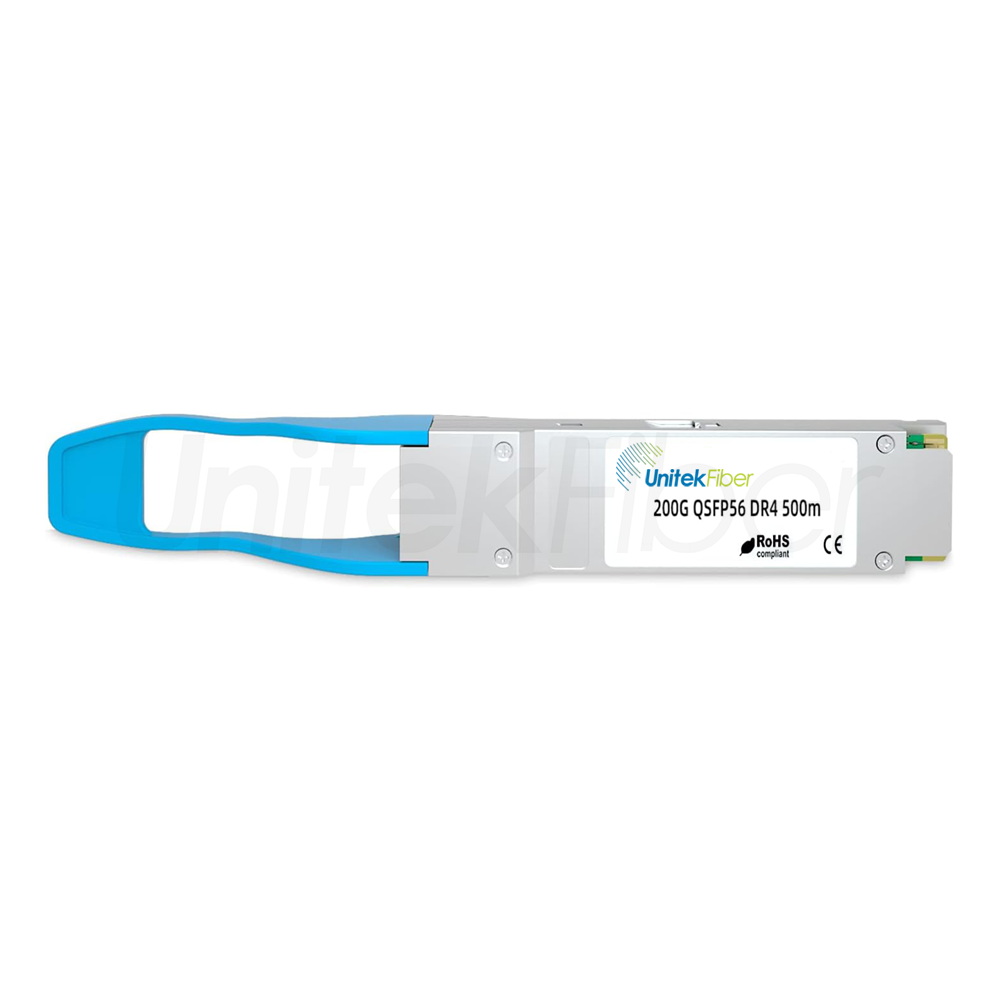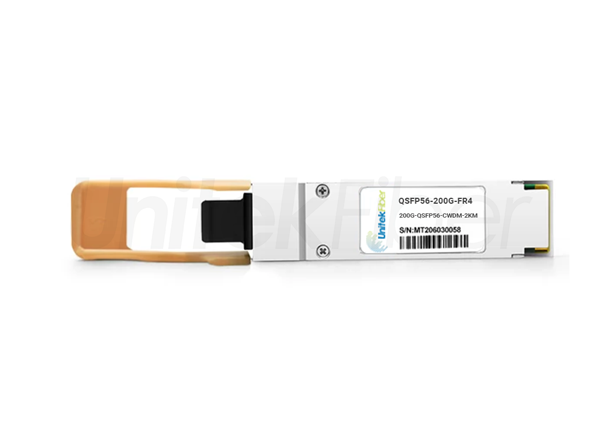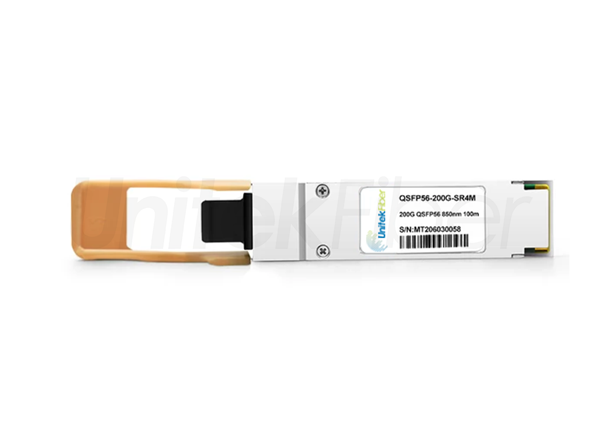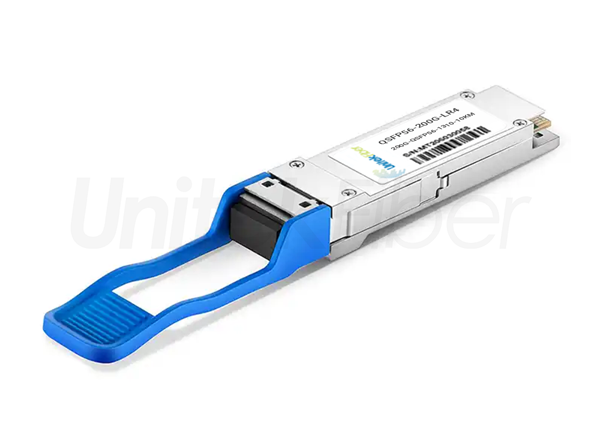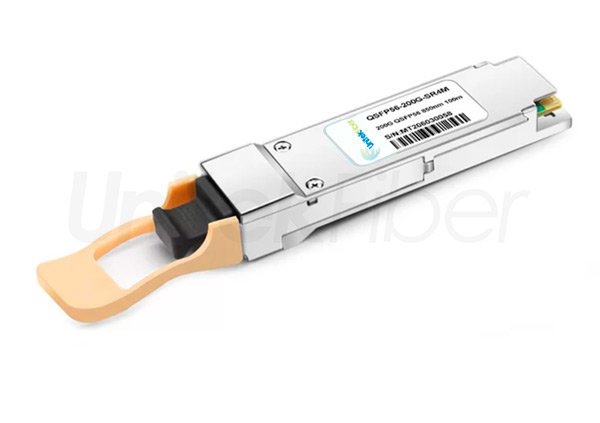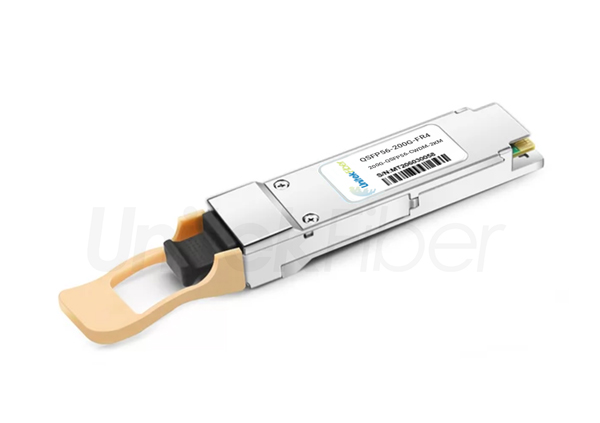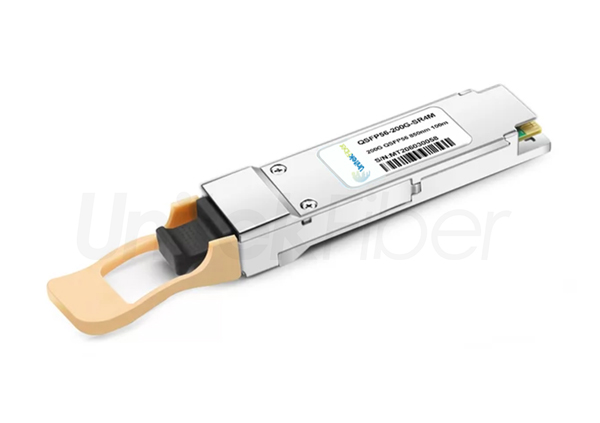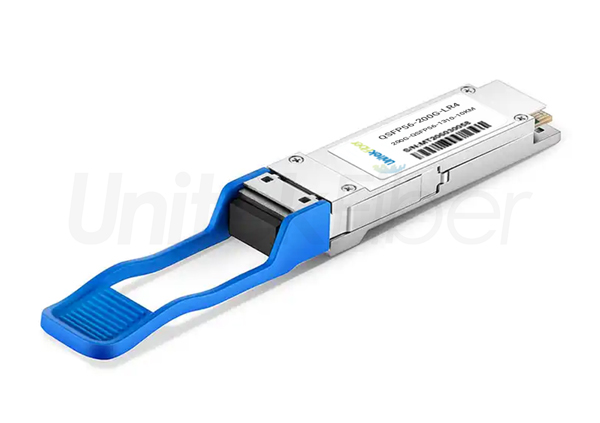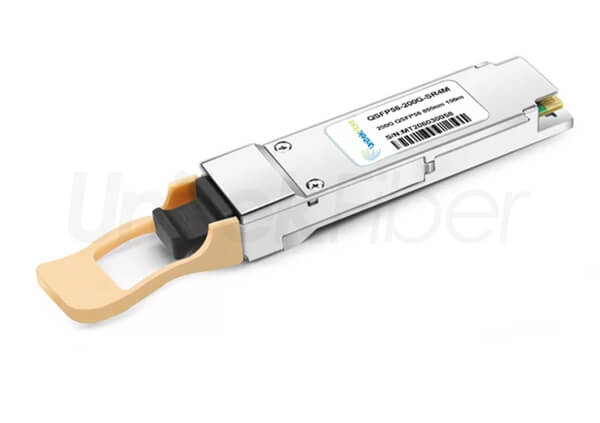

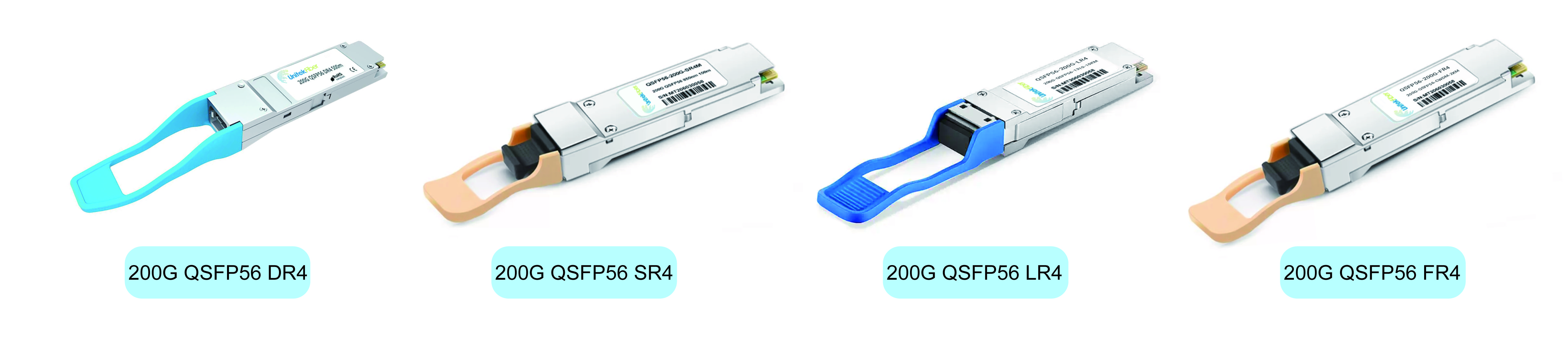
200G QSFP-DD/QSFP56 optical transceiver is a key component in modern networking infrastructure, enabling the seamless transmission of large volumes of data at incredibly fast speeds. 200G QSFP-DD/QSFP56 optical transceiver is typically used in conjunction with high-speed switches and routers to establish high-capacity connections between network devices. As a professional optical transceiver manufacturer, UnitekFiber provides a series of 200G transceiver module, such as SR4/FR4/DR4/LR4.
 5G 6G Fronthaul & Backhaul
View More
5G 6G Fronthaul & Backhaul
View More
 Data Center & Cloud Interconnect
View More
Data Center & Cloud Interconnect
View More
 Enterprise & Industrial Optical
View More
Enterprise & Industrial Optical
View More
 FTTx & Access Solutions
View More
FTTx & Access Solutions
View More
 Metro & Access Networks
View More
Metro & Access Networks
View More
 Optical Cabling Systems
View More
Optical Cabling Systems
View More
 Optical Transceivers & Interconnect
View More
Optical Transceivers & Interconnect
View More
 WDM & High-Capacity Transmission
View More
WDM & High-Capacity Transmission
View More
A 200G optical transceiver is a high-speed hot-pluggable module engineered to transmit and receive data at an aggregate rate of 200 Gigabits per second (Gbps) over fiber optic cables. Operating primarily on standard G.652.D single-mode (OS2) or multi-mode (OM3/OM4) fibers, these modules utilize cutting-edge 50G PAM4 modulation to double data efficiency without doubling physical infrastructure costs. Widely deployed in modern hyperscale data centers, high-performance computing (HPC) clusters, and AI/ML fabrics, 200G optics are available in standard QSFP56 and QSFP-DD form factors to match specific switch routing architectures.
When architecting a high-density 200G network, specifying the correct mechanical envelope is the first step toward link initialization. Unitekfiber manufactures the two industry-standard form factors defined by Multi-Source Agreements (MSAs):
The 200G QSFP56 module is the native, single-row evolution of the traditional QSFP28 interface. It retains the exact same physical size but upgrades the internal electrical lanes from 25G NRZ to 4 channels of 50G PAM4 digital signaling. It is the most cost-effective and thermally efficient option for dedicated 200G Ethernet and InfiniBand HDR networks.
The 200G QSFP-DD (Quad Small Form-factor Pluggable Double Density) module introduces a dual-row contact design, doubling the electrical lanes from 4 to 8. For 200G applications, it can operate using 8 lanes of 25G NRZ or 4 lanes of 50G PAM4. Shifting to QSFP-DD provides unparalleled backward compatibility and sets a seamless hardware migration path toward future 400G and 800G scaling.
To satisfy strict optical link budgets, network engineers must select the specific 200G standard matching their target reach and fiber plant infrastructure:
| Industry Standard | Fiber Media Type | Connector Port | Max Reach | Core Deployment Application |
| 200GBASE-SR4 | Multi-mode (OM3/OM4) | MPO/MTP-12 | 70m (OM3) / 100m (OM4) | Intra-rack compute clusters, top-of-rack (ToR) switches. |
| 200GBASE-FR4 | Single-mode (OS2) | Duplex LC | 2 km | Inter-rack leaf-spine data center interconnects (DCI). |
| 200GBASE-LR4 | Single-mode (OS2) | Duplex LC | 10 km | Enterprise campus backbones and metropolitan local loops. |
| 200G AOC / DAC | Active Optic / Copper | Attached Breakout | 1m - 30m |
Every Unitekfiber third-party 200G optical module undergoes rigorous physical switch environment validation. We flash custom EEPROM coding to guarantee 100% cross-brand compatibility with Tier-1 hardware vendors, including Cisco, NVIDIA Mellanox, Arista, and Juniper switch architectures, eliminating OEM cost premiums.
Thermal dissipation is a major concern in high-density 1U network layouts. Our 200G QSFP56 transceivers integrate premium, energy-efficient Digital Signal Processor (DSP) chips and optimized uncooled laser drivers. This holds average power consumption under 3.5W to 4.5W, cutting enterprise cooling costs and maximizing hardware lifespans.
By utilizing superior Electro-absorption Modulated Lasers (EML) for our mid-to-long-range modules (FR4 and LR4), Unitekfiber delivers excellent Optical Signal-to-Noise Ratio (OSNR) stability. This ensures ultra-low Bit Error Rates (BER) even when navigating complex single-mode distribution frames.
UnitekFiber's 200G optical modules, AOC and DAC product series fully cover the new generation of 200G InfniBand and 200G Ethernet applications, including but not limited to 200G QSFP56 SR4, 200G QSFP56 FR4, 200G QSFP56 LR4, 200G QSFP-DD 2 SR4 and other optical modules, as well as 200G QSFP56 AOC, 200G QSFP-DD AOC, 200G QSFP56 DAC and 200G QSFP-DD DAC. Among them, all DAC and AOC products support “break-out” application mode. Please contact us via Email at sales@unitekfiber.com for more detail.
Yes, you can configure 200G breakout links depending on your switch OS. A native 200G QSFP56 or QSFP-DD port can be split into 4x 50G links or 2x 100G links using specialized breakout DAC copper twinax assemblies or MPO-to-LC optical harness cables. This provides excellent flexibility when connecting new high-speed core switches to legacy server network interface cards (NICs).
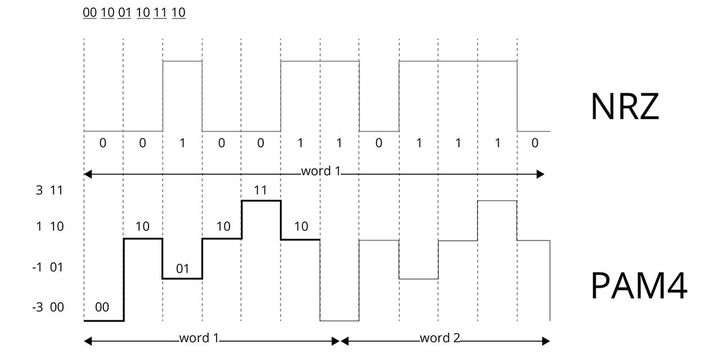
Because 50G PAM4 splits the optical signal into four separate voltage levels, the "eye height" (the signal spacing between states) is incredibly small. Even minor oil contamination, a fingerprint, or a microscopic dust particle on an LC or MPO end-face will cause massive light reflection, easily distorting these tight amplitude levels and causing immediate link drops or high packet loss. Always inspect and clean all fiber connectors before insertion.
Yes, 200G QSFP56 optical transceivers are widely deployed in high-performance computing (HPC) and AI clusters utilizing InfiniBand HDR (High Data Rate) protocols. While standard Ethernet 200G optics prioritize standard frame transmission, InfiniBand-optimized 200G modules are custom-coded to support ultra-low latency, cut-through routing, and strict Bit Error Rate (BER) thresholds required by AI model training workloads. When sourcing for these grids, ensure the transceiver firmware matches your NVIDIA Mellanox InfiniBand host channel adapters (HCAs).
The core difference is the signaling modulation. Standard QSFP28 is capped at 100G because it uses 4 lanes of 25G NRZ (binary on/off pulses). QSFP56 doubles this throughput to 200G inside the exact same physical form factor by deploying 50G PAM4 technology. PAM4 uses four distinct light amplitude levels, allowing it to pack two bits of digital data into every single clock cycle.
The maximum transmission distance of a 200G transceiver depends entirely on the optical standard, laser configuration, and fiber type utilized:
Short-Range (Up to 100m): Standard 200GBASE-SR4 QSFP56 optics can transmit up to 70 meters over OM3 or 100 meters over OM4 multi-mode fiber using MPO-12 connectors.
Medium-Range (Up to 2km): The 200GBASE-FR4 single-mode module uses duplex LC connectors to cover paths up to 2 kilometers, making it the premier choice for inter-rack leaf-spine data center interconnects (DCI).
Long-Range (Up to 10km): The 200GBASE-LR4 single-mode transceiver integrates high-performance EML lasers to shoot signals up to 10 kilometers over standard OS2 G.652.D fiber for campus backbones.
Ultra-Short Range (Up to 3m): 200G DAC (Direct Attach Copper) cables are hard-limited to 3 meters due to high-frequency copper attenuation
The 200G optical transceiver occupies a strategic sweet spot in network migration, offering unique architectural balances over both 100G and 400G frameworks:
Advantages over 100G: 200G doubles the overall bandwidth capacity per rack unit within the exact same physical footprint. By upgrading from 100G (25G NRZ) to 200G QSFP56 (50G PAM4), data centers reduce physical cable clutter by 50%, slash port power consumption per gigabit, and maximize capital efficiency without changing their switch cage configurations.
Advantages over 400G: Deploying 200G yields significant CAPEX and thermal relief compared to immediate 400G onboarding. 400G modules require complex 100G PAM4 electronics, causing high power consumption (≈ 12W to 14W per port) and intense thermal loads. 200G QSFP56 optics run cooler (≈ 3.5 W to 4.5W), allowing legacy air-cooled data centers to double their speeds without investing millions in liquid cooling retrofits.

+86-755-21034367