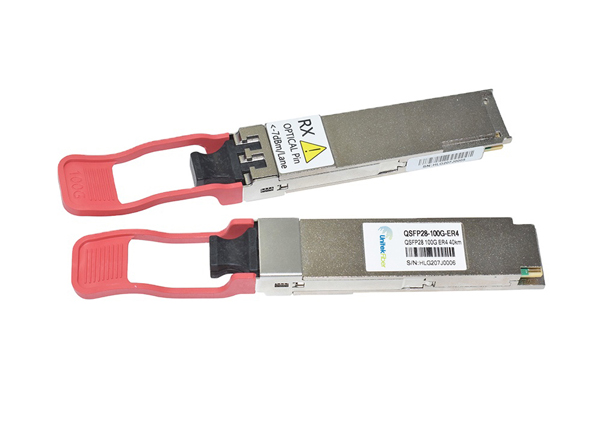

As the demand for higher bandwidth continues to surge across data centers, cloud computing, and the telecommunications industry, network traffic is increasing at an exponential rate. As a critical component of optical communication systems, optical transceivers have evolved from 100G to 400G, and further to 800G and 1.6T, witnessing the rapid transformation of the high-bandwidth era. This article explores how fiber transceivers meet the growing data rate requirements of next-generation networks from three perspectives: the evolution of bandwidth and form factors, key technological enablers, and approaches to achieving high-speed optical transceivers.

The significant growth in internal traffic within data centers and backbone networks has driven an explosive demand for higher bandwidth. As a result, fiber optical transceiver speeds have rapidly advanced from 100G to 400G, laying the foundation for long-term scalability and upgrade needs of data centers and backbone infrastructures.
Building on the 400G foundation, advancements in optical communication technologies such as DSP (Digital Signal Processing) and multi-channel design have enhanced data processing capabilities and network bandwidth, accelerating the commercialization and large-scale deployment of 800G fiber transceivers.
Today, to further optimize fiber utilization and reduce port density, optical transceiver module speeds are advancing toward 1.6T, doubling data transmission efficiency and information processing capacity.
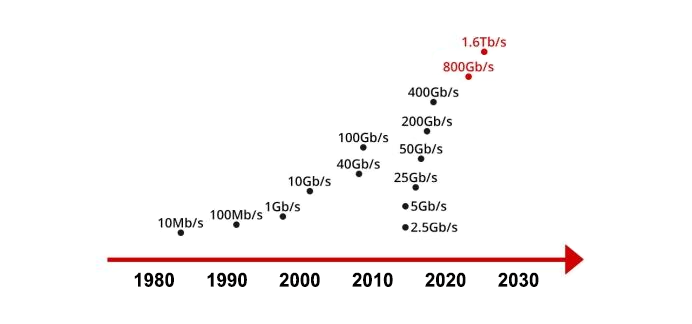
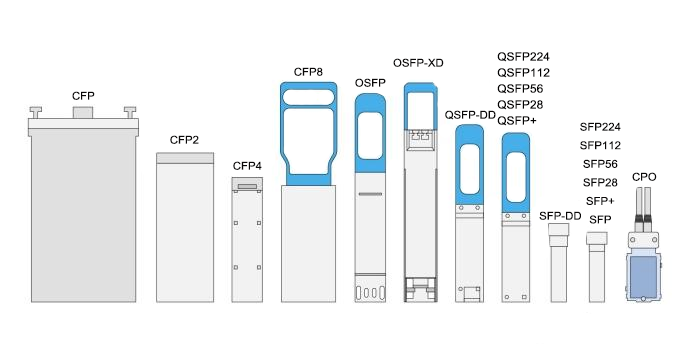
As fiber optical transceiver bandwidth continues to increase, the demand for higher data rates drives transceivers toward miniaturization, higher speed, and lower power consumption to meet the needs of higher integration and denser connectivity. Meanwhile, the performance and transmission bandwidth of optical components are steadily improving, and optical transceiver module form factors are evolving accordingly. Modern form factors such as QSFP-DD and OSFP have been developed to support these higher speeds, offering enhanced flexibility, higher port density, and improved thermal management.

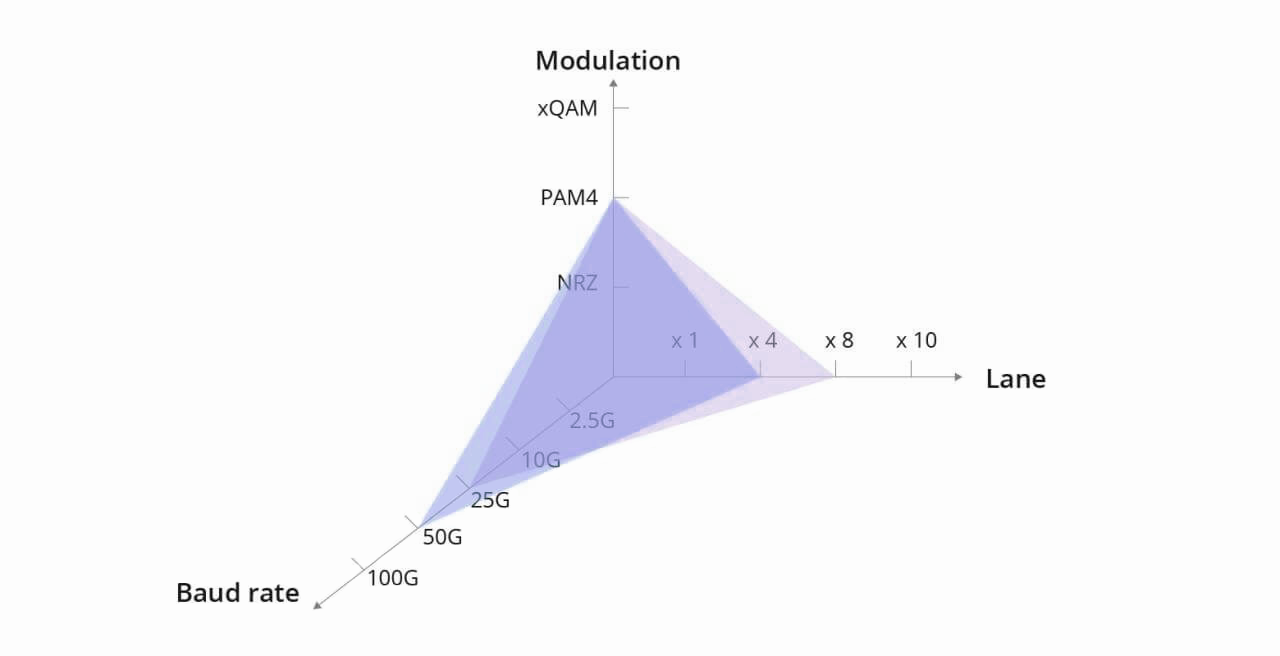
The increase in optical transceiver transmission rates from 400G to 1.6T is largely driven by continuous technological innovation. There are three primary approaches to enhancing the bandwidth of fiber transceivers:
Advanced Modulation Formats: Upgrading from traditional NRZ (Non-Return-to-Zero) modulation to PAM4 (4-Level Pulse Amplitude Modulation), and further to higher-order QAM (Quadrature Amplitude Modulation), increases modulation complexity and enhances data transmission rates.
Increased Baud Rate: By increasing the baud rate, more data can be transmitted within the same time interval. Upgrading the channel speed of optical transceivers from 25G to 50G, and further to 100G or even 200G, significantly enhances data transmission capacity.
Increasing Parallel Channels: Module bandwidth can be expanded by adding more parallel channels, which can be achieved in two primary ways:
• Higher transmission rates can be realized by expanding the number of parallel channels. For instance, the transition from 400G SR4 modules to 800G SR8 modules is accomplished by doubling the number of parallel channels.
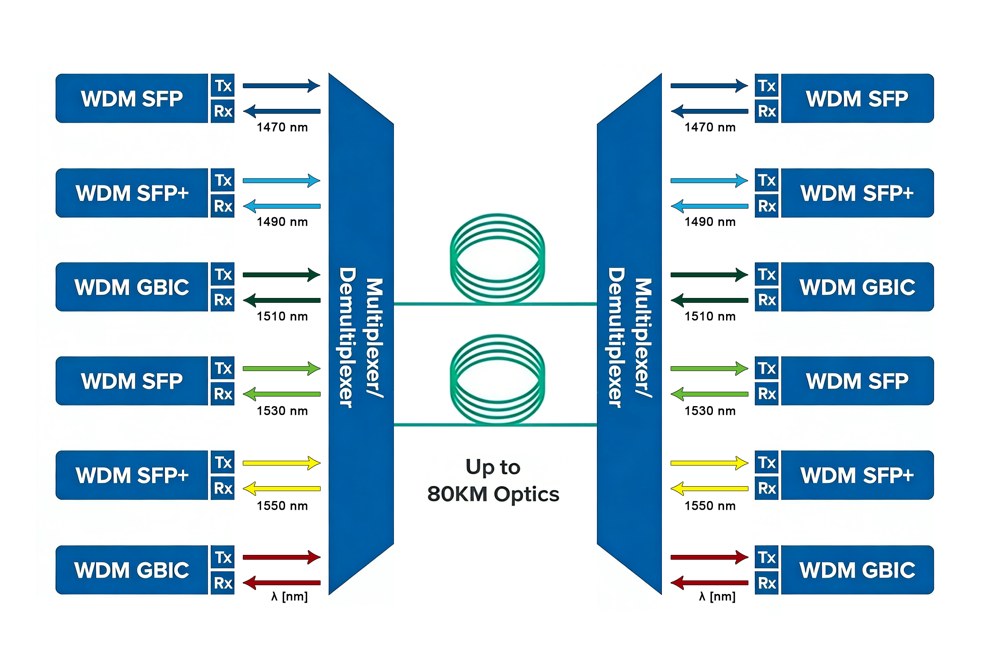
• WDM technology increases bandwidth by transmitting multiple signals at different wavelengths through a single optical fiber. For example, the 100G QSFP28 CWDM4 fiber transceiver utilizes CWDM (Coarse Wavelength Division Multiplexing) technology, operating across four independent wavelengths (each at 25G) to transmit data through a single fiber.
A variety of technical solutions are employed to realize high-speed 400G, 800G, and 1.6T optical transceivers, involving different combinations of channel count, baud rate, and modulation formats.

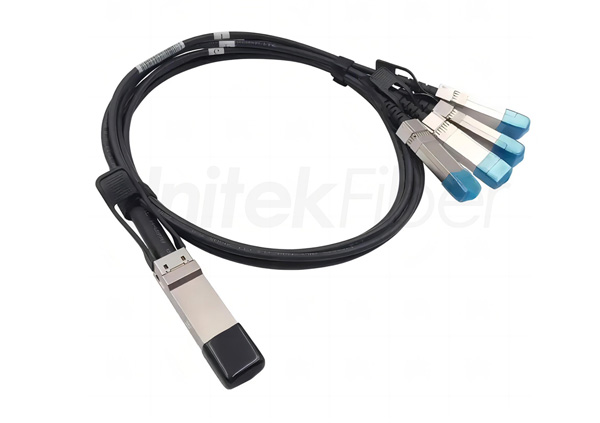
The era of 400G and 800G fiber optical transceivers has fully arrived, while demand for 1.6T solutions continues to grow. The adoption and widespread of 1.6T technologies will form the next major trend. Utilizing 1.6T OSFP InfiniBand and Ethernet cables, meeting the rapidly escalating traffic and data processing demands of hyperscale data centers while effectively reducing overall costs.
 5G 6G Fronthaul & Backhaul
View More
5G 6G Fronthaul & Backhaul
View More
 Data Center & Cloud Interconnect
View More
Data Center & Cloud Interconnect
View More
 Enterprise & Industrial Optical
View More
Enterprise & Industrial Optical
View More
 FTTx & Access Solutions
View More
FTTx & Access Solutions
View More
 Metro & Access Networks
View More
Metro & Access Networks
View More
 Optical Cabling Systems
View More
Optical Cabling Systems
View More
 Optical Transceivers & Interconnect
View More
Optical Transceivers & Interconnect
View More
 WDM & High-Capacity Transmission
View More
WDM & High-Capacity Transmission
View More
+86-755-21034367