
Nowadays, more and more people live in apartment buildings, dormitories and other multi-dwelling units (MDU), and with the increasing demand for high-bandwidth applications such as high-definition televisions, fiber to the home (FTTH) has become an irreversible trend, UnitekFiber will talk about how to lay a fiber to the home (FTTH) network in a multi-dwelling unit (MDU)?
To design a scalable optical infrastructure, engineers must first classify the structural footprint of the target environment. What is a multi-dwelling unit from a telecommunications perspective?
Unlike a Single-Family Unit (SFU)—which typically requires a straightforward, dedicated drop cable from an aerial wedge clamp or a buried handhole directly to one premises—==a multi-dwelling unit (MDU) is a complex, shared structural ecosystem.
When delivering fiber broadband to an MDU, carrier networks generally choose between two core structural pathways: Fiber-to-the-Building (FTTB) and true Fiber-to-the-Home (FTTH).
In an FTTB topology, the optical fiber core terminates at a single centralized optical network unit (ONU) or MxU switch located within the basement or main telecom room (MDF) of the MDU. From that central active switch, the final drop link to each tenant apartment is bridged using existing copper infrastructure, such as Category 6 (Cat6) Ethernet cables or G.fast twisted-pair lines.
The Downside: Copper lengths attenuate bandwidth quickly, limiting ultimate gigabit expansion and increasing active power consumption within the building property.
True FTTH routes a continuous, passive optical path from the carrier’s Optical Line Terminal (OLT) all the way into the tenant’s living space, terminating directly at a personal Optical Network Terminal (ONT). This path relies entirely on passive optical splitters (typically 1:32 or 1:64) housed in an external or basement Optical Distribution Frame (ODF).
Infrastructure Metric | Fiber-to-the-Building (FTTB) | Fiber-to-the-Home (FTTH) | Unitekfiber Engineering Impact |
Transmission Medium to Tenant | Copper (Cat6 UTP / Twisted Pair) | Single-mode Glass Core (G.657.A2) | FTTH ensures future-proof 10G/25G PON speeds. |
Active Components in Building | Yes (Requires powered switches in MDF) | No (100% Passive Optical Network) | FTTH cuts building power costs and hardware failure rates. |
Cable Path Footprint | Bulky copper bundles require large conduits | Ultra-slim fiber drops conserve duct space | FTTH resolves space limits in older building risers. |
Max Bandwidth Capacity | Hard-capped by copper distance constraints | Virtually unlimited (Dependent on OLT/ONT) | FTTH maximizes long-term property asset value. |
Susceptibility to EMI | High (Prone to elevator/power line noise) | Absolute Zero (Immune to interference) | FTTH eliminates cross-talk noise in high-density risers. |
Before laying, we should first design a reasonable optical fiber network architecture for the multi-dwelling unit (MDU). The following factors should be considered when designing:
This factor is very important. If a multi-dwelling unit (MDU) is newly built, its structure is more suitable for modern network access, and it is easier to design a fiber-to-the-home (FTTH) network; if the multi-dwelling unit (MDU) already has in a certain age, its network access infrastructure may be outdated, and some are not even suitable for access to fiber optic networks. Then there will be many restrictions when laying fiber to the home (FTTH) network, and even consume a lot of manpower and material resources.
The type of multi-dwelling unit (MDU) is another factor that needs to be considered, that is, different types of multi-dwelling units (MDU) are suitable for different fiber to the home (FTTH) structures. In general, there are three types of multi-dwelling units (MDU):
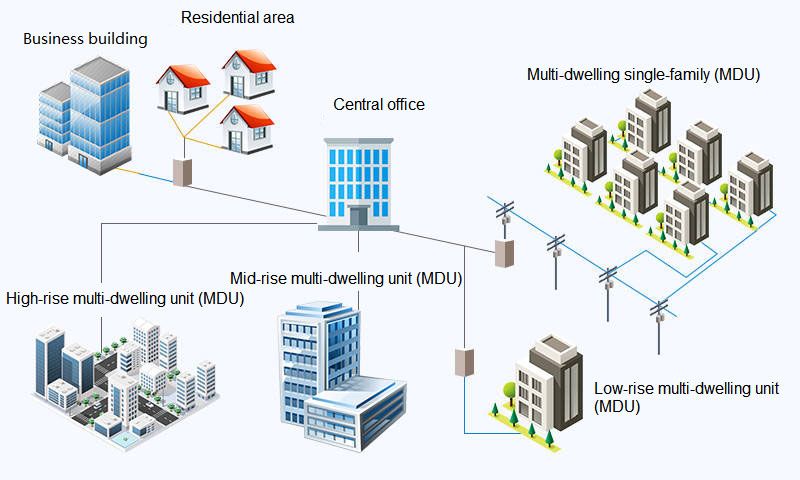
The low-rise multi-dwelling unit (MDU) has 3 floors and a maximum of 12 households. The fiber access point is usually outside the building, which is suitable for each household to use a separate fiber.
The middle-level multi-dwelling unit (MDU) has a maximum of 10 floors, and the number of households is between 12 and 128. The fiber access point is set inside the building, and multiple users can share a fiber interface.
The high-rise multi-dwelling unit (MDU) usually exceeds 10 floors, and the number of households is more than 128. The network architecture of FTTx terminal business is usually distributed vertically, and the network wiring is spread over multiple floors and areas of the high-rise multi-dwelling unit (MDU) to ensure Every household can enjoy an efficient and reliable fiber-to-the-home (FTTH) network.
In a fiber to the home (FTTH) network, the type and location of the optical network terminal (ONT) play an important role in the maintenance and operation of the network. There are two types of optical network terminals (ONT): single-dwelling unit optical network terminals (ONT) and multi-dwelling unit optical network terminals (ONT); among them, single-dwelling unit optical network terminals (ONT) can be used in single-dwelling units and It can be used in multi-dwelling units, and multi-dwelling unit optical network terminals (ONT) are only used in multi-dwelling units.
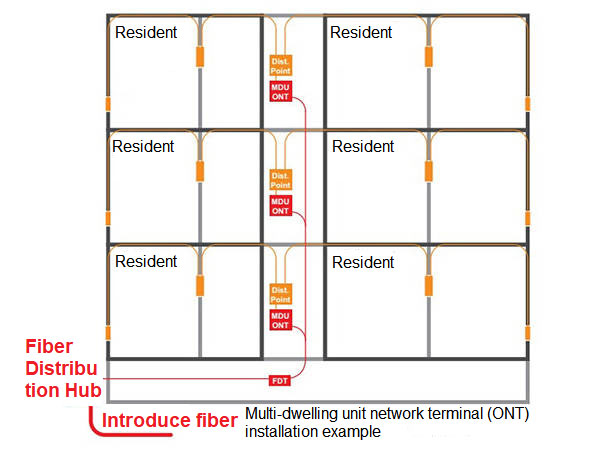
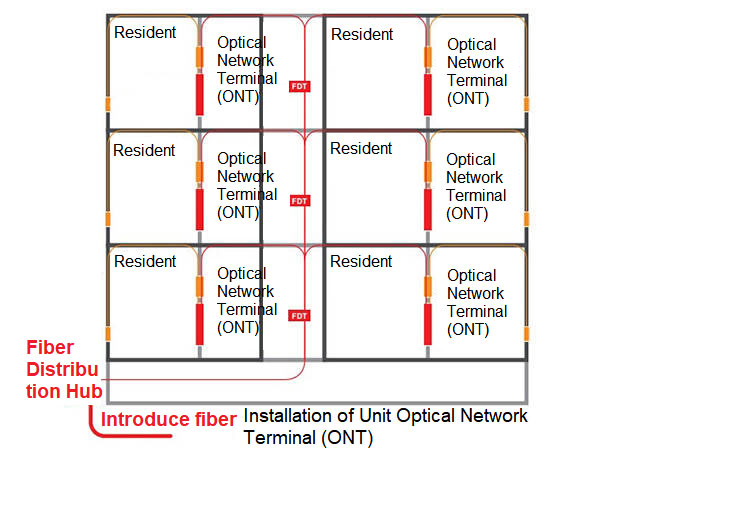
In general, the cost of installing a single-dwelling unit optical network terminal (ONT) will be higher because the related equipment is exclusive to a single household. The multi-dwelling unit optical network terminal (ONT) is that the residents of a unit building share related equipment, but if the number of end users is large, since the end users are connected through copper cables and the optical network terminal (ONT), the number of copper cables required at this time is also Many, the cost will increase. In addition, we should also consider network speed and security. The broadband speed and security provided by single-unit optical network terminals (ONT) will undoubtedly be higher. The following are examples of installing two types of optical network terminals (ONT) in a mid-to-high-rise multi-dwelling unit (MDU):
In this example, a multi-dwelling unit optical network terminal (ONT) is installed in the middle of the building, and multiple users share an optical network terminal (ONT), which has the feature of cost saving.
In this example, a single-dwelling unit optical network terminal (ONT) is installed in the building, and each resident has an exclusive use of an optical fiber, which requires a large number of optical fibers. This method is usually used in newly built multi-dwelling units (MDU).
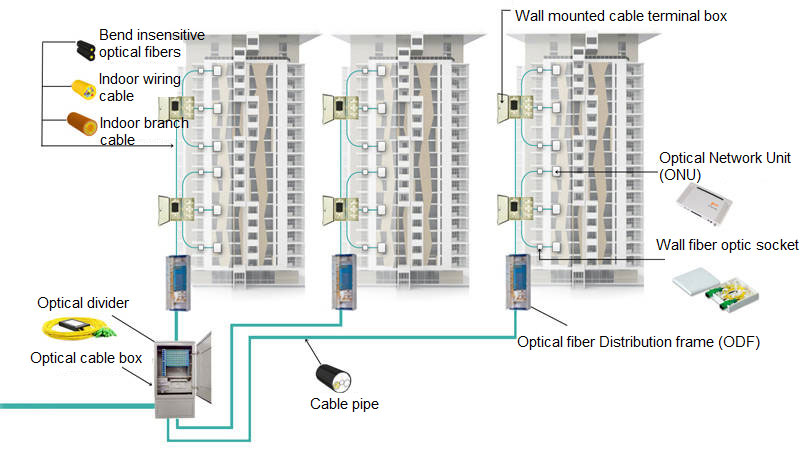
Due to the large number of residents in high-rise multi-dwelling units (MDU), a variety of optical fiber hardware equipment such as optical fiber cables, optical fiber distribution frames, and optical cable terminal boxes need to be used when laying fiber-to-the-premises (FTTP) networks. In order to better explain how to lay the optical fiber access network in the high-rise multi-dwelling unit (MDU), the following is an intuitive expression in the form of a legend:
As field consultants for international telecom deployments, our team at Unitekfiber Solution routinely resolves critical engineering roadblocks in multi-dwelling units. Here are two vital strategies for your field crews:
1. Managing Duct Starvation in Retrofit Projects
In older MDU structures, the existing vertical utility conduits are often choked with old copper telephone wires and coaxial cables, leaving almost zero physical space for new fiber deployment.
Our Solution: Avoid pulling traditional loose-tube cables. Instead, specify ultra-slim micro-duct fiber cables or adhesive-backed invisilight fiber configurations. Our G.657.A2 indoor clear drop cables can be glued directly along corridor crown moldings without disrupting building aesthetics or requiring heavy masonry conduit installations.
2. Guarding Against Micro-Bending inside Floor Enclosures
When pulling horizontal drops into individual apartment units, field technicians often force the fiber into tight, right-angle wall boxes or pinch them behind decorative baseboards. If the signal drops unexpectedly during testing, hook up an OTDR or an Optical Power Meter at 1550nm. Because 1550nm light is more sensitive to bending pressures than 1310nm, a massive power drop at 1550nm explicitly indicates a structural pinch point inside the tenant's wall outlet plate.
Thanks for your review, we hope it can help you to know the installation of MDU in FTTH solution. We are producing optical fiber indoor/outdoor cables, optical patch panels, fiber cable assembles etc. At the same time, it also produces optical transceiver modules, which can provide With different package types, transmission distance and transmission rate, it also has the characteristics of stable performance and strong compatibility. If you need any support,don't hesitate to contact us sales@unitekfiber.com.
The main difference lies in building density and cable routing architecture. An SFU (Single-Family Unit) is a standalone residence requiring an individual, direct optical drop cable from the nearest distribution closure.== An MDU (Multi-Dwelling Unit) is a multi-tenant structure (like an apartment or office complex) that requires centralized splitting hardware, high-tensile vertical riser cabling shafts, and specialized fire-retardant indoor distribution boxes to serve dozens of subscribers simultaneously.
MDU fiber networks primarily utilize PLC (Planar Lightwave Circuit) splitters due to their compact footprints and stable performance across the entire operating wavelength spectrum (1260nm to 1650nm). Depending on building density, engineers typically use a centralized configuration with a single 1:32 or 1:64 splitter in the basement, or a cascaded splitting architecture deploying a 1:4 splitter at the main entry point followed by 1:8 splitters on individual floor distribution hubs.
Indoor MDU cables must feature an LSZH (Low Smoke Zero Halogen) or OFNP (Plenum) rating to satisfy international building safety and fire codes. In the event of a structural fire, standard PVC jackets release thick, toxic black smoke and corrosive hydrogen halide gas. LSZH jackets emit extremely low levels of smoke and zero halogen toxins, protecting human life and keeping emergency egress paths visible in enclosed multi-tenant hallways.
Bend-insensitive fiber (conforming to the ITU-T G.657.A2 standard) features an altered refractive index profile that prevents light waves from escaping the glass core when the cable is tightly curved. In MDU installations—where cables must track along sharp hallway corners, pass through congested conduits, and coil inside small surface-mount wall boxes—G.657.A2 fiber prevents macro-bending signal attenuation, maintaining link stability where standard G.652.D fiber links would fail completely.
To verify the mechanical specifications, architectural layouts, and safety compliance codes utilized in this MDU guide, please refer to the official international standards documentation below:
 5G 6G Fronthaul & Backhaul
View More
5G 6G Fronthaul & Backhaul
View More
 Data Center & Cloud Interconnect
View More
Data Center & Cloud Interconnect
View More
 Enterprise & Industrial Optical
View More
Enterprise & Industrial Optical
View More
 FTTx & Access Solutions
View More
FTTx & Access Solutions
View More
 Metro & Access Networks
View More
Metro & Access Networks
View More
 Optical Cabling Systems
View More
Optical Cabling Systems
View More
 Optical Transceivers & Interconnect
View More
Optical Transceivers & Interconnect
View More
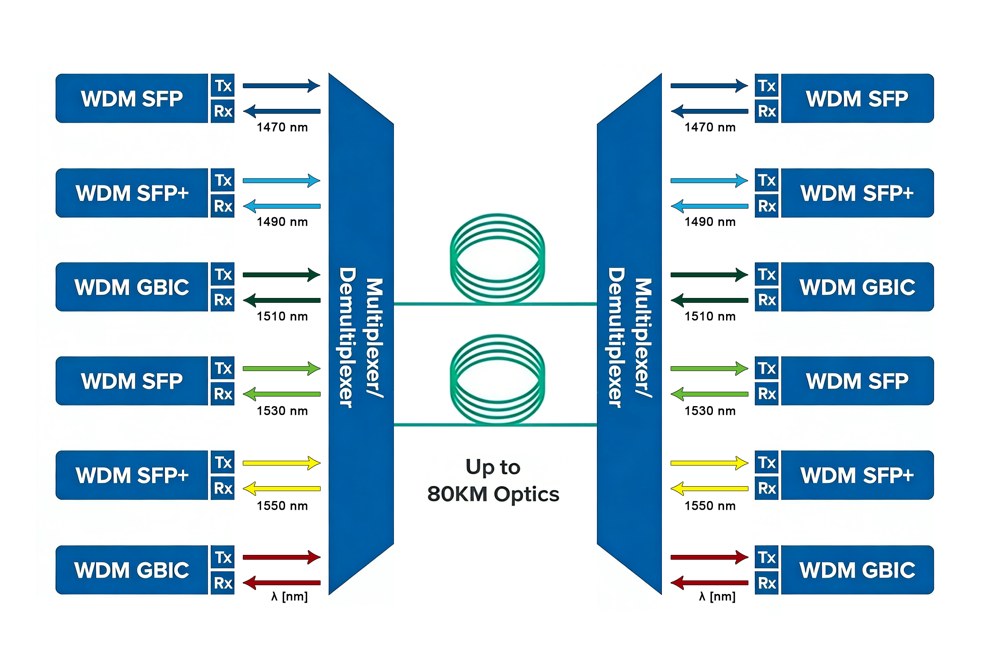 WDM & High-Capacity Transmission
View More
WDM & High-Capacity Transmission
View More
+86-755-21034367