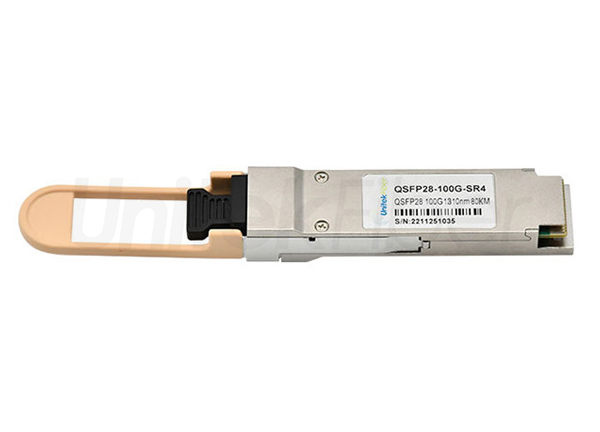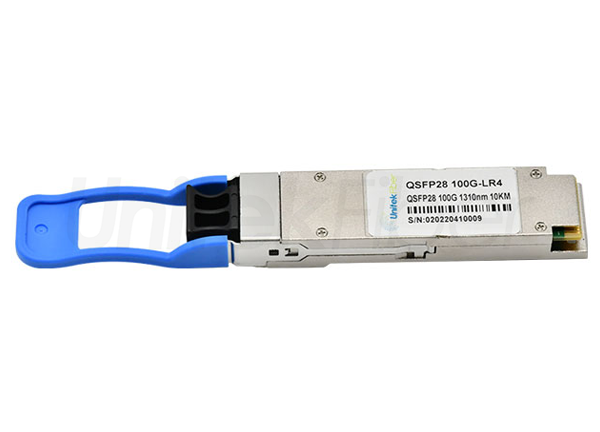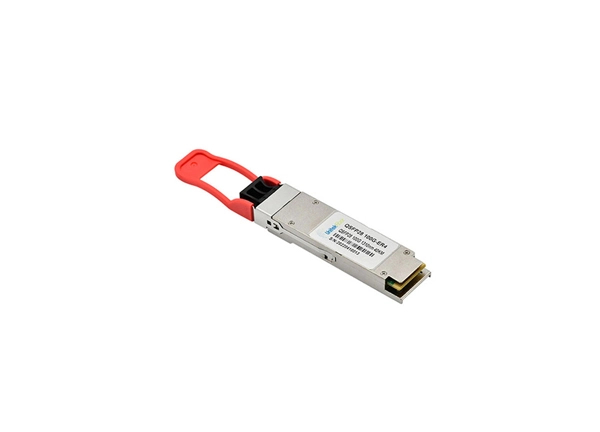

Among optical transceivers used for 100G links, the 100G QSFP28 has emerged as the top choice due to its compact size and low power consumption. What specific types of 100G QSFP28 optical transceivers are available, and what are the differences between them? And how should you choose among them? In this article, we will introduce 100G QSFP28 in detail, helping you understand the specific differences and connections among 100G QSFP28 optical transceivers.
100G QSFP28 optical transceivers are suitable for 100G Ethernet, EDR InfiniBand, and 32G Fibre Channel network, and typically have the same form factor and panel density as 40G QSFP+ optical transceiver. The 40G QSFP+ uses four 10Gbps channels. Similarly, 100G QSFP28 module employs four high-speed differential signal channels, supporting data rates of 25Gbps and potentially up to 40Gbps. Additionally, the QSFP28 features an upgraded electrical interface capable of supporting signals up to 28Gbps. Compared to other 100G fiber optic transceiver form factors (CFP/CFP2/CFP4), the 100G QSFP28(QSFP28 SR4, QSFP28 LR4, QSFP28 PSM4, QSFP28 CWDM4, and QSFP28 ER4)offer higher density, lower power consumption, and significant cost advantages.
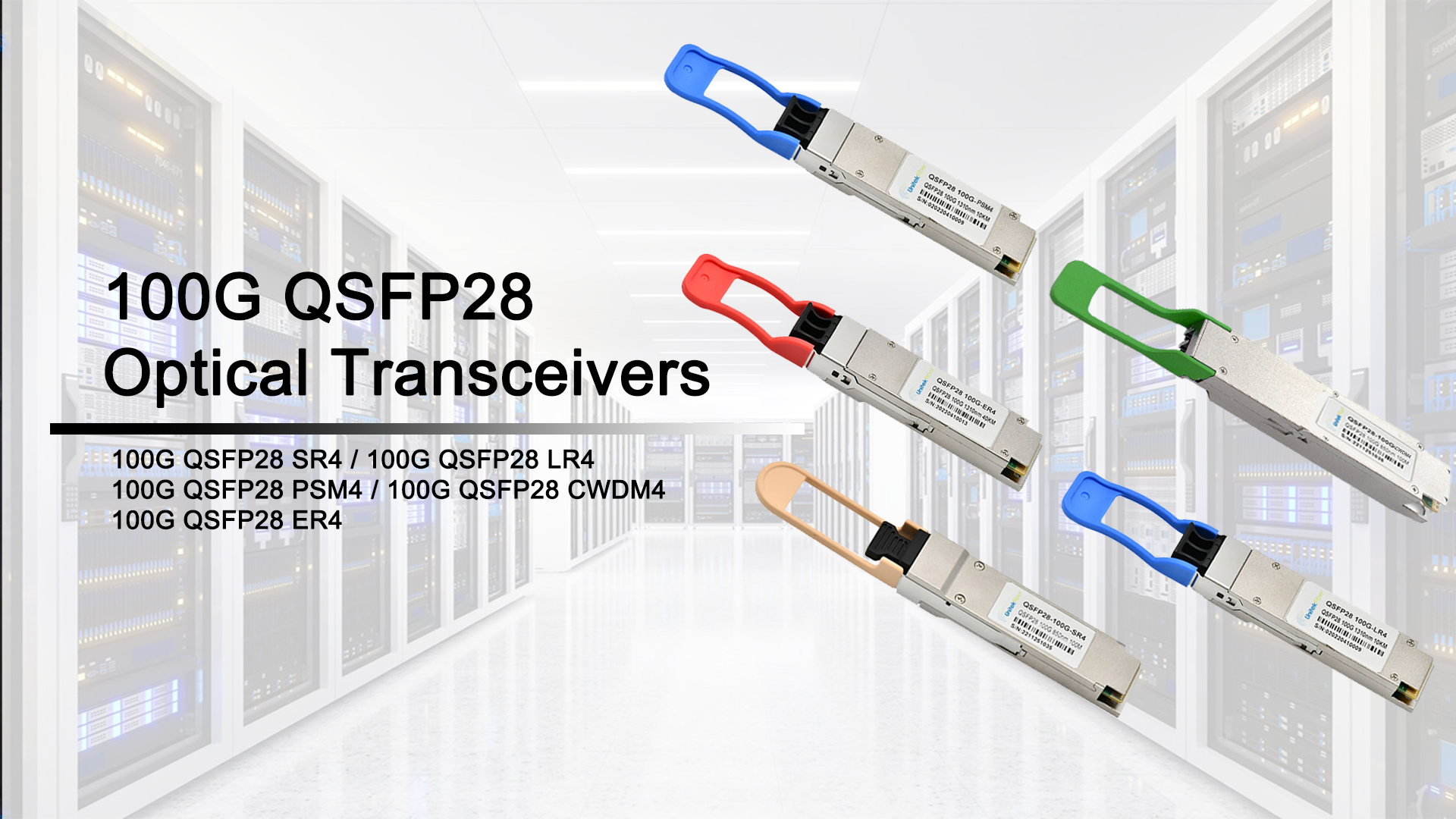
Having covered the basic concepts of the 100G QSFP28, this section will provide a detailed explanation of the differences among 100G QSFP28 optical transceiver in terms of standards, laser types, transmission media, and transmission distance.
The standards for 100G QSFP28 optical transceivers are primarily defined by two major organizations: the IEEE and the MSA. The IEEE has defined the standards for QSFP28 SR4, QSFP28 LR4, and QSFP28 ER4. “QSFP” refers to the module’s form factor; “28” indicates a maximum transmit data rate for each channel is 28 Gbpsl; “SR" stands for short reach (up to 100m), “LR” stands for long reach (up to 10km), and “ER” stands for extended reach (up to 40km); “4” indicates four channels. For example, QSFP28 LR4 means that this 100G fiber transceiver can transmit 100G signals through four wavelengths, with a maximum transmission distance of 10km.
100G-SR4 and 100G-LR4 optical transceivers are the two most common 100G port specifications defined by the IEEE. However, the transmission distance of QSFP28 SR4 optical transceiver is too short to meet all connectivity requirements, while QSFP28 LR4 optcial transceiver is too costly for large data centers application. Fortunately, the MSA has introduced new solutions for the mid-range transmission market: the QSFP28 PSM4 and CWDM4 fiber optic transceivers. Although the QSFP28 LR4 covers the same transmission distance as the QSFP28 CWDM4, but in terms of cost, the CWDM4 optical transceiver is far more cost-effective and competitive when transmitting over a 2-kilometer distance.
Lasers play a crucial role in 100G QSFP28 optical transceivers. There are five common types of lasers: VCSEL, FP, DFB, DML, and EML. These different types of lasers have distinct operating wavelengths, operating modes, and application environments.
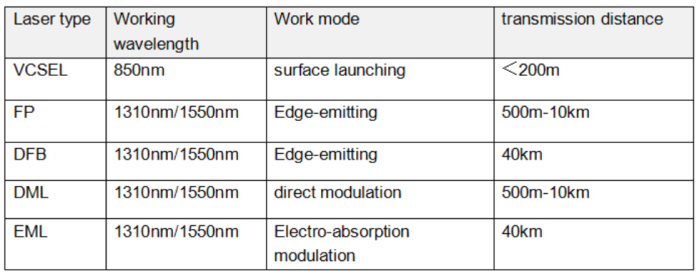
VCSEL lasers are characterized by their compact size, low power consumption, ease of integration, low cost, and high coupling efficiency with multimode fiber, they are commonly used in QSFP28 SR4 optical modules. QSFP28 LR4 and ER4 modules are used for long-distance transmission (10 km or 40 km), requesting lasers with a large eye figure, low dispersion, high extinction ratio, and long transmission distances—all of which EML lasers perfectly meet. DML lasers achieve signal modulation by modulating the laser’s injection current. Since the magnitude of the injection current alters the refractive index of the laser’s active region, it causes wavelength drift and thus generates dispersion. Therefore, DMLs are not suitable for long-distance transmission and cannot support high-speed signal modulation. However, they are suitable for QSFP28 PSM4 and QSFP28 CWDM4 fiber transceviers with transmission distances of 500m or 2 km.
100G QSFP28 optical transceivers feature duplex LC or MTP/MPO-12 fiber optic connectors, with transmission distances range from 70 meters to 40 kilometers. The transmission distance of these optical transceivers determines their application. All QSFP28 optical transceivers can be used for direct connections and interconnections in enterprise networks or data centers. Below are the differences between them for your check.
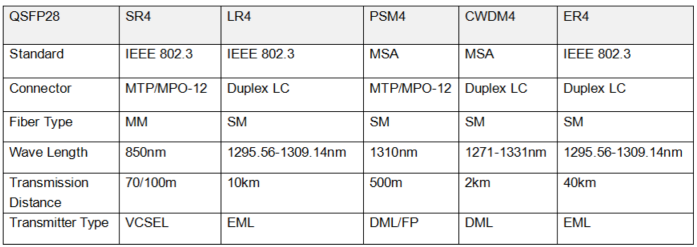
Now that we’ve introduced the different types of 100G QSFP28 fiber transceiver, you should have a basic understanding of them. Let’s discuss how to choose a 100G QSFP28 fiber optic transceivers.
For transmission distances between 5m and 100m, we recommend to choose 100G QSFP28 SR4 fiber transceiver. This type of fiber transceiver supports a transmission distance of 70m over OM3 fiber and 100m over OM4 fiber.
For transmission distances between 100m and 2km, you can choose either 100G QSFP28 PSM4 or 100G QSFP28 CWDM4 transceiver module. The price of the CWDM4 optical transceiver is generally higher than that of the PSM4 optical transceiver. However, the CWDM4 optical transceiver requires only two single-mode fibers for bidirectional transmission, whereas the PSM4 optical transceiver requires eight. Therefore, the overall cost of using the QSFP28 PSM4 fiber optic transceiver may be higher. In practical applications, you should consider the specific transmission distance before deciding which module is appropriate.
For transmission distances between 10 km and 40 km, either the QSFP28 LR4 or QSFP28 ER4 fiber transceivers can be selected. The former supports a maximum distance of 10 km, while the latter supports a maximum distance of 40 km.
Overall, the 100G QSFP28 offers high density and low power consumption, meeting current network demands while preparing for future network expansion, making it an ideal optical module solution for large data centers. UnitekFiber is a leading manufacturer for fiber optical transceiver offering high quality optical transceivers, including 1.25G SFP, 10G SFP+, 40G QSFP+, 100G QSFP28, 200G QSFP56, 400G QSFP-DD, 800G OSFP or etc.. All products undergo strict testing before shipment to ensure long term stable performance. Shop now at www.unitekfiber.com for more premium fiber transceivers.
 5G 6G Fronthaul & Backhaul
View More
5G 6G Fronthaul & Backhaul
View More
 Data Center & Cloud Interconnect
View More
Data Center & Cloud Interconnect
View More
 Enterprise & Industrial Optical
View More
Enterprise & Industrial Optical
View More
 FTTx & Access Solutions
View More
FTTx & Access Solutions
View More
 Metro & Access Networks
View More
Metro & Access Networks
View More
 Optical Cabling Systems
View More
Optical Cabling Systems
View More
 Optical Transceivers & Interconnect
View More
Optical Transceivers & Interconnect
View More
 WDM & High-Capacity Transmission
View More
WDM & High-Capacity Transmission
View More
+86-755-21034367