
An optical transceiver is a hot-swappable, integrated optoelectronic device that facilitates bidirectional data transmission by converting electrical signals into optical signals (E-O conversion) and vice versa (O-E conversion). Acting as the "heart" of fiber-optic networks, these modules—ranging from 1G SFP to 800G QSFP-DD—enable high-speed connectivity across data centers, telecommunications, and enterprise backbones. Key performance factors include data rate, reach, wavelength, and MSA compatibility.
An optical transceiver (also known as an optical module or fiber optic transceiver) is a critical component used in optical fiber communication systems. It bridges the gap between networking hardware—such as switches, routers, and firewalls—and the fiber optic cabling infrastructure.
Unlike a simple "converter," a modern transceiver is a sophisticated assembly that includes a Transmitter Optical Sub-Assembly (TOSA), a Receiver Optical Sub-Assembly (ROSA), and a complex PCBA containing the driver IC and a microcontroller for Digital Diagnostic Monitoring (DDM). At Unitekfiber, we adhere to the Multi-Source Agreement (MSA) standards to ensure these modules are physically and electrically interchangeable across different hardware platforms.
The operational logic of a transceiver is based on the principle of Optical Interconnect. The process can be broken down into two synchronized paths:
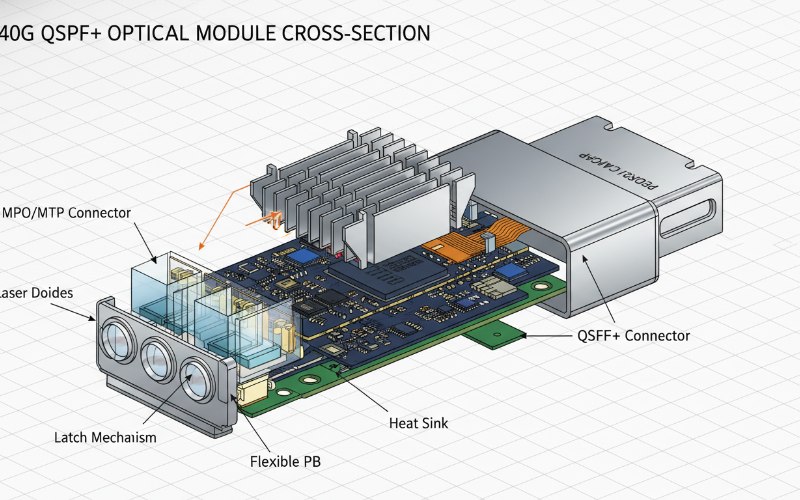
Electrical Input: The host device (e.g., a Cisco switch) sends high-speed electrical signals into the transceiver via the gold-finger interface.
Laser Driving: The driver IC modulates these electrical pulses into a light source—typically a VCSEL (for short distances), a DFB laser, or an EML laser (for long distances).
Optical Output: The TOSA focuses this light into the fiber optic core, sending data as light pulses across the network.
Light Detection: On the other end, the ROSA uses a Photodiode (PIN or APD) to capture the incoming light pulses.
Signal Recovery: The TIA (Trans-Impedance Amplifier) and limiting amplifier convert the weak optical current back into a clean, digital electrical signal.
Data Output: The recovered electrical signal is sent back to the host device for processing.
Modern transceivers are much more than simple "plugs." At Unitekfiber, we focus on the following core features:
Hot-Swappability: The ability to insert or remove modules without powering down the host device, minimizing network downtime.
Digital Diagnostic Monitoring (DDM/DOM): Real-time tracking of temperature, voltage, laser bias current, and TX/RX optical power.
Low Power Consumption: With data centers aiming for better PUE, our 100G modules are optimized to consume <3.5W, and 400G modules under 12W.
Small Form Factor: High-density designs allow for up to 48 ports on a single 1U switch panel.
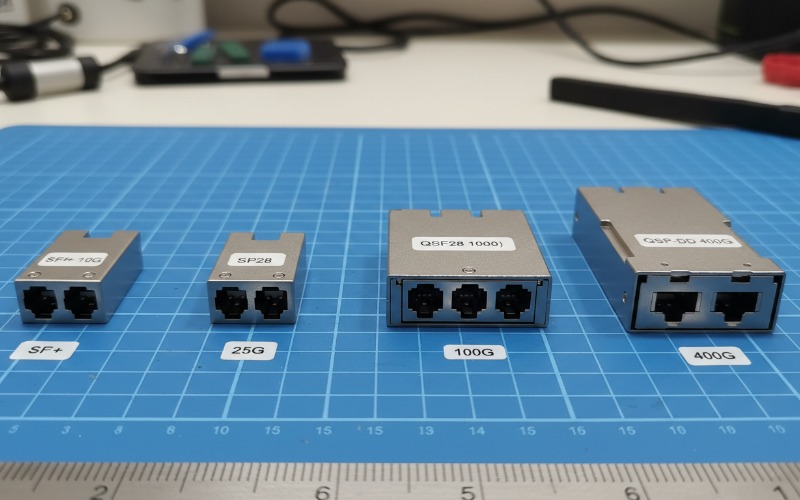
The industry classifies transceivers primarily by their physical "form factor" and the speeds they support:
The SFP (Small Form-factor Pluggable) is the veteran of the industry. SFP+ is the enhanced version, supporting 10Gbps and widely used in enterprise core networks.
The successor to SFP+, SFP28 is the primary interface for 5G front-haul and high-density server access in data centers, utilizing 25G NRZ signaling.
QSFP (Quad SFP) utilizes four parallel lanes. QSFP28 is the dominant standard for 100G, supporting $4 \times 25Gbps$ configurations.
QSFP-DD (Double Density) and OSFP are designed for hyperscale clouds, utilizing PAM4 modulation to achieve massive throughput within a compact footprint.
Transceivers are the "connectors" of the digital age, found in nearly every high-bandwidth environment:
Data Centers: Enabling Leaf-Spine architectures and server-to-switch ToR (Top-of-Rack) links.
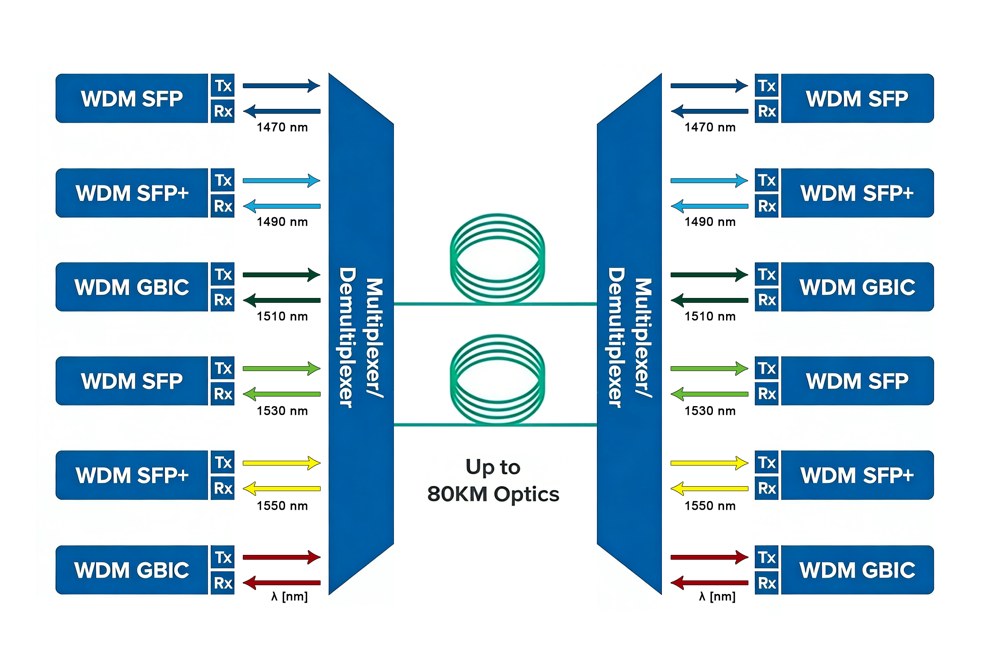
Telecommunications: Used in WDM/OTN systems for long-haul metropolitan area networks (MAN).
Enterprise LANs: Connecting floor-level access switches to the building's central core switch via fiber backbones.
5G Wireless Networks: SFP28 and CPRI modules facilitate the link between the Baseband Unit (BBU) and the Remote Radio Head (RRH).
The bandwidth of a module is not arbitrary; it is governed by three technical variables:
Baud Rate (Symbol Rate): How many times the light signal changes per second.
Modulation Technique: NRZ (Non-Return to Zero) carries 1 bit per symbol, while PAM4 (Pulse Amplitude Modulation) carries 2 bits per symbol, effectively doubling the speed without increasing the baud rate.
Number of Channels: Parallel optics (e.g., QSFP) use multiple lanes (4 x 25G or 8 x 53G) to aggregate speed.
As a wholesaler with 20 years of experience, I advise my clients to look beyond the price tag. Consider these 4 pillars:
Short Reach (SR): Up to 300m via MMF (OM3/OM4).
Intermediate/Long Reach (LR/ER/ZR): From 10km to 120km via SMF (OS2).
Ensure the transceiver matches your cabling. A Singlemode (SMF) transceiver will not work over Multimode (MMF) fiber due to core diameter mismatch (9µm vs 50µm).
Does the module's EEPROM contain the correct vendor code (Cisco, Juniper, Arista)? Unitekfiber provides hardened compatibility to ensure 100% "plug-and-play" recognition.
Calculate your link loss using:

Ensure the fiber attenuation and connector losses do not exceed this budget.
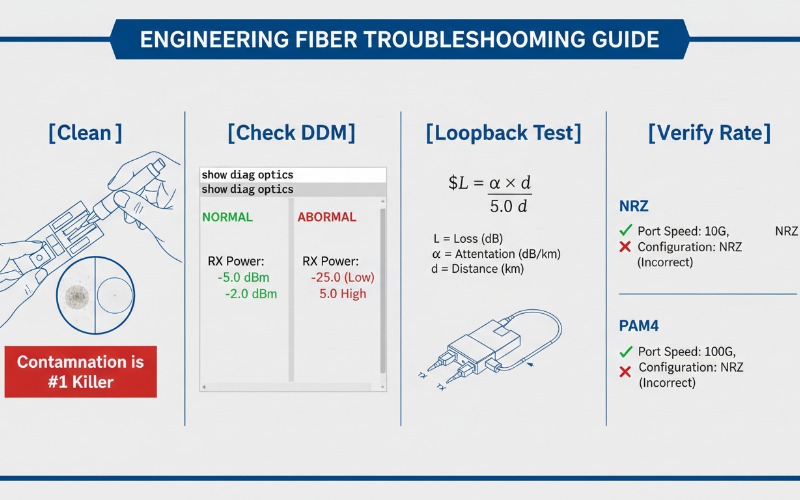
When a link goes down, follow this engineering checklist:
Check the DDM Data: Use the CLI command show inventory or show diagnostic to check the RX Power. If it is too low (e.g., below -15dBm for an LR module), the fiber is dirty or broken.
Clean the End-Faces: 80% of transceiver failures are caused by dust. Use a "One-Click" cleaner on both the module and the patch cord.
Loopback Test: Connect the TX of the module to its own RX (using an attenuator). If the link comes up, the module is fine, and the problem lies in the fiber run.
Verify Rate Negotiation: Ensure both ends of the link are set to the same speed (e.g., both 10G or both Auto).
Selecting the right optical transceiver is a balance of technical precision and cost-efficiency. At Unitekfiber, we don't just sell modules; we provide engineered solutions. From 10G SFP+ for enterprise stability to 400G QSFP-DD for AI-driven data centers, our products are built for the future.
What is the life expectancy of an optical transceiver?
Typically 10-15 years under controlled temperature environments. High heat is the #1 killer of laser diodes.
Are third-party transceivers safe for my switch?
Yes, provided they are MSA-compliant. They use the same hardware components as OEM brands but without the branding markup.
What is a BiDi transceiver?
A Bidirectional (BiDi) module uses WDM to send and receive over a single fiber strand, effectively doubling your fiber capacity.
 5G 6G Fronthaul & Backhaul
View More
5G 6G Fronthaul & Backhaul
View More
 Data Center & Cloud Interconnect
View More
Data Center & Cloud Interconnect
View More
 Enterprise & Industrial Optical
View More
Enterprise & Industrial Optical
View More
 FTTx & Access Solutions
View More
FTTx & Access Solutions
View More
 Metro & Access Networks
View More
Metro & Access Networks
View More
 Optical Cabling Systems
View More
Optical Cabling Systems
View More
 Optical Transceivers & Interconnect
View More
Optical Transceivers & Interconnect
View More
 WDM & High-Capacity Transmission
View More
WDM & High-Capacity Transmission
View More
+86-755-21034367