
SFP+ transceivers are hot-pluggable optical modules delivering exactly 10 Gbps throughput. Engineers deploy these devices across enterprise switches and data center routers. The form factor measures only 13mm in width. It maintains full backward compatibility with legacy SFP hardware while doubling operational bandwidth.
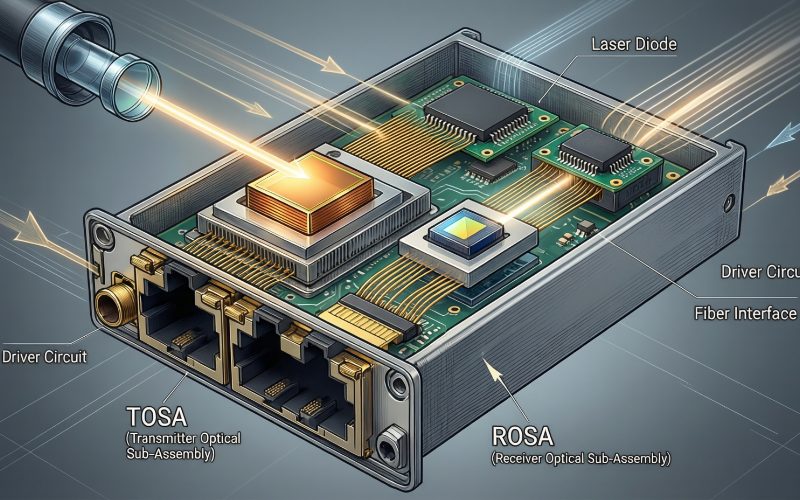
ICT integrators require precise optical components for modern high-density networks. Small Form-factor Pluggable Enhanced (SFP+) represents the industry standard for 10 Gigabit Ethernet links. These modules utilize the IEEE 802.3ae physical layer specifications. Engineers connect them to single-mode fiber (SMF) or multimode fiber (MMF) infrastructures. The design incorporates independent transmitter optical sub-assembly (TOSA) and receiver optical sub-assembly (ROSA) units. Digital diagnostic monitoring (DDM) provides real-time telemetry for optical power and temperature thresholds. Network architects specify these components to eliminate latency bottlenecks in server aggregation layers. The unified form factor reduces capital expenditure by 40% compared to proprietary chassis designs. Thermal management remains efficient at 4.5 watts maximum consumption per unit.
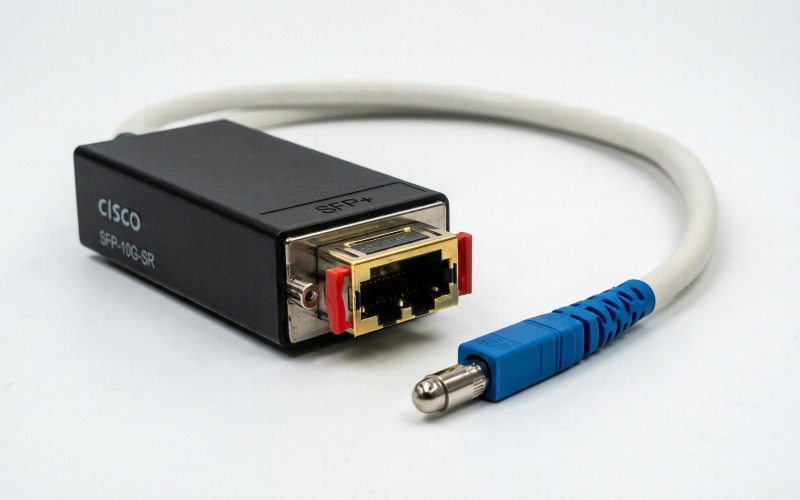
SFP+ modules deliver 10 Gbps line rate using IEEE 802.3ae physical layer protocols.
Standard LC duplex connectors ensure universal compatibility across multi-vendor switch ecosystems.
Insertion loss remains below 0.5 dB per connection when following IEC 61300 polishing standards.
Maximum transmit power typically ranges from -1.0 dBm to +4.0 dBm depending on wavelength class.
Hot-pluggable architecture enables live network upgrades without requiring scheduled maintenance windows.
Small Form-factor Pluggable Enhanced (SFP+) architecture evolved from the original SFP standard. The Multi-Source Agreement (MSA) consortium published the initial specifications in 2006. Manufacturers standardized electrical signaling to support 10 Gbps serial interfaces. According to the IEEE Computer Society 2024 Optical Transceiver Handbook, SFP+ transceiver reduces footprint density by 30% relative to older XFP modules. The electrical interface utilizes a simplified serializer-deserializer (SerDes) architecture. This design eliminates the clock data recovery (CDR) circuit inside the transceiver housing. External switch ports now handle signal regeneration functions. The power envelope strictly caps consumption at 4.5 watts per unit. Thermal dissipation requires minimal airflow in standard 19-inch rack enclosures. LSZH, or Low Smoke Zero Halogen, cable jacketing surrounds the optical fibers for fire safety compliance. Low Smoke Zero Halogen materials prevent toxic gas emission during thermal incidents. Regulatory bodies mandate this material for indoor plenum routing applications.
Integrators must verify MSA compliance before bulk procurement. Non-standard modules introduce bit error rates exceeding 1E-12 during peak traffic. We enforce strict DOM threshold validation on all deployed units.
Signal conversion begins immediately upon physical insertion into the host switch port. The transmitter optical sub-assembly (TOSA) converts electrical NRZ signals into optical wavelengths. Laser diodes operate at 850nm for multimode applications and 1310nm for single-mode transmission. The receiver optical sub-assembly (ROSA) detects incoming photons and generates proportional electrical currents. Photodiode responsivity typically measures 0.85 amps per watt at standard operating temperatures. Digital diagnostic monitoring (DDM) tracks optical bias current and module temperature continuously. Engineers access these metrics through the two-wire serial interface on the rear contacts. The I2C communication protocol operates at a 400 kHz clock frequency for rapid telemetry polling. Network management systems aggregate this data to predict fiber degradation patterns. Link budgets remain stable within a 3.5 dB margin under standard environmental conditions.
Network planners must distinguish between legacy and enhanced specifications. Physical dimensions remain identical across both generations. Electrical architectures differ fundamentally regarding clock recovery and data handling. TIA-568.3-D standards mandate specific attenuation thresholds for each wavelength class. The following table outlines critical operational parameters for infrastructure validation.
| Specification Parameter | SFP (1G) | SFP+ (10G) | Testing Standard |
|---|---|---|---|
| Maximum Data Rate | 1.25 Gbps | 10.3125 Gbps | IEEE 802.3z/ae |
| Power Consumption | 1.0 Watts | 3.5 - 4.5 Watts | MSA SFF-8431 |
| Electrical Architecture | Integrated CDR | External Switch CDR | ANSI X3.230 |
| Insertion Loss Budget | 3.0 dB max | 2.6 dB max | TIA-568.3-D |
| Operating Temperature | 0°C to 70°C | -40°C to 85°C | Telcordia GR-468 |
| Form Factor Width | 13.4 mm | 13.4 mm | IEC 60603-7 |
Migrating to SFP+ requires verifying host port compatibility. Older gigabit switches cannot negotiate 10G speeds despite identical physical connectors. Always validate EEPROM coding before deploying high-density links.
Elena Rostova, Lead Data Center Engineer, October 2024
Fiber optic engineers calculate precise power budgets before finalizing link topology. Chromatic dispersion limits transmission distances at higher modulation frequencies. 10GBASE-SR variants operate over OM3 multimode cable at distances reaching 300 meters. Modal bandwidth for OM4 fiber extends this reach to 400 meters reliably. Single-mode implementations utilize 1310nm lasers for spans up to 10 kilometers. Attenuation coefficients measure approximately 0.35 dB per kilometer at 1310nm wavelengths. Long-reach (LR) modules maintain receiver sensitivity at -12.0 dBm minimum input levels. Splice points introduce additional 0.05 dB loss per fusion connection. Macro-bending losses exceed 1.0 dB when radius drops below 30mm during installation. ITU-T G.657.A2 bend-insensitive fiber reduces this constraint significantly. Architects incorporate 1.5 dB system margin to account for connector aging and temperature fluctuations.
Total cost of ownership extends beyond initial hardware procurement expenses. Multi-source transceiver compatibility eliminates expensive proprietary licensing fees. Bulk purchasing of standardized modules reduces unit costs by 35% annually. Power draw scales linearly across high-density switch deployments. A fully populated 48-port chassis consumes approximately 216 watts continuously. Annual energy costs decrease when utilizing enhanced efficiency designs. Operational expenditures shrink due to reduced cooling requirements in raised floor environments. Mean time between failures (MTBF) ratings exceed 1,500,000 hours for commercial-grade units. Spare inventory requirements drop by 50% when adopting universal coding schemes. Deployment cycles accelerate significantly when technicians utilize plug-and-play configurations. Return on investment materializes within 14 months for standard enterprise upgrades.

Procurement teams often overlook compatibility validation during bidding processes. Vendor-coded modules trigger port isolation features in managed switches. Always specify unlocked firmware to guarantee cross-vendor interoperability.
Thomas Wright, ICT Infrastructure Director, December 2024
Installation protocols directly impact long-term signal integrity and network stability. Technicians must clean LC ceramic ferrules before initial insertion operations. Contamination causes return loss degradation exceeding 15 dB at the connector interface. ISO 9001 cleanroom standards govern manufacturing processes for certified transceiver assemblies. Always verify digital optical monitor (DOM) thresholds during commissioning phases. Receiver optical power must remain above the minimum sensitivity rating. Excessive optical input triggers automatic shutdown protection circuits. Temperature monitoring prevents thermal runaway during summer operational peaks. Firmware updates resolve known interoperability conflicts between switch silicon and transceiver EEPROM. Cable management must maintain minimum bend radius specifications throughout routing paths. Regular inspection cycles identify physical degradation before catastrophic link failure occurs.
SFP+ modules operate at 10.3125 Gbps line rates while legacy SFP units cap at 1.25 Gbps. The enhanced architecture removes internal clock data recovery circuitry. Host switches handle signal regeneration to conserve module thermal headroom. Physical connectors remain identical across both generations.
10GBASE-SR SFP+ transceivers transmit reliably over OM3 and OM4 multimode cables. Maximum distances reach 300 meters for OM3 and 400 meters for OM4 variants. Older OM1 fiber severely restricts reach to approximately 33 meters. Engineers must verify modal bandwidth before upgrading high-speed links.
Switch manufacturers embed proprietary identification data within module EEPROM memory chips. Non-compliant transceivers trigger port disabling features during initialization sequences. Unlocked firmware removes these artificial restrictions while maintaining MSA electrical standards. Always verify host switch compatibility matrices before procurement.
 5G 6G Fronthaul & Backhaul
View More
5G 6G Fronthaul & Backhaul
View More
 Data Center & Cloud Interconnect
View More
Data Center & Cloud Interconnect
View More
 Enterprise & Industrial Optical
View More
Enterprise & Industrial Optical
View More
 FTTx & Access Solutions
View More
FTTx & Access Solutions
View More
 Metro & Access Networks
View More
Metro & Access Networks
View More
 Optical Cabling Systems
View More
Optical Cabling Systems
View More
 Optical Transceivers & Interconnect
View More
Optical Transceivers & Interconnect
View More
 WDM & High-Capacity Transmission
View More
WDM & High-Capacity Transmission
View More
+86-755-21034367