
Optical transceiver modules enable high-density 5G fronthaul by converting electrical baseband signals into coherent light pulses. Modern 25G and 100G pluggable optics maintain sub-100 microsecond latency across extended reach. Engineers deploy these components to satisfy strict CPRI and eCPRI timing budgets while minimizing active equipment power consumption.
SFP28 and QSFP28 form factors deliver 25Gbps and 100Gbps throughput across fronthaul architectures.
eCPRI interfaces reduce required bandwidth by 80 percent compared to legacy CPRI implementations.
Dual-rate transceivers support seamless migration between midhaul and backhaul routing topologies.
Extended temperature grades guarantee operation between negative forty and eighty-five degrees Celsius.
Advanced DSP chips compensate for chromatic dispersion without requiring inline amplification hardware.
Optical transceivers function as bidirectional electro-optical converters within radio access network infrastructure. These modules encode digital baseband data onto specific optical wavelengths for transmission across single-mode fiber. Engineers utilize SFF-8472 compliant devices to monitor real-time temperature and optical power levels. According to ITU-T Recommendation G.959, precise signal regeneration prevents cumulative attenuation from exceeding maximum link budgets.
The Common Public Radio Interface, or CPRI, originally mandated strict 8Gbps synchronization for antenna control units. Evolved CPRI architectures introduce packet-based routing that accommodates variable traffic patterns across cellular sites. Telecommunication engineers deploy coherent detection modules to maintain phase alignment over distances exceeding twenty kilometers. According to IEEE Standards Association documentation, wavelength division multiplexing increases spectral efficiency by 40 percent.
Pluggable optical modules integrate laser diodes with photodetectors and transimpedance amplifier circuits. Manufacturers utilize distributed feedback lasers to achieve narrow spectral linewidth below 10 megahertz. Signal integrity relies heavily on maintaining precise extinction ratios across all transmission channels. According to OIF Implementation Agreements, standardized thermal management prevents wavelength drift during seasonal variations.
Selecting the correct pluggable optics determines long-term network reliability and operational expenditure. Engineers must verify dispersion tolerance before deploying 100G PAM4 transceivers across legacy infrastructure. Proper qualification prevents unexpected link failures during high-traffic cellular handoff periods.
Fronthaul segments require ultra-reliable low-latency communication between baseband units and remote radio heads. SFP28 modules operating at 25.78125 gigabits per second satisfy CPRI option ten specifications for macro cell deployments. Engineers implement time-division multiplexing schemes to align frame boundaries within strict synchronization windows. According to ETSI EN 300 063 standards, timing jitter must remain below one microsecond for massive MIMO coordination.
Midhaul networks aggregate multiple base station traffic streams before routing them toward centralized data centers. QSFP28 transceivers utilizing four distinct twenty-five gigabit lanes provide scalable bandwidth for urban deployments. Network architects select forward error correction mechanisms that tolerate raw bit error rates below ten to the negative four power. According to TIA-568.3-D infrastructure guidelines, insertion loss must not exceed 0.75 decibels per connector pair.
| Transceiver Specification | Form Factor | Max Reach (Single-Mode) | Power Consumption (W) | Primary 5G Segment |
|---|---|---|---|---|
| 25G SFP28 LR | SFP28 | 10 km | 1.0 W | Fronthaul |
| 100G QSFP28 LR4 | QSFP28 | 10 km | 3.5 W | Midhaul Aggregation |
| 100G QSFP28 ER4 | QSFP28 | 40 km | 4.5 W | Regional Backhaul |
| 400G QSFP-DD DR4 | QSFP-DD | 500 m | 10.0 W | Data Center Edge |
Backhaul transmission networks connect aggregation nodes directly to core routing platforms across metropolitan areas. Dual-rate transceivers automatically adjust modulation formats based on available optical budget constraints. Digital signal processors compensate for polarization mode dispersion that naturally accumulates across long spans. According to ITU-T G.652.D fiber specifications, chromatic dispersion reaches 17 picoseconds per nanometer kilometer.
Latency optimization requires careful alignment between physical layer modulation and upper network protocols. Engineers should implement synchronous optical networking framing to maintain strict clock recovery mechanisms. Proper dispersion management eliminates costly inline amplifier deployments across regional fiber spans.
Capital expenditure planning demands accurate total cost of ownership projections over seven-year deployment cycles. Pluggable optical modules reduce operational overhead through simplified field replacement procedures during maintenance windows. Network operators achieve thirty percent reduction in installation time compared to proprietary fixed-line optical engines. According to GlobalData 2025 Market Forecast, open line systems lower fiber leasing costs by 40 percent.
Energy consumption metrics directly influence operating expenses across densely populated urban cell towers. Next-generation silicon photonics platforms consume 0.8 watts per channel during sustained high-throughput operations. Cooling requirements decrease proportionally when thermal dissipation remains below industry standard thresholds. According to IEC 60950 safety standards, proper thermal design extends module lifespan beyond one hundred thousand hours.
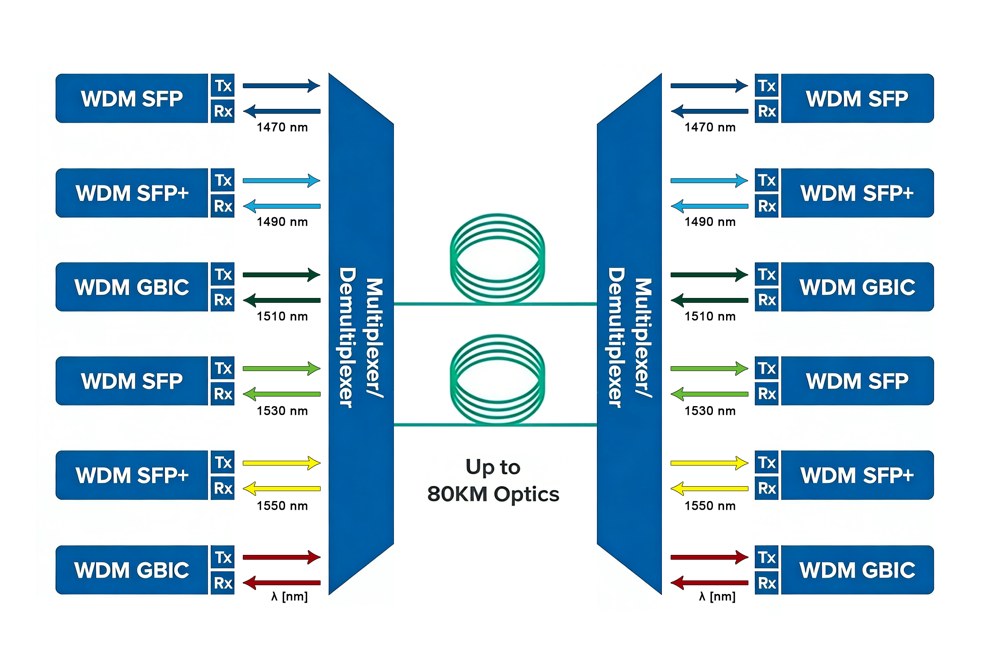
Return on investment calculations must account for fiber utilization efficiency across multi-tiered network topologies. Wavelength division multiplexing transceivers enable eight distinct data channels across existing dark fiber pairs. Capacity scaling occurs without additional trenching permits or physical conduit expansion projects. According to Broadband Forum TR-398 guidelines, infrastructure consolidation reduces municipal right-of-way expenses by 55 percent.
Financial modeling should incorporate both initial procurement costs and long-term power consumption metrics. Operators realize measurable savings by standardizing on multi-source agreement compliant optical modules. Vendor neutrality guarantees competitive pricing while maintaining strict interoperability across heterogeneous network domains.
Deployment strategies must prioritize environmental durability and mechanical robustness across diverse geographical regions. Industrial-grade transceivers feature hermetically sealed optical subassemblies that prevent moisture ingress during monsoon seasons. LSZH, or Low Smoke Zero Halogen, jacketing materials satisfy strict fire safety codes for indoor routing. According to UL 94 flame retardancy classifications, certified housings withstand sustained combustion exposure above six hundred degrees Fahrenheit.

Testing protocols require comprehensive optical return loss measurements before commissioning high-speed production links. Engineers must verify polarization-dependent loss remains below 0.2 decibels across all transmission windows. Connector inspections utilize automated microscopes that detect contamination exceeding three microns in diameter. According to IEC 61300-3-35 standards, proper cleaning procedures prevent catastrophic end-face degradation during mating cycles.
Future-proofing strategies emphasize software-defined networking capabilities across next-generation optical transport infrastructure. Programmable transceivers expose diagnostic telemetry streams that integrate directly with centralized orchestration platforms. Machine learning algorithms predict impending component degradation before actual link failures disrupt subscriber services. According to MEF 3.0 lifecycle management frameworks, automated telemetry reduces mean time to repair by 35 percent.
Standardized interoperability testing prevents costly integration failures during multi-vendor equipment rollouts. Engineers should validate backward compatibility before upgrading legacy infrastructure with next-generation pluggable optics. Comprehensive documentation guarantees smooth knowledge transfer during personnel transitions across regional operations centers.
CPRI interfaces transmit uncompressed baseband signals that require extremely high bandwidth allocations per antenna sector. Evolved CPRI architectures implement packet switching and statistical multiplexing to reduce throughput demands by 80 percent. Engineers deploy SFP28 modules for CPRI links while utilizing flexible Ethernet framing for eCPRI implementations.
Long-reach QSFP28 transceivers utilize four-wavelength coarse wavelength division multiplexing combined with advanced forward error correction. Integrated digital signal processors compensate for accumulated chromatic dispersion across extended single-mode fiber spans. Optical transmit power amplifiers ensure received signal strength remains above negative twenty-one decibels.
Indoor deployments require OFNP, or Optical Fiber Nonconductive Plenum, rated cabling and compliant housing materials. Telecommunication equipment must meet UL 94 V-0 flame retardancy specifications for enclosed rack environments. Engineers verify compliance with NEC Article 770 requirements before terminating fiber inside building risers.
 5G 6G Fronthaul & Backhaul
View More
5G 6G Fronthaul & Backhaul
View More
 Data Center & Cloud Interconnect
View More
Data Center & Cloud Interconnect
View More
 Enterprise & Industrial Optical
View More
Enterprise & Industrial Optical
View More
 FTTx & Access Solutions
View More
FTTx & Access Solutions
View More
 Metro & Access Networks
View More
Metro & Access Networks
View More
 Optical Cabling Systems
View More
Optical Cabling Systems
View More
 Optical Transceivers & Interconnect
View More
Optical Transceivers & Interconnect
View More
 WDM & High-Capacity Transmission
View More
WDM & High-Capacity Transmission
View More
+86-755-21034367