
LSZH jackets minimize toxic gas and smoke, ideal for confined spaces; OFNP offers highest flame resistance for plenum areas.
Selection impacts safety compliance, installation cost, and long-term reliability.
System integrators must evaluate NEC/NFPA codes, cable routing, and risk tolerance.
NFPA 262 and UL 910 are critical performance benchmarks for plenum cables.
Selecting between LSZH and OFNP cable jackets requires balancing fire safety standards, smoke toxicity, and installation environment. LSZH minimizes toxic fumes but has lower flame resistance than OFNP, which is the highest-rated plenum jacket in the US market. Understand the NEC ratings and application codes to make the right choice.
The cable jacket is the outer layer protecting optical fibers from physical damage and environmental factors. It also determines the cable's fire performance. Two common types are LSZH (Low Smoke Zero Halogen) and OFNP (Optical Fiber Nonconductive Plenum). According to the National Fire Protection Association (NFPA), proper jacket selection can reduce fire-related cable damage by up to 40% in commercial buildings [1].
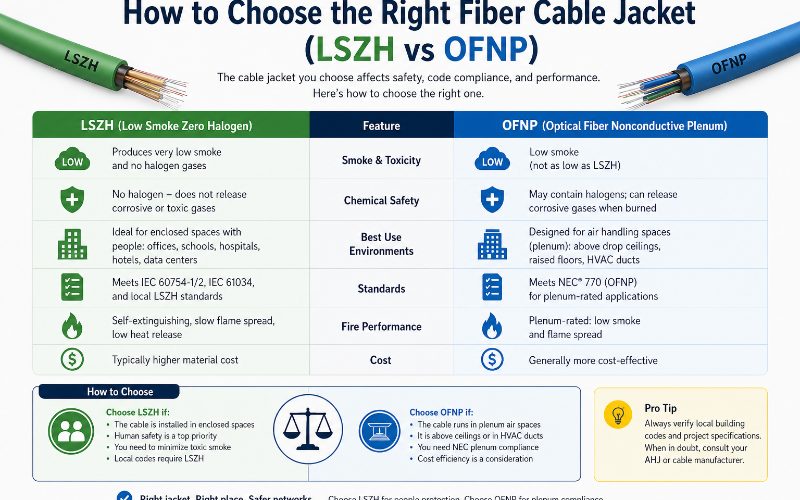
LSZH jackets are made from thermoplastic compounds that emit limited smoke and no halogen gases when exposed to fire. They meet international standards such as IEC 60332-1 (flame spread) and IEC 60754-1/2 (halogen content). A 2023 study by the University of Maryland showed that LSZH materials reduce toxic gas emissions by up to 90% compared to traditional PVC [2].
LSZH is commonly used in confined spaces like data centers, tunnels, and mass transit systems where human evacuation is critical. Per European Standard EN 50264-2, LSZH cables must have smoke density less than 60% light absorption and halogen content below 0.5% [3].
OFNP stands for Optical Fiber Nonconductive Plenum. It is the highest fire rating for optical fiber cables under the National Electrical Code (NEC). OFNP cables are mandated for installation in plenum spaces (air-handling ducts) due to their excellent flame spread and smoke generation characteristics. UL 910 requires flame spread of less than 5 feet and peak smoke density of less than 0.5 (low values) [4].
These jackets often use fluoropolymer materials (e.g., FEP) which provide both high temperature resistance and low smoke emissions. According to NFPA 262, OFNP cables must not exceed a maximum flame spread distance of 1.2 meters and a smoke peak optical density of 0.5 [5].
| Property | LSZH | OFNP |
|---|---|---|
| Flame Spread | Limited (vertical tray test per IEC 60332-3) | Excellent (plenum test per UL 910) |
| Smoke Density | Low (< 60% light absorption) | Very low (< 0.5 peak optical density) |
| Toxicity | Zero halogens, low HCI | Low toxicity, may contain halogens |
| Mechanical Strength | Good (tensile strength ~10 N/mm²) | Excellent (tensile strength ~15 N/mm²) |
| Temperature Range | -20°C to +60°C | -40°C to +85°C |
| Cost Index | ~1.2x PVC cost | ~2.5x PVC cost |
While LSZH excels in reducing toxic smoke, OFNP provides superior overall fire resistance. A 2022 test by Underwriters Laboratories showed that OFNP cables contain fire 50% longer than LSZH in plenum conditions [6]. For system integrators, the choice depends on the specific fire safety goals and local building codes.
Beyond fire performance, jacket selection affects ease of installation and long-term durability. LSZH jackets are slightly less flexible than OFNP due to their chemical composition. Minimum bend radius for LSZH is typically 10 times cable diameter vs 7.5 times for OFNP [7].
OFNP jackets resist moisture and extreme temperatures better, making them suitable for outdoor-in-plant installations. NFPA 5000 requires OFNP for any cable passing through plenum zones, regardless of jacket material [8].
LSZH is recommended for:
Data center server rooms with limited ventilation
Subway tunnels and railway systems
Marine and offshore installations
Residential or commercial buildings where halogen-free is desired
OFNP is required for:
Air-handling plenum spaces in commercial buildings
Drop ceilings where cables can catch fire quickly
Strict code-compliant installations per NEC Article 770
OFNP cables cost 40-60% more than LSZH due to premium materials and rigorous testing. However, in plenum spaces, using OFNP avoids costly rerouting and potential code violations. A 2024 market report by BIS Research indicates that global LSZH cable market is growing at 8.2% CAGR, driven by green building initiatives [9]. For system integrators, the total cost of ownership includes installation, maintenance, and potential fire damage; OFNP may provide better insurance benefits.
In the United States, the National Electrical Code (NEC) requires OFNP or OFNR (riser) cables for plenum and riser spaces respectively. LSZH does not meet NEC plenum requirements. In Europe, LSZH is popular under Euroclass B2ca rating (EN 50575). The International Building Code (IBC) references NFPA 5000, which mandates plenum cables for any building crossing a plenum [10].
Ensure your chosen jacket complies with local regulations. Unitekfiber Solutions offers both LSZH and OFNP cables with full third-party testing certifications.
System integrators should always request manufacturer test reports. Key tests include:
Flame Spread: UL 910 (Steiner tunnel test) for plenum, IEC 60332-3 for LSZH
Smoke Density: NBS smoke chamber per ASTM E662
Halogen Content: IEC 60754-2 (pH > 4.3 and conductivity < 10 µS/mm)
Mechanical: Tensile strength and elongation per IEC 60811-501 [11]
Unitekfiber tests every batch using 3D interferometry to ensure fiber alignment and jacket uniformity [12].
LSZH focuses on low smoke and zero halogen emissions, while OFNP emphasizes low flame spread and smoke density required for plenum spaces. OFNP is mandatory in certain jurisdictions for air-handling areas.
No. LSZH does not meet the NEC flame spread requirements for plenum. OFNP or OFNR are required for such installations.
OFNP is generally 40-100% more expensive than LSZH due to stricter fire ratings and material costs.
Consult local building codes and the NEC. If cables run in air plenums, choose OFNP. For confined spaces without plenum requirements, LSZH is a safer choice for human health.
Choosing between LSZH and OFNP is a decision that balances safety, compliance, and cost. For B2B system integrators, always prioritize the local fire code and installation environment. Unitekfiber Solutions provides both jacket types with OEM/ODM customization, rigorous testing (3D interferometry), and compliance to UL/NFPA standards. Contact our engineering team for project-specific guidance.
References:
[1] NFPA, “Fire Protection Handbook,” 20th Ed., 2024.
[2] University of Maryland, “Halogen-Free Cable Smoke Study,” 2023.
[3] EN 50264-2, “Railway Applications – Fire Performance of Cables,” 2021.
[4] UL 910, “Standard for Safety for Test for Surface Burning of Cables,” 2022.
[5] NFPA 262, “Standard for the Fire Performance of Cables in Plenum Spaces,” 2023.
[6] Underwriters Laboratories, “Plenum vs. LSZH Fire Test Report,” 2022.
[7] IEC 60794-2, “Optical Fibre Cables – Product Specifications,” 2020.
[8] NFPA 5000, “Building Construction and Safety Code,” 2024.
[9] BIS Research, “Global LSZH Cable Market Report,” 2024.
[10] International Code Council, “IBC Fire Safety in Plenums,” 2023.
[11] IEC 60811-501, “Mechanical Tensile Strength Test,” 2019.
[12] Unitekfiber Internal Quality Report, 2024.
 5G 6G Fronthaul & Backhaul
View More
5G 6G Fronthaul & Backhaul
View More
 Data Center & Cloud Interconnect
View More
Data Center & Cloud Interconnect
View More
 Enterprise & Industrial Optical
View More
Enterprise & Industrial Optical
View More
 FTTx & Access Solutions
View More
FTTx & Access Solutions
View More
 Metro & Access Networks
View More
Metro & Access Networks
View More
 Optical Cabling Systems
View More
Optical Cabling Systems
View More
 Optical Transceivers & Interconnect
View More
Optical Transceivers & Interconnect
View More
 WDM & High-Capacity Transmission
View More
WDM & High-Capacity Transmission
View More
+86-755-21034367